
Amazon (NASDAQ: AMZN) is an American e-commerce company based in Seattle. It is one of the giants of the Web grouped under the acronym GAFAM, alongside Google, Apple, Meta (formerly Facebook) and Microsoft. Created by Jeff Bezos in July 1994, the company went public on the NASDAQ in May 1997.
| Creation | July 5, 1994 |
|---|---|
| Key dates | 1994: Cadabra, Inc. 1995: Current name and launch of the site |
| Founders | Jeff Bezos |
| Legal form | Incorporation |
| Action | NASDAQ: AMZN |
| Slogan | work hard, have fun, make history |
| Head office | Seattle, Washington USA |
| Direction | Jeff Bezos, Chairman of the Board Andy Jassy, Chief Executive Officer Brian Olsavsky, Chief Financial Officer |
| Shareholders | Jeff Bezos (16%) (25 February 2019) The Vanguard Group (6.2%) (25 February 2019) BlackRock (5.2%) (25 February 2019) |
| activity | E-commerce, Logistics |
| Products | Amazon.com, A9.com, Alexa Internet, Amazon Echo, Amazon Kindle, Prime Video, IMDb, Box Office Mojo, Amazon Music, Amazon Pay, Amazon logistics, Amazon Go, Audible.com, Amazon Studios, Twitch, Amazon Influencer, Amazon Web Services |
| Subsidiaries | Mobipocket.com AbeBooks |
| number of people | 1,608,000 (September 2022) |
| Website | amazon.com |
| Capitalization | $959 billion as of November 2022 |
| Turnover | $470 billion (2021) |
| Accounting balance sheet | US $54,505,000,000 (2014), US $64,747,000,000 (2015), US $83,402,000,000 (2016), US $162,648,000,000 (December 31st, 2018), US $131,310,000,000 (December 31, 2017), US $321,195,000,000 (December 31, 2020), US $420,549,000,000 (December 31, 2021). |
| Net income | $33.4 billion (2021) |
Amazon’s initial activity was the distance selling of books, before the company diversified into the sale of cultural and then merchant products. Today, some food products can also be ordered via Amazon.
Amazon’s French subsidiary was opened in 2000. In 2016, the company became the leading non-food retailer in France in terms of revenue.
As of 2020, the company employs one million people worldwide and has established, in addition to the original American site, opened in 1995, specific sites in many countries.
In 2021, Amazon bought the film company Metro Goldwyn Mayer also known as MGM.
Historical of Amazon
Foundation and financial bubble
The Amazon sales site was founded in 1994 by Jeff Bezos. He said he was encouraged to start the company to “minimize [the] regret” he would have had for not having taken advantage of the gold rush of the early Internet.
Amazon was a project of an online bookstore. While the largest physical bookstores and mail-order catalogs could offer up to 200,000 titles, an online bookstore could display a much larger catalog. Bezos wanted his company name to start with an A and appear at the top of an alphabetical ranking. He started looking in the dictionary and stopped on Amazon because it was an “exotic and different” place and the river was considered the largest in the world, destined for his business. Since 2000, Amazon’s logo has featured an arrow from A to Z forming a smile that symbolizes customer satisfaction and also indicates that the company can sell everything, from A to Z.
Amazon opened its service on July 16, 1995. The first item sold was a book Fluid Concepts and Creative Analogies by Douglas Hofstadter. Amazon makes its IPO on 15 May 1997. The stock is listed as “AMZN” on the NASDAQ and has a starting price of $18.
The company did not expect to turn a profit for four or five years. Its “slow” growth angered shareholders complaining that the company wasn’t making a profit fast enough. When the dot-com bubble burst and many internet companies went bankrupt, Amazon held on and finally made its first profits in the last quarter of 2001: $5 million, or 1 cent per share, on more than a billion in revenue. The profit, although modest, served to prove that the business model could be profitable. In 1999, Time magazine named Bezos “Person of the Year”, noting that his company helped popularize online commerce.
On 12 May 1997, Barnes & Noble sued Amazon, ruling that its claim to be “the world’s largest bookstore” was false, because “[It] is not a bookstore at all. He’s a book dealer.” The case was eventually settled out of court. However, the company continued to describe itself as “the world’s largest bookstore”. The 16 October 1998 Walmart has also taken legal action, accusing Amazon of stealing trade secrets by hiring former Walmart executives. This case was also settled amicably.
Global and Technology Strategy
Until 2016: technological growth
One of the big issues for Amazon is the conditions and costs of delivery of its products. The goal is to improve the time between the customer’s order on the platform and the delivery of the purchased item.
In 2011, Amazon set up a cloud service reserved for U.S. government administrations, called GovCloud.
In December 2013, Jeff Bezos presented to the public a drone delivery system “Prime Air”, a system “very ecological” according to him. However, the completion of this project may take some time, as the legal, technical and security obstacles are significant. However, the group has announced that it plans to test its service this year in India.
On June 18, 2014, the company enters the smartphone market by marketing the Fire Phone. It is a commercial failure, and the marketing of the device ceases in September 2015.
Jeff Bezos, announces, on July 28, 2014, that the company embarks on 3D printing. This expanding sector has great potential for Amazon’s future, according to the CEO. The company currently has a choice of more than 200 printable objects and the ability to offer a varied choice of materials. It also offers customers the choice of the size of the object and its color.
In November 2014, the group has begun full-scale drone delivery trials at its Cambridge research center in the UK. Two positions for aeronautical engineers able to fly drones have also been opened. In February, in the United States, the Federal Aviation Administration has rejected the “Prime Air Drone” project, prohibiting the flight of drones out of sight of their pilot. The drones were planned with a range of 80 kilometers and had to be able to deliver packages weighing up to 20 kilos.
In addition, the group is currently testing a new taxi delivery service in California with the taxi ordering application Flywheel. The principle is simple: Amazon orders a taxi that delivers 10 products within the hour. The purpose of this maneuver is to limit delivery costs, be more flexible, deliver quickly and stay ahead of competitors in the “quest” for same-day delivery.
In its search for new customers, Amazon has signed, since 2014, several partnerships with different universities: Purdue University, University of Massachusetts Amherst and the University of California Davis. The site has set up online shops for students to allow them to acquire their textbooks. In addition, lockers have been installed on university campuses to allow students to pick up their orders without delivery costs.
On October 9, 2015, Amazon opens a platform for the online sale of handicrafts, “Handmade at Amazon”. The goal is to compete directly with Etsy.
In December 2015, while the song of the anti-immigration movement PEGIDA is among the most downloaded music on the platform, Amazon Germany announces that it wants to donate the profits of this song to refugees. PEGIDA, for its part, had stated that the profits it would derive from the song would be devoted to helping the German homeless.
Since 2016: the giant company
In April 2016, is announced, on Amazon’s official blog, the appointment of two new CEOs alongside Jeff Bezos, Jeff Wilke and Andy Jassy, to the respective positions of CEO of Worldwide Consumer and CEO of Amazon Web Services.
On <28 September 2016, Google, Facebook, IBM, Microsoft and Amazon formalize, in a joint statement, the creation of the “Partnership on Artificial Intelligence to Benefit People and Society”. This partnership will take the form of a non-profit organization that will “conduct research, recommend good practices and publish the results of its research under an open license”.
On December 14, 2016, the company announces the expansion of Prime Video, its online video service, to 200 countries. With this service, Amazon intends to compete with Netflix on a global scale.
In July 2017, Amazon reaches a historical capitalization of $ 510 billion and thus joins companies whose stock market value exceeds $ 500 billion, such as Apple, Alphabet and Microsoft.
In November 2017, Amazon’s market capitalization during Black Friday records $586 billion.
On November 2018, the company announces the construction of a second headquarters divided between the New York and Washington metropolitan areas, bringing together 25,000 jobs and an investment of $ 2.5 billion; a third headquarters, of a much smaller size, will also be built in Nashville.
In 2018, Amazon is the most expensive of the world’s major companies, with $840 billion in market capitalization. The company has more than 500,000 employees.
Moreover, in 2018, the company benefited, in Europe, from 241 million euros in tax credits.
In 2019, thousands of Amazon employees signed a letter asking their management to better consider the issue of global warming and to take action to reduce its greenhouse gas emissions. However, shareholders rejected the proposal at a board meeting.
Strikes take place at the company warehouses in the United States and Germany, in July 2019, against the daily “stress” and “hell” of promotions.
In November 2019, Nike announced that it would stop selling its products directly on Amazon’s e-commerce platform, mainly due to counterfeits.
At the end of September 2020, Amazon announced the release of a home surveillance drone, a flying camera that should be marketed in 2021.
The Dash Cart, created by Amazon, is a smart cart full of cameras and sensors that avoids checkout. In December 2020, Amazon announced the release of this cart that scans groceries automatically.
In November 2022, faced with the economic crisis, the group laid off around 10,000 employees.
Global supremacy within the “GAFAM”
Amazon becomes the main player in online commerce (being accessible everywhere in the world, except in China where the State has refused access to its market) and one of the constituent names of the acronym “GAFAM” (Google, Apple, Facebook, Amazon, Microsoft) to designate the giants of the Web. In 2021, according to estimates by the firm eMarketer, the company controls 41% of online sales in the United States and 22% in France, far ahead of its competitors. It became the second largest employer in the United States with 1.4 million employees, behind the retail giant Walmart. Chinese imports constitute between 40% and 60% of the references of products sold on Amazon.
The Covid-19 pandemic further reinforces Amazon’s dominance of global commerce due to imposed lockdowns and fear of leaving home: in 2020, the group increased its global turnover by nearly 40% ($386 billion) and its profit more than doubled ($21.3 billion). Its market capitalization was then nearly 1,800 billion dollars, a value close to the gross domestic product of Italy. However, the public image of the group is damaged as the wealth of the group and its founder increases, due to criticism of its overwhelming domination, its management methods, the consumption model it carries and its surveillance technologies.
In July 2021, Jeff Bezos leaves his position as CEO and is replaced by Andy Jassy, who built the subsidiary Amazon Web Services and has been close to Jeff Bezos since the early 2000s.
In March 2022, the company announced the closure of all its 68 physical stores including the Amazon Pop-Up, Amazon Books, Amazon 4-star brands.
Acquisitions and equity investments
- 1998: PlanetAll, Junglee, Bookpages.co.uk (became Amazon UK on 15 October 1998)
- 1999: IMDb, Alexa, Accept.com, Exchange.com;
- 2003: CDNow;
- 2004: Joyo.com (Chinese e-commerce site);
- 2005: BookSurge, Mobipocket.com, CreateSpace.com;
- 2006: Shopbop;
- 2007: dpreview.com (review site on photographic equipment), Brilliance Audio;
- 2008: Audible.com, Fabric.com, Box Office Mojo, Shelfari, AbeBooks (online bookstore specializing; in antiquarian books), Reflexive Entertainment;
- 2009: Zappos (online shoe seller), Lexcycle, SnapTell;
- 2010: Touchco, BuyVIP, Diapers.com, Woot, Amie Street;
- 2011: Lovefilm, Yap (voice message transcription application for mobile phones), The Book Depository, Pushbutton;
- 2012: Kiva Systems;
- 2014: Double Helix, Colis Privé (up to 25% of the capital), Twitch, Rooftop Media;
- 2015: Private parcel (before giving up), Orbeus Inc.
In 2017, Amazon acquired, for an undisclosed amount, Souq, an Internet distribution company present in the Middle East, a region where Amazon has hitherto had little presence. The same year, Amazon announced the acquisition of a 23% stake in Plug Power, an American manufacturer of hydrogen fuel cells. On June 16, 2017, the company announced the acquisition of Whole Foods Market for 13.7 billion and entered full force in food distribution, including fresh products, by acquiring more than 460 stores.
On February 27, 2018, Amazon formalized for a billion dollars the acquisition of Ring, an American start-up manufacturing doorbells and connected surveillance cameras. A range of products that Amazon intends to use to deliver its customers’ purchases inside their homes and thus avoid theft. On June 2018, the company announces the acquisition of Pillpack, an online pharmaceutical company, for an undisclosed amount.
In June 2020, Amazon announced the acquisition of Zoox, specializing in autonomous vehicles, for $ 1 billion. In December 2020, the company announced the acquisition of Wondery, an independent American podcast platform created in 2016, also courted by Spotify. The exact amount is not revealed.
In March 2022, Amazon announced the acquisition of MGM for $8.5 billion. On July 2022, Amazon announced the acquisition of One Medical, a private clinic management company for $3.9 billion. In August 2022, Amazon announced the acquisition of iRobot, the company designing the Roomba, for $ 1.7 billion.
Ownership and management of Amazon
Shareholders
List of major shareholders on November 13, 2021:
| Name | Actions | % |
|---|---|---|
| Jeff Bezos | 50 533 149 | 9,98 |
| The Vanguard Group | 30 907 168 | 6.10 |
| MacKenzie Bezos | 17 404 224 | 3,44 |
| T. Rowe Price Associates (Investment Management) | 16 173 783 | 3,19 |
| SSgA Funds Management | 15 963 398 | 3,15 |
| Fidelity Management & Research | 14 593 446 | 2,88 |
| BlackRock Fund Advisors | 9 307 013 | 1.84 |
| Geode Capital Management | 6 749 351 | 1,33 |
| Northern Trust Investments (Investment Management) | 4 840 325 | 0,96 |
| Norges Bank Investment Management | 4 567 893 | 0,90 |
Business model
For a long time, Amazon.com lost money with each book sold because of its large investments to expand, especially because the company had to build its own database ex nihilo, ensuring the complete bibliographic description and digitization of each document put up for sale. In July 2005, Amazon launched its French electronics section, selling items such as LCD TVs.
In 2006, the company diversified and launched a range of web computing infrastructure services called Amazon Web Services (AWS) based on a platform called cloud computing. AWS offers a set of products such as Online Storage with Amazon Simple Storage Service (Amazon S3), Amazon Elastic Compute Cloud (Amazon EC2) On-Demand Server Cluster, Amazon Flexible Payments Service (FPS), and more.
Direction
In March 2018, the Directorate is composed of:
- Jeff Bezos: President and Chief Executive Officer (CEO)
- Brian T. Olsavsky: Senior Vice President and Chief Financial Officer (CFO)
- Jeffrey M. Blackburn: Senior Vice President and Business Development;
- Andrew R. Jassy: CEO of Amazon Web Services;
- Shelley L. Reynolds: Vice President of Worldwide Controller;
- Jeffrey A. Wilke: Managing Director of Worldwide Consumer;
- David A. Zapolsky: Senior Vice President.
Presence in the world
In 2017, the company employs 541,900 people worldwide and has established, in addition to the original American site (opened on July 16, 1995), specific sites for Germany (15 October 1998), the United Kingdom (October 15, 1998), France (August 31, 2000), Japan (October 31, 2000), Canada (June 25, 2002), China (September 7, 2004), Italy (November 23, 2010), Spain (September 14, 2011), India (February 2, 2012), Brazil (December 6, 2012), Mexico (August 29, 2013), Australia (November 12, 2013), the Netherlands (opened on November 12, 2014), Turkey (opened on December 4, 2015) and Singapore (opened on 27 July 2017).
Amazon in France
Amazon’s headquarters in France is located in Clichy. The current CEO of Amazon France is Frédéric Duval. The French logistics network consists of six distribution centers, located in Saran (Loiret), Montélimar (Drôme), Sevrey (Saône-et-Loire), Lauwin-Planque (Nord), Boves (Somme) and the Brétigny-sur-Orge (Essonne). These six centers total an area of 485,000 m2 (48.5 ha). The American giant is also planning a warehouse site that will open in 2020 on the Portes de Senlis business park in Senlis, with an area of 50,000 m2 and providing 500 jobs.
In February 2017, Amazon France has 5,000 employees and announces that it wants to make 1,500 new hires on permanent contracts by the end of 2017.
In May 2017, Amazon opens a research center in Clichy on delivery drones; twelve engineers are employed with the aim of creating traffic management software for the “Prime Air” project.
On April 2019, Casino announces a partnership with the company, allowing it to distribute its products on Amazon’s internet platform and the installation of France delivery lockers in Casino stores.
In 2021, Amazon plans to have 14,500 employees in France, after the opening of the distribution center in Augny, near Metz.
Despite a favorable vote in 2020 of the municipality of Petit-Couronne, Amazon renounces in 2022 the establishment of a warehouse in the metropolis of Rouen. The losses are estimated at 600,000 euros in tax revenue and between 1000 and 1800 jobs.
| Status of Amazon sites in France to December 31, 2021 | |||||
|---|---|---|---|---|---|
| Commune | department | Area | Opening | Type | Address |
| Clichy | Hauts-de-Seine | 12,000 m2 | 2017 | Corporate Office | 67 boulevard du Général-Leclerc 92110 Clichy |
| Bonneuil-sur-Marne | Val-de-Marne | 13,000 m2 | 2017 | AMZL-Amazon Logistics | 36 rue du Moulin-Bateau 94380 Bonneuil-sur-Marne |
| Plane | Pas-de-Calais | 9,400 m2 | 2020 | AMZL-Amazon Logistics | 14 rue des Atrebates
62210 Airplane |
| Boves | Sum | 107,000 m2 | October 2017 | Fulfillment Center | 1 avenue du Superbe-Orinoque 80440 Boves |
| Brétigny-sur-Orge | Essonne | 142,000 m2 | October 2019 | Fulfillment Center | ex-air base 217 20 Flight test center 91220 Bretigny-sur-Orge |
| Courbevoie | Hauts-de-Seine | 2,700 m2 | 2017 | Amazon Web Services | 31 place des Corolles 92400 Courbevoie |
| Lauwin-Planque | North | 90,000 m2 | 2013 | Fulfillment Center Sort Center |
Rue de la Plaine 59553 Lauwin-Planque |
| The Blanc-Mesnil | Seine – Saint – Denis | 10,000 m2 | 2017 | AMZL-Amazon Logistics | 1 rue Robert-Brémond 93150 Le Blanc-Mesnil |
| The Loroux-Bottereau | Loire-Atlantique | 72,000 m2 | 2020/2021 | – | unknown |
| Saint-Priest | Rhône | 6,100 m2 | 2018 | AMZL-Amazon Logistics | 913 avenue des Temps-Modernes 69800 Saint-Priest |
| Metz-Frescaty | Moselle | 186,000 m2 | 2021 | AMZL-Amazon Logistics | Former Air Base 128 |
| Montélimar | Drôme | 36,000 m2 | August 2010 | Fulfillment Center | Rue Joseph-Lagarde ZAC Les Portes de Provence 26200 Montélimar |
| Paris | Paris | 4,000 m2 | 2016 | Prime Now | 3 boulevard Ney 75018 Paris |
| Sainghin-en-Mélantois | North | 10,000 m2 | March 2017 | AMZL-Amazon Logistics | 1343 rue des Hauts-de-Sainghin 59262 Sainghin-en-Mélantoi |
| Saran | Loiret | 70,000 m2 | 2007 | Fulfillment Center Sort Center |
1401 rue du Champ-Rouge 45770 Saran |
| Satolas-et-Bonce | Isère | 34,000 m2 | September 2019 | AMZL-Amazon Logistics | 91 rue des Combes 38290 Satolas-et-Bonce |
| Senlis | Oise | 47,701 m2 | September 2020 | Fulfillment Center | Parc d’activités des Portes de Senlis 60300 Senlis |
| Sevrey | Saône-et-Loire | 40,000 m2 | September 2012 | Fulfillment Center | ZAC du Parc d’Activité du Val de Bourgogne 71100 Sevrey |
| Strasbourg | Bas-Rhin | 5,000 m2 | 2017 | AMZL-Amazon Logistics | 9 rue Livio 67100 Strasbourg |
| Toulouse | Haute-Garonne | 7,500 m2 | 2018 | AMZL-Amazon Logistics | 124 route d’Espagne 31100 Toulouse |
| Vélizy-Villacoublay | Yvelines | 13,000 m2 | 2018 | AMZL-Amazon Logistics | 3 rue Marcel-Dassault 78140 Vélizy-Villacoublay |
In September 2022, Amazon Web Services decided to spend €5.3 billion in France over the period 2022-2031.
Amazon in Canada
In Quebec, a province of Canada, 33% of Quebec adults make between one and five purchases per month on Amazon, and 2% make six or more purchases.
Intelcom is one of Canada’s leading Amazon parcel delivery companies.
Websites
 |
||
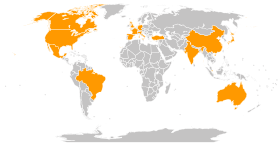 Amazon’s site worldwide |
||
| Address | amazon.com | |
|---|---|---|
| Slogan | “Work hard, have fun, make history” | |
| Commercial | Yes | |
| Written in | C++, Java | |
| Advertising | Yes | |
| Type of site | E-commerce | |
| Registration | Optional | |
| Head office | Seattle, Washington USA |
|
| Owner | Amazon | |
| Launch | 1995 | |
| Current status | in service | |
Localized Amazon showcase sites, which differ in selection and price, are defined by the top-level domain and country code:
| Region | Country | Domain name | Launch |
|---|---|---|---|
| Asia | Japan | amazon.co.jp | 31 October 2000 |
| China | amazon.cn | 7 September 2004 | |
| India | amazon.in | February 2, 2012 | |
| Turkey | amazon.com.tr | December 4, 2015 | |
| United Arab Emirates | amazon.ae | May 2019 | |
| South East Asia | Singapore | amazon.sg | 27 July 2017 |
| Europe | France | amazon.fr | 31 August 2000 |
| Germany | amazon.de | 15 October 1998 | |
| Italy | amazon.it | November 23, 2010 | |
| Netherlands | amazon.nl | November 12, 2014 | |
| Sweden | amazon.se | October 28, 2020 | |
| Spain | amazon.es | September 14, 2011 | |
| United Kingdom | amazon.co.uk | 15 October 1998 | |
| Poland | amazon.pl | March 2, 2021 | |
| Belgium | amazon.com.be | October 18, 2022 | |
| North America | Canada | amazon.ca | 25 June 2002 |
| Mexico | amazon.com.mx | August 29, 2013 | |
| United States | amazon.com | July 16, 1995 | |
| Oceania | Australia | amazon.com.au | November 12, 2013 |
| South America | Brazil | amazon.com.br | December 6, 2012 |
Goods and services
- Amazon Dash
- AmazonFresh
- Amazon Prime
- Amazon Web Services
- Alexa
- Amazon Appstore
- Amazon Drive
- Echo
- Kindle
- Fire tablets
- Amazon Fire TV
- Prime Video
- Kindle Store
- Amazon Music
- Amazon
- Amazon Digital Game Store
- Amazon Studios
- Amazon Luna
Kindle e-reader
In November 2007, Amazon markets its own e-book reader, called Kindle. The Kindle is also available as an application for personal computers, on iPhone or Android phones, which allows you to read e-books that have been licensed to read on different platforms (digital files remain the property of Amazon, which can delete them from the consumer’s e-reader at any time).
Amazon Marketplace Platform
Since 7 November 2003, the company also offers individuals, as well as specialized sellers, to sell their own items, provided that they are referenced in the Amazon catalog, via the “MarketPlace” platform. For France, Amazon charges a commission on the selling price, a management fee, as well as a fixed commission per object, and also levies, in accordance with the law, a value-added tax.
In February 2013, the company announces a unilateral increase of 50% in commissions charged on the sale of cultural items. Thus, for example, on every book sold, since April 4, an affiliate seller is subtracted from management fees ranging from €0.45 (previously €0.30) to €3.99 + 15% of the total (previously 10.44%). To this total is added a flat rate of € 1.14 corresponding to the monthly subscription to the service. Since the first of January 2015, it is the VAT rate of the country of establishment that applies to finalized transactions, further increasing the cost of the service.
Amazon Mechanical Turk
Amazon Mechanical Turk (AMT) is a micro-working service launched by Amazon in late 2005. It is a crowdsourcing web platform that aims to make humans perform more or less complex tasks for a fee. The tasks in question must be dematerialized; It is often a question of analyzing or producing information in areas where artificial intelligence is still too inefficient, for example, the analysis of image content.
Amazon Video
Founded in 2006, Amazon Video is Amazon’s video-on-demand platform, available online in the United States, the United Kingdom, Japan, Austria, France and Germany.
Amazon Studios has produced several original programs broadcast since 2013 on Amazon Video became Prime Video.
Amazon Lockers
Automatic lockers to retrieve products ordered via the Internet were deployed in shopping malls in France.
At the end of 2015, the company set up automatic lockers in Levallois-Perret and Villeneuve d’Ascq after having done so, initially, in the United States and the United Kingdom.
Freight
In March 2016, Amazon signs an agreement with the American aircraft lessor ATSG for the lease of twenty Boeing 767 freighter aircraft over a period of five to seven years. The goal is to reduce its dependence on logistics companies FedEx and UPS.
Amazon announced the 25 July 2016, an agreement with the UK government to set up a project to deliver small packages by drones. The three main authorizations obtained are to fly drones that are no longer within sight of their operator in rural and suburban areas, to have several automated drones operated by a single person, and to test the performance of sensors that are supposed to allow the devices to identify and avoid obstacles. If the project works, packages can be delivered in thirty minutes anywhere in the world.
In December 2016, Amazon filed a patent for the establishment of flying warehouses suspended by zeppelins to support delivery by drones.
Amazon Go
In December 2016, Amazon opens its first checkoutless food supermarket, Amazon Go. Located in Seattle, near the company’s headquarters, it remained in the test phase for nearly a year, reserved for Amazon employees. In January 2018, the store is open to the general public.
On July 2019, there are 13 Amazon Go stores in the United States: four in Seattle and Chicago, three in San Francisco and two in New York.
In July 2020, the company unveils its new cart concept, “Dash Cart“, intended for Amazon Go stores and which automatically scans the items it is filled with and avoids checkout.
In March 2021, the group launches Amazon Fresh, a store modeled on the Amazon Go model, without checkout or queue, in Ealing, west London, on 230 m2. This is the company’s first automated outlet outside the United States.
Amazon Textiles
Amazon is present in the textile departments with its brands Goodthreads and Paris Sunday.
Amazon Key
Amazon has launched a service to unlock your door remotely and watch live the person who enters the home. The device was marketed under the name Amazon Key, now available in 37 U.S. cities. The company also has other ambitions in the new connected home market, competing directly with Google and its Nest Hello connected systems. In March 2018, the company acquires Ring, a start-up specializing in connected doorbells equipped with cameras to accelerate the development of these new objects.
The Amazon Key system has been the subject of concern since cybersecurity research showed its non-infallibility.
Amazon Music
Amazon offers its Prime Music streaming music service as a way to generate Prime service subscriptions.
Amazon Halo
In September 2020, Amazon launched a connected bracelet that analyzes physical activity and emotions.
Amazon Care
Amazon care, “Amazon Health”, Amazon care is launched in Sept 2019: telemedicine, telepharmacy, and targets common pathology, unscheduled care, prevention, sexual health, general issues. Initially restricted to employees (like Amazon Go initially), it opens to the general public in 2020, in the USA, United Kingdom.
Astro
On September 28, 2021, Amazon unveils its next robot named Astro. It will assist households in their daily lives.
communication
Lobbying activities
Amazon is (or was, it was at least in 2007-2008) one of the founders of the European libertarian think tank network Stockholm Network, which opposes the welfare state and promotes an economic doctrine of the globalized, free and deregulated market.
In the United States
According to the Center for Responsive Politics, Amazon’s lobbying expenses in the United States amounted to $13 million in 2017. These expenditures have increased significantly since 2011.
At the institutions of the European Union
Amazon Europe has been registered with the European Commission in the transparency register of interest representatives since 2015. In 2017, it declares annual expenditure for this activity of between EUR 1 750 000 and EUR 2 000 000.
In France
Amazon France declares to the High Authority for Transparency in Public Life that it carries out lobbying activities in France for an amount not exceeding 200,000 euros in 2017.
In 2018, Amazon France declares to the High Authority for Transparency in Public Life that it carries out lobbying activities in France for an amount that does not exceed 600,000 euros (up from 2017).
Also, in 2019, Amazon France declares to the High Authority for Transparency in Public Life that it carries out lobbying activities in France for an amount that does not exceed 900,000 euros (up from 2018).
Notable advertising campaigns
In 2020, in the show A World in Docs, during the debate entitled Amazon: World Before… or the world after? following the broadcast of the documentary The World According to Amazon, Attac spokesperson Raphaël Pradeau France denounces the firm’s refusal to participate in the contradictory debate while at the same time, it uses its colossal means in the dissemination of false advertising concerning the protection of its employees against Covid-19, and presents itself only in media without opponents.
Social practices
Working conditions
Investigations by journalists regularly denounce the extreme working conditions imposed on employees, conditions described as “Darwinian”, designed to crush and break the weakest employees. The most effective employees are referred to by the supposedly meritorious name of “Amabot” but which is a contraction of the company and robot. The journalist Benoît Berthelot evokes, in his book, The World According to Amazon, a “policing of employees and customers”, “underpaid and exploited delivery drivers”.
In December 2008, Amazon UK, which operates in four major warehouses in Britain, is severely criticized for the working conditions it imposes on its workers in one of its warehouses during the holiday season.
Amazon France also knows these conditions. In February 2013, journalists Diana Löbl and Peter Onneken published a report denouncing the degrading working conditions for Amazon’s temporary foreign employees in Bad Hersfeld, Germany, also during the holiday season. In May 2013, journalist Jean-Baptiste Malet publishes, at Fayard, the book En Amazonie: Infiltrée dans le “brave des mondes”, an investigation on Amazon France.
To discover the backstage of the company, he was hired as a temporary worker in the logistics center of Montélimar, on a night shift. The story, “edifying” according to Le Nouvel Observateur, describes the working conditions of the many temporary workers working for Amazon, these “new proletarians whose jobs we create every day, with clicks”. In particular, he points to the large proportion of precarious jobs, the difficult pace of work, poor working conditions masked by a reinvented paternalism. Extending his investigation to Germany, he addressed the question again in an article in Le Monde Diplomatique published in November 2013.
Following the controversies concerning the working conditions of its employees, Amazon is preparing, in August 2016, a small-scale program to experiment with part-time work of entire teams with 30-hour weeks of work.
The American site The Verge reveals, in April 2019, that Amazon has set up an automated redundancy system. It analyzes the productivity of employees in the warehouses where packages are assembled and organized. It automatically generates warnings and termination notices for employees who do not meet quotas.
During the Covid-19 crisis of 2020, the group is criticized for not offering its employees sufficient protection against the risks of contamination. In France, the SUD union referred the matter to the courts in order to limit the distributor’s activities to basic necessities during the lockdown.
In January 2021, the newspaper l’Humanité published a study on working conditions within the company in France. This information, which management refused to pass on to employee representatives, testifies to supervisory practices in contradiction with the company’s communication: significant use of temporary workers, increase in precarious contracts, job rotation of 50% over two years, numerous accidents at work with a high proportion of attempts to conceal concentrated in the most precarious contracts.
Anti-union practices
Amazon is known for its long anti-union tradition, regardless of the country in which it operates, which the multinational acknowledges: “We do not believe that unions are beneficial to our customers, shareholders and partners.” In France, she had not hesitated to break into the premises of the General Confederation of Labour (CGT) to confiscate computers and erase their contents.
In September 2018, the American online magazine Gizmodo revealed the existence of an internal video for executives of Whole Foods Market (a subsidiary of the company since 2017) to train them to prevent and stop any creation or action of unions in the company.
The video explains how to spot the signs of union action: “If your employees start talking about ‘living wages’ or ‘representatives’, if they spend time together when it was not their habit, if they want access to the staff list, or if they are too interested in the life of the company, then you have warning signs of a workers’ organization that must be quickly answered: you can tell them that you prefer “direct relations with your employees” (without going through a union) or, more strongly, tell them that “unions are lying and deceitful rats”. In both cases, the law protects you!” advises the video.
The multinational has recruited former members of US military intelligence in particular to spy on union activities. In France, these actions targeted the CGT, the Yellow Vests movement and NGOs such as Greenpeace. Amazon’s intelligence agents list dates, locations and the number of participants in union meetings, as well as the specific actions taken by unions around warehouses. In addition, they would use fake profiles on social networks to spy on employees in order to know their private lives.
Failed and successful attempts to form a union
In 2021, employees at the sorting center in Bessemer, Alabama, made an attempt to create a union branch within the company that ended in failure. During this campaign, a Twitter message is spilling a lot of ink: Amazon displays an outrageous disdain for employees who can not take a break to go to the toilet and are forced to urinate in bottles. In addition, the National Labor Relations Board (NLRB), the government labor inspection agency responsible for conducting union elections, says Amazon is showing a “blatant disregard for the law.” He ordered a new election, the result of which was, however, negative.
Inspired by this experience, two thirty-somethings, Derrick Palmer and Chris Smalls, from New York’s only warehouse, JFK8, sought to form a local union after being laid off in March 2020 for denouncing the health conditions related to the COVID-19 crisis. They suffer disproportionate attacks from the company: crowdfunding raises $120,000 to fund their campaign while at the same time, Amazon pays more than $4.3 million just to consult with anti-union experts across the country. Their petition to allow the formation of a union was rejected by the NLRB. However, a court decision in December 2021 allows employees to meet at Amazon’s premises to organize.
In retaliation, Christian Smalls was arrested in February 2022 on the same premises. Their campaign to decide on the creation of the union was nevertheless launched in March; and on April 1, 2022, despite a strong mobilization on the part of Amazon for the “no”, the “yes” won by 2,654 votes against 2,131. The organization, which called itself the Amazon Labor Union, was the first union mobilization of an Amazon warehouse in the United States, and one of the most significant union victories in a generation. After the vote, U.S. President Joe Biden said he welcomed the news and was pleased that employees were making sure they were heard for important decisions that affected them. Amazon, for its part, declares to contest the vote in court.
December 2021 tornado
Six Amazon employees die in the aftermath of a tornado that destroyed a workshop in Illinois. Due to the weather warning, the site should have been evacuated for safety reasons.
2022 layoff wave
In November 2022, the company announced 10,000 layoffs among its office employees.
Tax and competition issues of Amazon
In 2019, Amazon hosts a massive French VAT fraud, the resellers whose products it resells are not all registered for VAT payment of about 20%. In 2021, VAT will have to be paid by Amazon, in accordance with French law resulting from a European directive.
On November 2020, the European Commission suspected Amazon of having violated European Union rules by distorting competition principles in online marketplaces. The Commission also suspects Amazon of granting preferential treatment to offers and sellers who use its delivery and storage services.
On November 17, 2020, a petition has been launched calling for a “Christmas without Amazon”, aimed at curbing the development of the digital giant in France. The signatories of the petition, including François Morel, François Ruffin, Anne Hidalgo, as well as several personalities from the world of associations and culture, call for the implementation of laws to put an end to the practices of unfair competition and tax injustice between local shops and digital giants.
In October 2021, Reuters revealed that Amazon had changed the algorithm of its internal search engine in India, so that AmazonBasics products systematically appeared at the top, ahead of local products.
Suspicions of tax evasion
In Great Britain, the company is in the spotlight by being suspected of not paying taxes to the extent of its turnover: “Through a complex financial package, amazon.co.uk pays intellectual property rights to Amazon EU SARL, Amazon is taxed only 2.4% on its profits made in Great Britain, when the corporate income tax was 26% in the country in 2011”.
Amazon is experiencing the same problem in France. In an interview with the Lorraine Republican, the former Minister of Culture, Aurélie Filippetti, accuses the company of not paying taxes commensurate with the turnover achieved in France. The Minister considers these practices “destructive of employment, destructive of culture, destructive of social ties, because killing small bookstores in city centers is a disaster”.
On July 4, 2014, the Financial Times reports that the European Commission has sent a request for information to the Grand Duchy of Luxembourg, where Amazon’s European headquarters are located. The aim is to check whether the corporate tax applied to the company complies with EU competition rules. At the end of May 2015, the company announces from this month its income in the United Kingdom, Germany, Spain and Italy; It also claims, without giving a precise date, that it is working to declare them in France, a country where it paid only 3.3 million euros in tax in 2011 for an estimated turnover of between 1.5 and 2 billion dollars.
In her overall analysis of how Amazon gained dominance, attorney Lina Khan points to the tax benefits it has managed to obtain, and the optimizations, with a significant impact on its accounts. According to this lawyer, Amazon thus distorts the game of competition.
In October 2017, Amazon is condemned by the European Commission: accused of having benefited from a tax advantage of 250 million euros from Luxembourg, the company is ordered to repay this sum, but the request contested by the Amazon group and Luxembourg, which had appealed against the decision to the Court of Justice of the European Union. On May 12, 2021, the Court concludes that the evidence adduced by the Commission is not sufficient to confuse the company.
As of November 2020, the issue of the corporate tax rate paid by Amazon France remains opaque. Indeed, its managing director, Frédéric Duval, highlights the 230 million euros in taxes declared in 2019, amalgamating, in a “specious” way according to France Culture, value-added tax, employer contributions, local taxes and corporate tax.
In 2020, the company achieved a turnover of €44 billion in Europe but paid no corporate tax due to a reported deficit of €1.2 billion.
Dispute with the French tax authorities
In 2012, the French Ministry of Finance announced to Amazon France an adjustment in tax arrears and penalties for the years from 2006 to 2010.
This tax adjustment amounts to nearly €252 million.
Initially, Amazon’s management initially vigorously contested this decision and the French tax administration’s estimate. She also expressed her intention to contradict her and “use all administrative remedies at her disposal”. The leaders of the American firm also justified their dissatisfaction by arguing that its commercial activities in France were managed from Luxembourg, where its European headquarters are located (the taxation of the Grand Duchy being more advantageous than in France).
Subsequently, in February 2018, the French press announces that the American giant has reached an agreement with Bercy (the Ministry of Finance).
The accusation of dumping and counterfeiting
On January 8, 2014, the French Senate adopted a bill to regulate the conditions for the distance selling of books. This measure includes a ban on free carriage of books, so as not to harm independent bookstores.
In July 2014, Amazon found a solution to circumvent the law by offering deliveries at one euro cent.
Amazon is also accused of taking advantage of its dominant position to indicate as “unavailable” works whose distribution the publisher has refused to grant it, thus giving credence in the public mind to the erroneous idea that these books are out of print or cannot be found.
Moreover, the Reuters investigation of October 2021 reveals that at least in India, some of Amazon’s very popular products are all counterfeits of popular Indian products, whose success was spotted through the company’s internal database, so that the latter launches its own range at lower prices.
In December 2021, the competition authorities fined Amazon €1.1 billion for discriminating on its site against sellers who did not use its logistics activities.
Destruction of retail trade
In August 2017, Donald Trump is attacking the company, whose owner Jeff Bezos has taken a stand against him since the beginning of his presidential campaign. Trump accuses Amazon of causing “a lot of harm to small retailers who pay taxes.” The company then lost 1.2% of its value on the stock market, or $ 5.7 billion, and had to wait several hours before recovering its initial value.
A report produced in November 2019 by ATTAC and Friends of the Earth confirms Mounir Mahjoubi’s observation: for every job created by the company, two retail jobs are destroyed.
In December 2021, the National Assembly passed a law to increase the selling prices of books on Amazon in order to favor booksellers.
Commercial relations with suppliers
Bonnier
In 2014, 1,188 German writers signed a petition criticizing Amazon’s methods against their Scandinavian publisher Bonnier. Writers, including Elfriede Jelinek, winner of the 2004 Nobel Prize in Literature, accuse the company of boycotting their publishing house because of a disagreement over commercial terms.
Amazon v. SLF lawsuit
In November 2007, a lawsuit opens between the Syndicat de la librairie française and Amazon France about the shipping costs offered by the latter. Amazon then sent a letter to its customers, denouncing the lawsuit and asking Internet users to send a multitude of emails to the SLF in order to defend free shipping, a practice sometimes called “email bombing”. In response to this letter and the petition set up on the Amazon.fr website, the Lekti-ecriture.com structure is launching in February 2008, a “Call for the Book” to defend another reading of the case.
Meanwhile, at the beginning of December 2007, the company is sentenced at the end of this trial for non-compliance with the law on the price of the book to € 100,000 in damages and a penalty of € 1,000 per day until modification of its General Conditions of Sale.
Nevertheless, the Court of Cassation considers, the 6 May 2008, in another similar case concerning Alapage, that “the assumption by the seller of the cost relating to the performance of his obligation to deliver the product sold does not constitute a premium within the meaning of the provisions of the Consumer Code”, thus making free shipping possible.
Amazon/French State lawsuit
On December 18, 2017, the Minister of the Economy Bruno Le Maire sues Amazon before the Commercial Court of Paris, claiming a fine of ten million euros for abusive practices of the North American group towards its French suppliers.
Canadian Class Action
In Canada, from the beginning of January 2018, the Consumer Law Group filed a class action lawsuit against Amazon for invalid sales tax. According to the class action lawsuit, the company applied provincial and federal tax fees on products normally exempt from those taxes. Amazon immediately proceeded to correct the faulty prices of the affected items on its site and promised to compensate any affected consumer.
Miscellaneous controversies
Sales of extremist books
Historians such as Fabrice d’Almeida or Stephanie Courouble Share accuse Amazon of having left anti-Semitic and negationist works for sale (including texts by Maurice Bardèche, Paul Rassinier, Robert Faurisson, Carlo Mattogno, and David Hoggan and of serving their propaganda in the commentaries of the books.
In 2013, The Kernel revealed the presence on sale of many fascist, anti-Semitic and white supremacist books. Moreover, in 2017, the Sunday Times discovered in the Amazon.co.uk catalog a dozen books claiming that the Holocaust was exaggerated, even completely invented, before being withdrawn from sale.
In France, Amazon was criticized for selling or having sold the book The Protocols of the Elders of Zion under the title The Jewish Peril, and various versions of Renaud Camus’ theory of the great replacement, for allowing the far-right site Fdesouche to integrate advertisements for articles in return for a commission. or for advertising on a site “administered by convicted neo-Nazi activist Boris Le Lay”. This position, according to the organization Sleeping Giants, is an “interesting funding for sites in the fachosphere. There is a great opacity behind these financial flows because there is no public accounting”.
Environment
Greenpeace cites Amazon in 2017 as among the least environmentally friendly large companies. The NGO accuses it of making no effort to reduce its environmental impact and of not disclosing any statistics on the recycling of its products or its share of renewable energy.
Amazon’s (AWS) web hosting services would have issued, in 2018, as many greenhouse gases as Portugal and, in 2019, its online sales site, as much CO2 as Bolivia is respectively 55.8 and 18.87 million tons. In September of the same year, Jeff Bezos announced that his company was committed to achieving the goals of the Paris climate agreement ten years ahead of schedule.
Denouncing the opening of three giant warehouses in France, activists from Nonviolent Action COP21, Friends of the Earth and members of the Yellow Vests blocked the headquarters of Amazon France and two other buildings in Lille and Toulouse, on July 2, 2019. They denounce the overproduction generated by Amazon and want to prevent the establishment of these new warehouses because of their environmental impacts, but also social impacts, particularly on local employment. They accuse the entity of promoting overconsumption and abusing air transport in particular because of its fleet of fifty cargo planes, the number of which should be increased to seventy in 2021.
In April 2021, the company announces that it is continuing to grow in the renewable energy market through an investment in a solar energy project in Alberta.
In November 2021, Amazon announced that it wanted to stop the use of plastic pouches in France before the end of 2021.
Mass destruction of unsold products
In 2018, Amazon destroyed 3.2 million new products in France, according to estimates by CGT elected officials. The cause of this ” mass destruction” would be the storage policy which boils down, for the sellers, to an alternative: recover the unsold goods or destroy them. However, the costs of repatriating the goods dissuade sellers from making it, preferring a low cost to have it destroyed by Amazon.
A report by journalist Guillaume Cahour on this subject was broadcast in January 2019 on the program Capital. The journalist was hired by an Amazon France site. The report cites the example of Chalon-sur-Saône where more than 293,000 products were thrown away new or almost new, in the space of nine months.
Amazon Prime
In 2020, 60 million consumers were alert about involuntary subscriptions when validating an “express delivery” that generates a tacit commitment to the Amazon Prime program, for a 30-day trial period. A service that is well paid, and which turns into an annual prescription of 49 euros. Details about how to purchase this paid subscription to Amazon Prime do not appear until the second step of the order, in small print.
In September 2019, the company launches a version of Amazon Prime for students called Amazon Prime Student with 90 days of trial which, if not canceled, turn into an annual prescription of 24 euros.
Sale of pedophile dolls
In August 2020, associations for the protection of minors, including the International Association of Victims of Incest, denounce the sale of pornographic toys resembling children. The intervention of the French Secretary of State for Children and Families, Adrien Taquet, forced Amazon to withdraw these dolls from sale. A trial opened in Dieppe (France) in May 2022.
Privacy and personal information
In December 2020, Amazon is sentenced by the French CNIL to a fine of 35 million euros for having installed advertising cookies on the systems of its users without having requested their consent and without having informed them beforehand sufficiently. Such practices are in contravention of the European Privacy Directive of 2002 (directive on privacy and electronic communications), and not only with the GDPR, which authorizes the CNIL to deal with the file directly. Amazon, for its part, claims to regularly update its operation in order to comply with the various national regulations and proclaims its disagreement with the CNIL’s decision.
References (sources)
|