
Tennis is a racquet sport that opposes either two players (called singles) or four players who form two teams of two (this is called doubles). Players use a racquet stringed vertically and horizontally (in a sieve) at a tension varying with the power or effect that one wants to achieve.
| Tennis | |
|---|---|
| International Federation | FIT (founded March 1, 1913) |
| Olympic sport since | 1896 to 1924 and since 1988 |
| Clubs | 38,000 (Europe) |
| Licensed players | more than 10,000,000 (Europe) |
| Practicing players | more than 26,000,000 (Europe) |

Racquet, whose materials can vary, is used to hit a rubber ball, filled with air and covered with felt. The goal of the game is to hit the ball leaving no more than one bounce so that the opponent cannot put it back within the limits of the court, either by scoring the point by putting the opponent out of reach of the ball, or by forcing him to commit a foul (if his ball does not fall within the limits of the court, or if it does not pass the net).
Tennis history
The birth of tennis
Tennis is an English adaptation of the “jeu de paume”. The first puck is made at fifteen feet, then thirty, then forty, hence the peculiar way of counting points in modern tennis. Following the Battle of Agincourt (25 October 1415), the Duke of Orléans was imprisoned for twenty-five years in England (he was released on 3 November 1440). On the occasion of this captivity at Wingfield Castle in the county of Suffolk, the duke introduced to England the jeu de paume which he practiced almost daily.
Tennis was born according to sources between 1850 and 1870, more than four centuries later. In 1858 Major Harry Gem sketched a kind of tennis court on the grass of his property: he played a game quite similar to today’s tennis. Around 1863, Major Walter Clopton Wingfield, a descendant of the lord of Wingfield, also played tennis in his residence in London. Around 1869, in Warwickshire, Harry Gem and his Spanish friend Augurio Perera experimented with a new version of the game which they called first pelota and later lawn rackets. Gem, Perera, Frederic Haynes and Arthur Tomkin formed a club in Leamington: it was the first lawn tennis club in the world.
It was probably Harry Gem who invented “modern tennis” (from the French jeu de paume) but it was Wingfield who passed to posterity because he marketed this sport under the name of “sphairistike” on February 23, 1874, but he did not invent it as legend claims. Sphairistike is the consequence of the game of palm and the invention of rubber which makes it possible to make balls that can bounce on the grass. It is the missing link between the game of palm and tennis. Tennis in England is also called lawn tennis while the jeu de paume is referred to as real tennis. The word “tennis” comes from the French “tenez”, a word that was addressed to the opponent when serving. The word, distorted in Middle English into “tenetz”, “teneys” or “tenes”, will eventually become “tennis”.
It seems that the first tennis tournament was held in August 1876 on a court built on the estate of Mr. William Appleton in Nahant, Massachusetts and won by James Dwight 7. This was followed by the Wimbledon Tournament in 1877 from 9 to 16 (or 19) July, the future British Amateur Open, which is, therefore, the oldest tournament still in existence. The final of the first edition was played in front of 200 spectators. England’s Spencer Gore won the men’s singles title (24 participants). On the occasion of this tournament, the rules of the Wingfield sphairistike were modified by the organizers who became, in fact, and for a decade, the sole authority on tennis.
France, once the land of choice par excellence of the jeu de paume, does not wait long to succumb to the charms of tennis promoted by Wimbledon. In 1878, the first tennis club was founded in France in Dinard, Brittany. At the same time, the first parts take place in Australia.
Other tournaments soon followed: in 1878 a tournament would have been organized at the Marylebone Cricket Club, and the first amateur championships in Scotland were held indoors on wood that same year, the Irish Amateur Championships began in 1879 at the Fitzwilliam Club in Dublin, those of Bohemia the same year and those of the Australian colony of Victoria in Melbourne in 1880, each Australian colony also created its tournament well before the 1st Australian National Championship, organized in 1905 and entitled “Australasian International”, future Australian Open. The U.S. Championships were first held in Newport in 1881 (the 1st edition reserved for citizens of the country is the ancestor of the U.S. Open, etc.).
Tennis was born in the Victorian era with Victorian rules: the sport in these conditions can only be practiced as a hobby by rich aristocrats, therefore without need for money to live, and can therefore not be the subject of a paid profession. This explains why tennis professionals have long been banned from the traditional circuit and considered plagues. In addition, tennis officials, very jealous of their authority, another legacy of the Victorian era, absolutely do not want to deal with professional players beyond their control: this is another reason to exclude the “pros” from the traditional circuit. Later in 1891, the France Tennis Championship was created, which became truly international in 1925 under the name “Internationaux de France de Tennis”.
In 1933 when Australian Jack Crawford, who had won the Australian Open, from France to Roland Garros, from Great Britain to Wimbledon, also reached the final of the United States Amateur Open at Forest Hills, journalists John Kieran and Allison Danzig used for the first time the expression “Grand Slam” (taken from bridge and also golf) when evoking a possible victory of the Australian in all four tournaments. in the same year. These championships began to gain importance because the four host countries were the only countries of the time that won the Davis Cup which was the largest international amateur competition for at least forty years, from 1920 to 1960 (it often refers to the world number 1 amateur and has much more importance than Wimbledon or Forest Hills).
This competition was created by Dwight Davis in 1900 and initially pitted only the British Isles against the United States. There is no edition in 1901. Then other countries wanted to participate and until 1973 only the four countries mentioned won this team competition. In 1938 Donald Budge had the idea of winning the championships of the four countries that won the Cup: he was therefore the first player to consciously attempt the Grand Slam (Crawford had no intention of going to the United States because he suffered from the New York climate) and to succeed.
This became the real individual reference of amateur tennis in the 1950s, more precisely in 1956 when Lew Hoad was close (two sets precisely) to accomplish this feat. When tennis became “Open” in 1968 the Grand Slam became the Holy Grail of all players. The women’s version of the Davis Cup is the Federation Cup, better known today as the Fed Cup.
The first champions
The rivalry, once very lively, between amateurs and professionals, did not make it possible, for a long time, to establish objective rankings of the best players. Professionals are prohibited until March 1968 of any competition organized by the International Federation (Davis Cup…) or by the National Federations (Internationals of countries such as those of the Grand Slam…). Nevertheless, some comparisons between these different players were possible (for example: in January 1963 Rod Laver, winner of the Grand Slam in 1962, was pitted against the two best professionals of 1962, Kenneth Robert Rosewall and Lewis Alan Hoad, as part of a tour of Australasia on grass: Laver won two matches and suffered… 19 defeats, clearly indicating the supremacy of the old professionals): it seems that from 1948 the best player in the world was probably always a professional player.
Since 1931, all the greatest champions of the pre-open era have turned professional and, with the exception of Henri Cochet, they have all reached their peak in the pro circuit: Bill Tilden, Ellsworth Vines, Fred Perry, Donald Budge, Bobby Riggs, Jack Kramer, Pancho Segura, Pancho Gonzales, Frank Sedgman, Tony Trabert, Ken Rosewall, Lew Hoad, Rod Laver.
In 1966 talks began between Wimbledon officials and Jack Kramer, then a promoter of professional tennis, to organize a professional tournament in the “Temple” the following year: a month and a half after the traditional amateur tournament of Wimbledon, BBC2 sponsored a professional tournament of eight players from 25 to August 28, 1967. This tournament meeting a great success with the public and viewers, the president of Wimbledon, Herman David, decided in the autumn of 1967 that the next traditional Wimbledon (in 1968) would be “Open” that is to say “open” to professional players.
On March 30, 1968, the International Federation accepts that a dozen tournaments are open to all players: the first of them is organized in Bournemouth and starts on April 21, 1968. Despite everything, the International Federation and the promoters of professional play continue to fight each other: it takes more than four years (August 1972) so that tennis is totally “Open” that is to say that the segregation between pros and amateurs is shattered.
To no longer be completely dependent on their leaders (on the one hand the federations for amateur players and on the other hand the promoters for professional players) who imposed on them the competitions they had to (or should not) play, the players united in September 1972, during the US Open, the only Grand Slam tournament of the year where all the best players participated (at Wimbledon and Roland Garros professionals under contract were excluded in 1972), to create the first union bringing together all players who wished to do so: the Association of Tennis Professionals (ATP).
This association tries to organize the tennis circuit in “collaboration” with the Federations and sets up in August 1972 the ATP World Tour circuit: from then on the ATP, which escapes a little the players themselves, manages all the events of the main circuit except the Grand Slam tournaments and the Davis Cup which fall under the responsibility, them, the International Federation and the respective National Federations. The ATP published on August 23, 1973 its first world ranking, of which Romania’s Ilie Năstase was the first number one.
For its part, Wimbledon remains a bastion of conservatism. While all other tournaments now allow players to wear colorful clothing, the Wimbledon tournament maintains the requirement of white clothing, faithful to its traditions.
Suzanne Lenglen contributed to the success of tennis, being the first true female star of the discipline; she will participate in what will be called the match of the century, in Cannes, which she will win against Helen Wills; the same year she will leave amateur tennis and become the headliner of the 1st professional tour in North America. But despite this precedent, women’s tennis then struggled to assert itself and it was not until the 1960s that players influenced the course of events. Like boys, girls set up a professional circuit that struggles to establish. The WTA permanently installs professional women’s tennis.
The Open Era
In 1968, modern and professional tennis was truly born with the beginning of the Open era. The four Grand Slam tournaments, major events of the season, abandon their status as a tournament reserved for amateurs and open their doors to professional players. Little by little, all circuit players are becoming professional. It is from this date that professional tennis is considered modern; The era of statistics and records begins.
Martina Navrátilová’s career, which began in 1973, was marked by the use of new preparation techniques, with advanced physical and psychological preparation, including the use of computers to analyze matches and study game sequences. Computer science now plays an important role in the evolution of players, as coaches even use it today at an amateur level.
The policy of leaders such as Philippe Chatrier, president of the International Tennis Federation from 1977 to 1991, was decisive at the international level, but rather poorly prepared at the national level. Indeed, if tennis leaves its sports suit for privileged and becomes accessible, the establishment of an operation called “5000 courts”, launched by Philippe Chatrier and the French Tennis Federation, will have the effect of economically destabilizing existing clubs in France by creating micro-clubs composed of one or two courts without real reception structure; The effect of scattering on the membership level will be felt for decades and will be at the origin of the crisis of French tennis.
Tennis is becoming popular and has more than one million licensees in France since the early 1980s.
The major achievement of both men’s and women’s tennis remains the Grand Slam: winning all four majors in the same year. Donald Budge did it but at a time when amateur and professional tournaments were separate; Australian Rod Laver managed the feat of achieving it twice: in 1962, but also in 1969 under the “Open” era when all the players were gathered on a world circuit (the Open era began for tennis in 1968), which is a real feat. More women have achieved it, including Australia’s Margaret Smith Court in 1970, and Germany’s Steffi Graf in 1988.
The historical origin of the points mark
The singular accounting of tennis is also dependent on the Provençal jeu de paume. This way of counting, comes from penalties forcing the player to move back fifteen, thirty and forty steps, as the game progresses. Other hypotheses have been put forward to seek, a posteriori, to justify this particular count, for example, a count by multiples of fifteen, straight from the Middle Ages where the number 60 was the most widespread numerical symbol. Back then, time (60 minutes) and silver (a gold denarius was worth 15 cents) were counted this way.
The expression “deuce” would be a cultural borrowing from the accounting system of the jeu de paume. When tied, the referee declared “two”, which meant that the players were two points (consecutive) away from winning the game. This “à deux” borrowed by English mouths from the French, took the flayed form of “deuce”. This use has been practiced since the Middle Ages in jeu de paume.
Other hypotheses have been put forward to explain this system. Chronologically, the first hypothesis put forward dates from 1431. The Flemish jurist Jan Van den Berghe publishes Le Jeu de paume moralisé. To explain how to count, he states a pious explanation: the player who scores a point is assimilated to a fair and sees his reward multiplied by 15. Another track, betting, which was common during palm game meetings. Some numismatists then point out that since 1340 the French currency included double gold which was worth 60 sous and the gold denarius which was worth 15 sous. Players would have become accustomed to counting points in monetary value, that is to say in multiples of 15.
However, the study of letters of remission shows that the stakes often did not reach such large sums. At the beginning of the sixteenth century, Erasmus admits in his Colloquia, that the way of counting the points in the game of palm is a mystery, of which even the Parisian players have lost the memory. Despite this opinion of Erasmus which appears definitive, which the encyclopedists of the eighteenth century take up, other hypotheses, more or less fanciful, are stated since the end of the sixteenth century.
According to the testimony of Jean Goselin, bookseller of the king of France in 1579, this way of counting would relate to astronomy and the sexagesimal system used for calculations of angles. Each physical sign is divided into 60 degrees, dividing a physical sign into four parts gives 15 degrees per part. For Charles Delahaye, a palm player in the nineteenth century, 15 represents a distance of 15 feet. The service line and net are 60 feet apart, or four times 15 feet. Charles Delahaye says he witnessed a game where the points were not counted but where the winner of a point advanced each time 15 feet until reaching the net and, thus, winning the game.
Tennis Rules

In both singles and doubles, each player serves in turn for the duration of a match. The player serving must be placed behind the backline of the court when hitting his serve. The server also has two services: if it misses the first, often hit with a certain risk, it benefits from a second service ball, usually hit with more caution. The receiver, on the other hand, can place himself wherever he wants on the court to return the serve.
Most of the time, it is necessary to win two rounds in order to win the game. The two exceptions are the men’s draw matches of Grand Slam tournaments and the Davis Cup matches, which are played in three winning sets. To win a round, you must be the first to score six games with at least two games apart, otherwise, the round continues. The possible scores to win a round are as follows: 6/0, 6/1, 6/2, 6/3, 6/4 and 7/5 (if the two players could not decide after ten games).
If the two players have not been able to decide during the first twelve games (so tied at 6/6), they play a decisive game (“tie-break” in English, “tie-breaker” in French-speaking Canada) which consists of playing points, the first who has 7 points won the decisive game, which is worth a game, and wins the round 7/6. On the other hand, in Grand Slam tournaments, with the exception of the US Open, for both men and women, there is no decisive game in the decisive set (the fifth for men, the third for women), and the match is won only when one manages to be two games ahead of the opponent; e.g. 8/6, 9/7, 10/8, etc.
The invention of the “decisive game” dates back to 1970, two years after the beginning of the open era. The purpose of this game was to prevent endless matches, because it happened at the time that rounds were won on the score of 29/27 for example. The principle of the decisive game is quite simple. Players take turns. The one who starts serves only once from right to left, then his opponent serves twice in a row, from left to right, then from right to left, and so on. The winner of the round is the first player to reach seven points with at least two points difference (e.g. 7/2, 7/5, 9/7…) The set was won 7-6.
For younger players, the rules of play are relaxed. Indeed, until the age of eleven, in France, a round is won when a player reaches 5 games two games ahead of his opponent. In case of a 4-game tie everywhere, the players also decide with a “decisive game”. Another format allows to make rounds of 4 games with decisive game to 3 everywhere.
In the doubles game, the match is played in a best-of-three format, so you have to win both sets to win the match. If both teams win one set each, for example: 6-3 3-6; A “super tie break” of ten points is held to decide between the two opposing teams: it is considered as a decisive round. The “super tie break” takes place in the same way as the “decisive game”, so you have to win ten points with at least two points difference (e.g. 10/5, 10/7, 11/9…).
A round is won by scoring a certain number of games. As mentioned above, each player serves in turn, for the duration of a game. In order to win a game, it is necessary to score at least four points, either on your serve when you serve, or on the opponent’s serve when you receive. It is therefore possible for either the server or the receiver to win a game, even if theoretically, the server has an advantage over the receiver. If both opponents score three points, we have a tie situation, explained below.
During a game, here is how points are counted:
- Love: for no points scored in the game;
- fifteen: for one point scored;
- thirty: for two points scored;
- Forty: for three points scored.
When both players have scored three points, (so at 40/40, called “40 to”), there is a tie. Whoever scores the next point gets an “advantage”. To win the game, a player who has the advantage must score another point. If it is the player who does not have the advantage who scores the next point, we come back to tie, and so on until one of the two players wins the game. For young children up to 11 years of age, the benefit rule does not exist. It is the rule of “No-ad” (“No advantage“) that is exercised. The receiving player chooses his service return area for the decisive point (always at 40-40). This variant is also sometimes applied in duplicate.
Regarding arbitration, we always give the score of the server first. For example, if the server scores three points against his opponent’s two, the score is 40/30. Otherwise, the score is 30/40. It is the same at the level of “advantages” when there is equality in a game. When it is the server that has the advantage, the referee will announce “advantage” and then the name of the player. In doubles, the referee will announce the name of the server or booster. However, in the case of a team championship or national teams (Davis Cup or Fed Cup, for example), the name of the club or country is given.
Challenges
Since 2006, players have been able to use a computer-generated image system tracing the trajectory and especially the point of impact of the ball, called “Hawk-Eye” to challenge a refereeing decision they consider erroneous. Several rules apply to the use of this means:
- The challenge must be requested immediately after the blow presumed to be just by the referee, but seen as fault by the player, or seen as fault by the referee but considered fair by the player.
- The player has three challenges at the beginning of each round, plus one if the game goes up to the tiebreak. If his assessment of a point or a fault is wrong, he loses one of his challenges each time.
- If the refereeing body announces a foul when it was good, the shot must be replayed, provided that the opponent has been deemed able to return the ball. For example, if player A hits a ball that is mistakenly flagged, then player B’s position relative to the ball at the time of impact is taken into account. If player B was obviously too far away to return the ball, the point is awarded to player A. Otherwise, the point is replayed (the server then serves with a first ball, even if the point had been engaged by a second ball).
- If, during an exchange, one of the players sees an unreported foul ball, he can interrupt the exchange and ask for the challenge. If the ball is fouled, the point is awarded to him, if the ball is good, the point is awarded to the opponent.
- If, for any reason, the Hawk-Eye system should not work, the arbitration award would prevail.
Due to the high cost of this system, few tournaments use it. In addition, only the main courts have it, which can lead to a certain form of injustice vis-à-vis low-ranked players, forced to play on annex courts without the Hawk-Eye.
Faults
There are several types of faults in tennis. For example, a ball will be announced as a foul (or “out” in English) when it does not fall within the limits of the field (the lines being located inside the field). The point is then awarded to the opponent. When the ball falls into the net, on the side of the player who hit the ball, the point is also awarded to the opponent, but there is no need to announce a foul. The referee must not report a ball that falls into the net as a “foul”.
The serve must be struck diagonally so that the ball falls into the serving square. If the ball does not fall into the service square during the play, the referee announces “foul”, and the server must either serve a second ball if the foul occurs on the first serve, or award the point to the opponent if the foul occurs on the second service ball. When both serves are fouls (they do not fall into the service squares, or fall into the net), it is called a “double fault”.
The point is then awarded to the receiver. When on serve, the ball touches the strip of the net and falls back into the service square where the player was supposed to serve, the referee announces “let” or “net“, the ball is not fouled, and the player can replay the serve. On the other hand, if the server’s ball touches the strip of the net and falls outside the service square, the ball is announced foul, and the player must either move to his second ball, or award the point to the opponent depending on whether he hit a first or second ball.
A more complex fault concerns the server. Indeed, to perform a valid service, it is necessary that the ball is hit before the player crosses the backline of the court. Thus, when the player hits his serve, and already has a part of his body that touches the ground inside the court or when the server “bites” the backline of the court at the time of his ball throw, the service is denied. The player must then either hit a second service ball (if his foul was committed on the first ball), or award the point to the opponent if this foul occurs on the second ball. This fault, rarely reported because it is difficult to judge, is called “foot fault”.
The “foot fault” is also valid on a lateral plane: the server must be on the right side of the field so as to serve in a diagonal. If the server serves on the right, he must stand on the left side of the field (and vice versa) without being in the extension of the corridor.
Breaks
The break time in tennis between sets is one minute. The regulation indicates an exception for (toilets, care…) with a duration of two minutes.
Changes from 2022
In November 2021, the ATP published new rules regarding the length of breaks:
- Toilet break or change of outfit:
- Players can take a maximum of three minutes once they have entered the toilet;
- Players will have two minutes to change outfits in addition to the three-minute toilet break. Note: The change of dress can only be done in conjunction with a toilet break, unless authorized by the chair umpire;
- A player can only take one toilet break per game;
- Toilet breaks can only be taken during a break at the end of the set;
- Time violations will apply if a player is not ready within the allotted time.
- These rules will apply to the 2022 season.
- Medical break:
- Players can take a three-minute break per match, to be taken during a side change or an end-of-set break only. If the player cannot continue until the next change of side or end of set, he will lose the points necessary to arrive at this change of end/end of set;
- The date of entry into force is yet to be determined.
FFT 2023 Game Rules
The official document of the FFT specifies the principle of continuous play in chapter 29.
Chapter 29 CONTINUOUS PLAY
In principle, the game must be continuous from the beginning of the game (when the first serve of the game is played) until the end of the
game.
- Has. Between points, the game must be continuous. When players switch sides at the end of a game, they are allowed ninety seconds maximum. However, after the first game of each round and during a decisive game, the game will be continuous and players will switch sides without rest time. At the end of each round, players are entitled to a rest of one hundred and twenty seconds maximum. The maximum rest time starts as soon as one point ends and ends as soon as the first service of the next point is served.
- B. If, in circumstances beyond the player’s control, his clothing, shoes or any essential equipment (excluding his racquet) is damaged or requires replacement, additional time to remedy the problem may be granted.
- C. No additional time will be given to a player to allow him to recover. However, for a player suffering from a treatable medical condition, a medical treatment time of three minutes may be granted. A player is allowed to leave the court to go to the toilet twice per game (including warm-up) preferably at the end of a round; he is given a reasonable amount of time to do so, which, in general, should not exceed three minutes cumulative to the two minutes of the end-of-round break.
- D. The organizers of the event may grant a rest period of ten (10) minutes maximum, provided they announce it before the start of the game. This rest time can be taken after the third leg of a best-of-five game, or after the second leg of a best-of-three game.
- E. The duration of the warm-up period may not exceed five minutes, unless the organizers of the event have decided otherwise.
The court and equipment
The short

The tennis court corresponds to the playground. Its dimensions are very accurate due to the original English measurements, in yards. It must have lines painted with white paint, in order to facilitate their legibility. Tennis courts come in several surfaces, which are discussed in the rest of the article. Each surface has its own characteristics (speed, rebound) which contributes to the diversity of possible games.
As shown in the image opposite, the tennis court must be 23.77 meters (26 yards) long and 8.23 meters (9 yards) wide. That’s 11.89 meters (13 yards) long on each side of the net, and 8.23 meters wide for a singles match, where side lanes are not counted. For the doubles game, two lanes of 1.37 meters are added. The width of the doubles court is 10.97 meters (12 yards).
In the field, there are five different kinds of lines:
- The bottom lines at each end, a mark indicates the middle of this line;
- Service lines parallel to the net that delineate service areas placed 6.40 meters (7 yards) from the net;
- The net mediator who divides each service area into two service squares;
- The singles sidelines that delimit the playing area for a singles game;
- Doubles sidelines that delineate the playing area for a doubles game.
There are also dimensions concerning the distance at the back of the court and on the sides: spaces of 5.50 meters at the bottom and 3.05 meters on the sides (these are the minimum distances imposed by the French Tennis Federation in clubs).
The net
Its height is fixed at the ends at 1.07 meters, its height at its center 0.914 m maintained with the help of a regulator. The regulator shall consist of a white strap with a width of not more than 5 cm. The closing system of the regulator shall ensure that this height is maintained constant for a period of four hours. The net should be dark in color and the net strip should be white with a dimension of 10-13 cm, folded down on each side of the net.
The net is supported by two posts having a square or round section with a maximum width of 10 cm. The axis of these posts is placed 0.914 m outside the lateral lines of the court. When a singles match is played on a court equipped with a doubles net, two 1.07 m high pegs are placed in the lanes 0.914 m outside the singles lines (2/3 of the lane).
Snowshoeing

The racket was invented in the early sixteenth century to practice the game of palm. It is now available in dozens of models, intended for all types of players, and sometimes radically different compositions.
Until 1963 and the invention of the steel racket by René Lacoste, tennis was played with a wooden racket. The last winner of a Grand Slam tournament with this type of equipment was Yannick Noah, at Roland-Garros in 1983, on clay. We still say nowadays “make a wood” when we hit the ball with the frame of the racket.
The main innovation of recent years lies in the materials that are used in the design of the frame (rigid part of the racket), and which have made it possible to gain both power and lightness, making the game more and more comfortable. Among the materials used, we find graphite, titanium, carbon, steel, etc. The various equipment manufacturers also offer many concepts to facilitate the game (vibration reduction, optimized power and control…).
It should be noted that while ranges and technologies evolve regularly, most very high-level players keep their old model for many years, made up occasionally by their sponsors to look like the latest models available. In addition, their rackets are specially adapted to their demand (weight, rigidity, length) and therefore have little to do with those available commercially.
You can adapt the racquet according to your needs for example: well-balanced, heavy in the head (by adding lead), or heavier in the handle.
The size of the racket handle is also variable. The size of the sieve can vary significantly by providing specific characteristics, so a small sieve (580 cm2) will bring control at the expense of power, while a large sieve (645 cm2) will bring power rather than control. To this will be added the rigidity of the frame which will strongly influence the power and control parameters. A small frame combined with strong rigidity will give a racquet cut for precision. The choice of these combinations depends mainly on the players and the type of game they play. Thus, Federer plays with a small sieve racket, very rigid and a thin frame profile, with a relatively tight string (between 23 and 25 kg depending on the tournament). Nadal has a rather light large frame racket (about 300 g ), with a specific string for the effect.
Rope
A racket is also not only made up of a frame. The choice of string is also very important for the player. “The string is the soul of the racket,” said Arthur Ashe. There are many models of ropes, made of different materials (beef casing, synthetic materials), available in several gauges and with their own characteristics (power, comfort, control, tension stability…). There are 2 main types of ropes: multifilament and monofilament, the first is more complete but breaks faster and the second more resistant but less comfortable and powerful. An anti-vibrator can be placed to reduce the vibrations caused by the bullet on impact.
In 2017 the average voltage is 25 kilos, which corresponds to a good compromise power/control. Tensions below 20 kilos or more than 30 kilos are rare.
The more a racquet is tense, the more control the player will have and the less power he will have. A racket that is too tight (a “board”) can cause medical problems (tennis elbow). At a very high level, some players change rackets when receiving the opponent’s serve. In order to gain precision, they choose a higher voltage of 0.5 to 1 kilo.
In 1875, a year after the creation of tennis, Walter Clopton Wingfield asked Pierre Babolat to create the first natural gut string.
Tennis balls
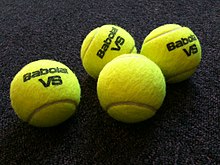
The balls are rubber spheres, filled with air. They are covered with felt, and must be yellow or white in official competitions (mostly yellow). Their composition may vary depending on the type of player who will use them (leisure, regular or intensive, adult or young). The difference will be mainly in terms of longevity. Competition balls are indeed most often pressure, with an optimal quality of rebound and play, but a rather limited lifespan (of the order of two or three games in recreational players).
The tennis ball must have a diameter between 6.350 and 6.668 cm, and its mass must vary between 56.7 and 58.5 grams. Dropped 254 cm high and falling on a concrete base, the ball must bounce between 134.62 and 147.32 cm.
The manufacturing process consists of eight steps:
- Extrusion of a mixture of natural and synthetic rubber
- Modeling in sphere form
- Cutting into half-spheres
- bonding and pressurization (twice atmospheric pressure)
- cooling
- Cutting nylon layers covered with felted cotton
- Semelage: two pieces of felt are glued to the surface
- Finish: a jet of steam gives its final texture, packaging in a pressurized box
Originally the balls were white, but in the late 1970s, yellow became established in order to offer more visibility to viewers, because there was a lack of visibility when the ball touched a line. White bullets are still allowed, however.
Each tournament specifies in its rules the procedure for changing balls, necessarily an odd number of games so that it is not always the same player who benefits from new balls. The first change of balls is made two games earlier to take into account the warm-up period. For example at Roland Garros, the first change of balls is done after 7 games, the other changes after 9 games. In principle, there is no change of balls before a decisive game.
On the professional circuit, men and women do not play exactly the same balls: if the size and bounce must be identical on the same tournament, the felt surface is different, making the balls of the women’s circuit faster, while those for the men’s circuit are more subject to air friction. This decision to use different balls was made by the WTA in 2004; according to the Wall Street Journal, “this double standard is designed to improve the competitiveness of tennis, blunting the power of large servers, and allowing women to play more aggressively”. Women’s circuit balls are also used in mixed doubles.
The outfit
At the beginning of the twentieth century, tennis evolved faster than clothing fashion. Thus, players come to play with their ties, bustiers or flannels. Then, little by little, dresses appear and the players compete for standing by displaying themselves with more and more elegant clothes. The French Suzanne Lenglen then freed the sporty body of the woman, becoming a fashion icon, the “divine”.
Clothing has continued to evolve since the early 1980s, becoming lighter and more comfortable; shorts and shirts for men, which succeed polo shirts inspired by René Lacoste, dresses for women, who gradually wear shorts and tank tops. The arrival of new fabrics, such as polyester in the late 1990s, made it possible to better control perspiration, making clothes even more comfortable. The most common outfits currently are polo shirt and shorts for men, tank top and shorts for women, however, the men’s tank top and dress remain appreciated by some players.
Faced with the arrival of major equipment manufacturers in tennis, rules have been put in place concerning the size of logos allowed on shorts, polo shirts, skirts, dresses…
Playing surfaces (flooring)

A tennis match is played on a court, the surface of which can vary. Indeed, there are different playing surfaces, whose characteristics are very variable, on the one hand with regard to the speed of the ball (some surfaces are slow, others very fast), on the other hand, the “quality” of the bounce (low bounce, or high bounce).
There are thus four main types of surfaces.
- The hard surfaces (Rebound Ace, Decoturf, concrete or quick) found in most clubs, are in principle fast surfaces. On the other hand, the quality of the rebound is variable. The main advantage of fast surfaces is the low maintenance they require, but on the other hand, hard surfaces are physically demanding, and require good support. There are also clip-on polypropylene tiles with relatively similar performance to other fast surfaces.
- The clay surface of the Roland-Garros tournament and most major tournaments in Europe, is a surface composed of a limestone screed covered with crushed brick or crushed stone. This surface requires significant maintenance because it fears frost, wind and rain. There are improved surfaces approved “rammed earth” consisting of a flexible frost-free screed, not afraid of rain, covered with crushed brick and requiring much less maintenance. The slowness of the “clay” surface tends to favor long exchanges, counter-kicks or cushioning, which explains why matches on clay are in principle longer and more playful. On the other hand, the players’ joints are less physically stressed, and the slides spectacular.
- The grass surface of the Wimbledon Tournament is rare and requires very important maintenance. It is a moderately fast surface (although the speed has been reduced in recent years) with a very low bounce. The grass is thus a surface that favors attacking tennis (serve, volley), allowing the exchange to be concluded relatively quickly.
- Synthetic surfaces (carpet), used indoors: Taraflex (Gerflor), Greenset, sometimes parquet. These surfaces are very fast, and their characteristics are close to those of hard surfaces. They are rarely found in clubs, because they require a lot of maintenance and they are especially very expensive compared to other surfaces.
- Synthetic turf (basic turf, Olympus, Melbourne…) is a slightly faster surface than clay.
- Synthetic clay (rubber). This surface offers a game similar to that of clay.
The main effects of tennis
Tennis is a discipline whose basic strokes: forehand, backhand and serve can be supported by effects printed on the ball, and which change the behavior of the latter. Here are the main effects of modern tennis.
The flat game
Flat play is not an effect per se, but it remains widely used on all surfaces. A ball hit flat will pass quite close to the net. This is the effect that offers the most speed because the trajectory of the ball is quite straight. Flat strikes are neutral in terms of speed after the bounce, which decreases on average by 50%, compared to 25% for the lift and 75% for a cut ball. In addition, flat strikes are used in both offense and defense, and most of the time allow a player in an attacking position to finish the point. Flat balls are the ones most found on fast surfaces that favor attacking tennis, where the power of the players can be best expressed. This type of strike nevertheless carries a greater risk of fault compared to the lift.
The brushed

Brushing is a widely used effect among players of all skill levels, as it is relatively simple to perform and provides several advantages. Its main attraction is the safety it provides in relation to the net, as a lifted and spinning ball will follow a curved trajectory compared to a flat ball. In addition, this same rotation imprinted on the ball allows it to fall back faster than a ball hit with another effect, and to lose less speed after the bounce (the speed of the ball will decrease by only 25%). Another effective application of brushed is the lob (defense ball that aims to pass the opponent to the net) because a brushed lob will rise very quickly, and fall back quite quickly in the court. Well executed, it allows a player to pass to the net.
Brushing is an effect used in attack as in counterattack. On a short ball, it allows you to accelerate with a large margin of safety, but can also allow you to change pace. With professional players, brushing is used almost constantly, even if it does not seem noticeable: totally flat balls are only used to finish the point. In addition, some surfaces make brushing more effective than others; For example, clay allows large brushers to take advantage in long exchanges, while on grass, where the bounce is much lower, brushed is less used, or at least less effective.
Sliced shots and retro effect

A sliced ball is a ball that will be hit, with a rotational movement opposite to the trajectory. A cut ball will thus tend to be slowed down before and after the bounce (where the speed of the ball decreases by 75%), and to crash (highest bounce under similar conditions). A cut shot, however, confers some security, because the ball is well-controlled. The easiest shot to cut is the backhand, because the racquet movement from top to bottom is done quite naturally on this side.
Used most often in defense, the cut shot allows to get out of difficult situations, or to break the rhythm after an exchange dominated by the lift or flat shots. It is also possible to cut in forehand, especially at the end of the race, but the cut forehand is often a defensive shot (or cushioning), while in backhand, it can be used to go to the net or make a passing shot.
The retro effect is a very marked variant of the cut shot, where the player will really come to rub the ball from the back to the front. This blow is often used on cushioned balls, especially on clay, in order to hinder the opponent in his race. Some players are even able to put a retro effect that brings the ball back into their own court after falling into the opponents.
Effects on the service
The service cut off
The slice is applied most of the time to the service. A cut ball is struck on the side, so that a diagonal rotational motion is imprinted on it. The trajectory of a cut serve will not be straight, unlike that of a flat serve, and the ball in flight will tend to follow a curved trajectory. In addition, after the bounce, a cut ball will tend to crash with a fairly low bounce, and go to the side.
The slice is a widely used effect on all surfaces. This is a relatively simple effect to give to the service compared to the brushed effect. It is for this reason that many players use it on their second service ball, in order to better ensure the latter. Indeed, the cut effect makes it possible to give the ball a curvilinear trajectory, while allowing a significant safety margin.
A cut service is also generally less powerful than a flat service. It is a particularly effective weapon on the grass where the bounce is already lower than on other surfaces because it allows the opponent to get out of the field, and therefore to open the court. If the opponent does not use the same hand as the server, the coupe is often played on his backhand, which is often the weak point of the players. The cut serve is also a weapon widely used by left-handers since it is played on the “advantage” side, so on a decisive point.
In general, the coupe is applied a lot on second balls. Performed on the tie side, this serve allows the opponent to be taken off the court in order to have the court empty, while on the advantage side, it is often directed toward the T.
The brushed service
The brushed service is probably the one that requires the most practice and technique. Indeed, brushing is an effect that requires the ball to rotate from back to front, which is difficult to achieve when it comes to hitting it stationary and above the head. But in compensation for these technical difficulties, the brushed serve, and its kicked variant are extremely effective, especially in the second ball. Indeed, the rotation printed on the ball allows it to dive much faster once the net is crossed, which gives it a lot of speed. A successful brushed serve will tend to pass quite high above the net before diving, then bounce very high because of the effect of the ball.
The kicked variant of the lifted serve consists of giving both a lifted effect and a slightly lateral effect to the ball, so that it rises and shifts to the side after the bounce. The vast majority of high-level players use the brushed serve on their second ball, because the margin of safety with the net is important, and because the brushed serve, once mastered, is very easily controlled. In the first ball, a very brushed serve can destabilize an opponent by forcing him to hit the ball high, sometimes even above the shoulder, which is particularly difficult in backhand, shot targeted by the kick when playing against someone with the same hand as you.
On the tie side, and directed towards the T, it allows to touch the backhand of the opponent and forces him to execute a backhand while he is on the right side of the court; while on the advantage side, it allows to take the opponent out of the field in order to have the court empty.
The grading system
Professional rankings
The top level consists of two main circuits; the WTA ranking, women’s world ranking, and the ATP ranking, men’s world ranking, updated weekly, which list the results obtained during the last 12 months of competition. Parallel to this ranking, which serves as a reference (especially for the allocation of seeds in tournaments), there was the “Race” ranking (which existed from 2001 to 2008 for men, and from 2006 to 2008 for women) which listed the results obtained during the season. A player who made a very good start to the season could thus find himself at the top of the Race ranking, and much further in the reference (or technical) ranking. At the end of the season, these two rankings obviously converged.
The great tennis champions
Yesterday

Since the beginning of the twentieth century, which was marked by the appearance of many tournaments that still exist today, many players have distinguished themselves. Thus, until the beginning of the Open era in 1968, several champions marked the history of tennis. The most illustrious of them are undoubtedly the American Bill Tilden and the Australian Rod Laver, the former having won ten Grand Slams, and the latter having achieved two of the three Grand Slams to date.
After the beginning of the Open era, which was marked by the professionalization of tennis, new champions have distinguished themselves. These outstanding players include:
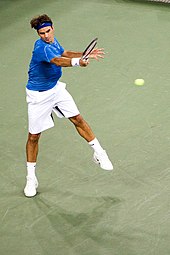
- Switzerland’s Roger Federer has won 20 Grand Slam titles, the third-best total behind Novak Djokovic and Rafael Nadal with 22. He won 103 ATP titles, the second-highest total in history behind Jimmy Connors’ 109. Federer has made the Grand Slam in his career (he won Wimbledon eight times, the Australian Open six times, the US Open five times and Roland Garros once). He also holds the record for the most consecutive Grand Slam semifinals (23). He also won six Masters (absolute record), 28 Masters 1000 (3rd best total behind Novak Djokovic with 38 titles and Rafael Nadal with 36 titles) as well as the Olympic title in doubles with his compatriot Stanislas Wawrinka at the Beijing Olympics and a silver medal in singles at the London Olympics. He won the 2014 Davis Cup with Switzerland. He holds the second-highest total number of weeks spent at the rank of world No. 1 in the ATP rankings (310), behind Novak Djokovic.
- American Pete Sampras, long holder of the record for Grand Slam victories (14) and the record of past weeks No. 1 in the ATP rankings (records then broken by Roger Federer)
- Sweden’s Björn Borg, six-time Roland Garros winner and five-time Wimbledon winner,
- the American Jimmy Connors, winner of 8 Grand Slam tournaments and 109 ATP-sanctioned tournaments (absolute record),
- American Andre Agassi, the first player in the Open era to win all four Grand Slam tournaments on four different surfaces and former Masters Series title holder with 17 goals (record broken by Roger Federer with 28 titles, Rafael Nadal with 36 titles and Novak Djokovic who currently holds the record with 38 titles won),
- Germany’s Steffi Graf, who won 22 Grand Slam tournaments and achieved the Grand Slam in 1988,
- Australia’s Margaret Smith Court, who won 24 Grand Slam tournaments and achieved the Grand Slam in 1970.
- Czechoslovakia and then American Martina Navrátilová, who won 18 Grand Slam singles tournaments, 31 major doubles titles and 10 mixed doubles titles.
- The Yugoslav and American Monica Seles, who won 32 titles including 8 Grand Slams at the age of 19 and suspended for 178 consecutive weeks (from 1991 to 1993) the reign of Graf, before being stabbed in the middle of a match in Hamburg in 1993. Although she never reached the top spot in the world again after her return to competition in 1995, she still won 20 other titles including a Grand Slam until her retirement in 2004.
Today
Players
Active champions
- Rafael Nadal (Spain) has won 92 career trophies. He co-holds with Novak Djokovic the record for the number of Grand Slam titles (22). He is the record holder for the number of titles on clay with 63 trophies. He has won the French Open fourteen times, becoming the only player in tennis history to have won at least ten titles in the same Grand Slam tournament, in 2005, 2006, 2007, 2008, 2010, 2011, 2012, 2013, 2014, 2017, 2018, 2019, 2020 and 2022. He even has 4 tournaments with more than 10 titles, all on clay: Roland-Garros (14), the Barcelona tournament (12), the Monte-Carlo Masters (11) and the Rome Masters (10). He won 36 Masters 1000 titles (2nd best total behind Novak Djokovic with 38 titles). He won the Davis Cup with Spain in 2004, 2008, 2009, 2011 and 2019. He won the gold medal in singles at the 2008 Beijing Olympics, as well as the gold medal in doubles with his compatriot Marc López in 2016, at the Rio de Janeiro Olympics. He won the 2008 Wimbledon tournament by defeating Roger Federer in the final, although the latter had won the previous five editions. In early 2009, he won the Australian Open against Roger Federer and won Wimbledon again in 2010. During this year, he also won the US Open and became the 7th player in history to have won all 4 Grand Slam titles and the first player in history to achieve the Ochre Grand Slam (4 most important tournaments on clay: Monte-Carlo, Rome, Madrid and Roland-Garros). At 24, he became the fourth player in the Open era (since 1968) – and especially the youngest – to win all four Grand Slam tournaments (after Rod Laver, Andre Agassi and Roger Federer). In addition to his 14 titles at Roland Garros, he has four titles at the US Open, two at Wimbledon and two at the Australian Open.
- Novak Djokovic (Serbia), has won 93 singles trophies, including 22 Grand Slam titles like Rafael Nadal: ten times the Australian Open (2008, 2011, 2012, 2013, 2015, 2016, 2019, 2020, 2021 and 2023), seven times the Wimbledon tournament (2011, 2014, 2015, 2018, 2019, 2021 and 2022), three times the US Open (2011, 2015, 2018) and twice Roland-Garros (2016 and 2021). He holds the record for the number of weeks spent at the rank of world No. 1 (373), ahead of Roger Federer. He holds the record for Masters 1000 titles with 38 titles. In 2018, he won the Cincinnati Masters, becoming the only player in the history of tennis to have won all 9 tournaments in this category in singles. Two years later, he repeated his victory at the Cincinnati Masters and became the first and only player in history to have won at least twice each of the 9 Masters 1000. He also won five Masters in 2008, 2012, 2013, 2014 and 2015. He is the eighth player to complete a career Grand Slam and the third to achieve a two-year Grand Slam: Wimbledon 2015, US Open 2015, Australian Open 2016 and Roland Garros 2016. In 2011, he won 41 consecutive victories, stopped by Roger Federer, and reached the first place in the world. He won the Davis Cup in 2010 with Serbia. He also holds the record for the most ATP points in a single season (16,585 at the end of 2015) and the largest point gap with No. 2 in the rankings (5,605 points with Andy Murray).
- Andy Murray (UK), has won 46 singles tournaments, including three Grand Slam titles, the 2012 US Open, 2013 Wimbledon and 2016 Wimbledon. He also won the Masters in 2016. He has also reached the finals of 8 other Grand Slam tournaments: US Open 2008, Australian Open 2010, 2011, 2013, 2015, 2016, Roland-Garros 2016 and Wimbledon 2012. He became Olympic champion at the London Games on August 5, 2012 by beating Roger Federer in the final in front of an audience that had been waiting for a Briton to win Wimbledon since 1936. He takes revenge on Federer who beat him in the Wimbledon final a month earlier. At the Rio de Janeiro Games, four years later, he became Olympic champion for the second time in a row by defeating Juan Martín del Potro in the final, a unique performance in the history of tennis at the Olympic Games. He also won the Davis Cup in 2015 with Great Britain.
- Stanislas Wawrinka (Switzerland) has also won three Grand Slam tournaments: the 2014 Australian Open, the 2015 Roland Garros and the 2016 US Open. He won the Olympic doubles title with compatriot Roger Federer at the Beijing Olympics and also won the Davis Cup in 2014 with Switzerland.
- Juan Martín del Potro (Argentina), revelation of the 2008 season by winning four consecutive tournaments (Stuttgart, Kitzbühel, Los Angeles and Washington) during the summer. Quarter-finalist at the US Open in 2008 and the Australian Open in 2009, then semi-finalist at Roland-Garros in 2009, he won the US Open 2009 against Roger Federer at only 20 years old. He also won the Davis Cup in 2016 with Argentina.
- Marin Čilić (Croatia), a finalist at Wimbledon in 2017 and the Australian Open in 2018, won a Grand Slam tournament at the 2014 US Open. He also won the Davis Cup in 2018 with Croatia.
- Dominic Thiem (Austria), won the US Open 2020 and has previously reached the final of a Grand Slam 3 times including 2 at Roland Garros in 2018 and 2019 and at the Australian Open in 2020. He also reached the Masters final in 2019 and 2020 and won the Indian Wells Masters 1000 in 2019. The Austrian reached his best world ranking on February 24, 2020 (3rd) surpassing Roger Federer.
- Daniil Medvedev (Russia), won the 2021 US Open and reached the final of a Grand Slam 3 times. He also won the Masters in 2020 and 4 Masters 1000. The Russian reached the top spot in the world on February 28, 2022, by overtaking Novak Djokovic.
Champions who have recently stopped competing
- Lleyton Hewitt (Australia), world No. 1 for 80 weeks between 2001 and 2003. Winner of the US Open in 2001, Wimbledon in 2002 and the Masters Cup in 2001 and 2002, he has also reached two other Grand Slam finals (US Open 2004 and Australian Open 2005) as well as the final of the Masters Cup in 2004 and has also won two Masters 1000. He also won the Davis Cup with Australia in 1999 and 2003. He ended his career after the 2016 Australian Open.
- Andy Roddick, (USA), world No. 1 for thirteen weeks. He won the US Open in 2003, and appeared in four other Grand Slam finals (Wimbledon 2004, 2005, and 2009, US Open 2006), all losing to Roger Federer. It also held the record for the fastest service with 249.4 km/h for a very long time, beating on March 5, 2011, by Ivo Karlović with its 251 km/h. He also achieves a high number of aces or winning serves in each of his matches.
- Marat Safin, (Russia), world No. 1 for 9 weeks in 2000 and 2001, the youngest player to reach this ranking in the history of tennis at the time. He won the US Open in 2000 and the Australian Open in 2005, and has appeared in two other Grand Slam finals (2002 Australian Open and 2004 Australian Open). He also won five Masters 1000 (including three times the Paris-Bercy Masters in 2000, 2002 and 2004) and two Davis Cups in 2002 and 2006. He ended his career as a professional tennis player in November 2009.
- Yevgeny Kafelnikov, (Russia), world No. 1 for 6 weeks in 1999. He won two Grand Slams in singles (Roland Garros in 1996 and Australian Open in 1999) and four in doubles (Roland Garros 1996, Roland Garros 1997, and the 1997 Australian Open with Daniel Vacek and Roland Garros 1997 with Paul Haarhuis), was a gold medal at the 2000 Summer Olympics and also won the 2002 Davis Cup. at the end of which he decided to retire from sport the following year. He is one of the last players to have been in the top 10 in singles and doubles at the same time.
- Gustavo Kuerten, (Brazil), world no. 1 for 43 weeks in 2000 and 2001, including 30 consecutive. Three-time winner of Roland Garros (1997, 2000 and 2001), winner of the Masters in 2000 and five Masters 1000. He retired from the sport in 2008 and was inducted into the International Tennis Hall of Fame in 2012.
- Juan Carlos Ferrero, (Spain), world no. 1 for 8 weeks in 2003. Winner of Roland Garros in 2003, he was also twice finalist of a Grand Slam tournament (US Open 2003 and Roland Garros 2002). He also won four Masters 1000 and the Davis Cup in 2000, 2004 and 2009. He stopped his professional career in 2012.
- Carlos Moyà, (Spain), world No. 1 for 2 weeks in 1999. Winner of Roland Garros in 1998, finalist at the 1997 Australian Open and the 1997 Masters men’s tennis, he also won three Masters 1000. He also won the 2004 Davis Cup. He stopped his sports career in 2010.
Players
Active champions

- Serena Williams (USA). Winner of all four Grand Slam tournaments, Serena won all four consecutive rounds between 2002 and 2003 and then again between 2014 and 2015. She has 72 singles titles to her name including twenty-three Grand Slam titles and five Masters, as well as three Olympic gold medals in doubles, and one in singles.
- Venus Williams (USA). Venus won forty-six singles titles. She has seven Grand Slam tournaments to her name (including five Wimbledon), an Olympic title in 2000 and the Masters in 2008.
- Svetlana Kuznetsova (Russia). World number 2 following the US Open 2007 where she reached the final, this Russian, aged twenty-four, revealed at the same US Open 2004 where, then No. 9 in the world, she had won the title to everyone’s surprise. She also has another Grand Slam title, won at Roland Garros in 2009, and a total of fourteen singles tournaments.
- Kim Clijsters (Belgium). She won four Grand Slam singles titles (US Open 2005, 2009, 2010 and Australian Open 2011) and two doubles titles (Roland Garros and Wimbledon) in 2003 (with Ai Sugiyama), three Masters (2002, 2003 and 2010), one Fed Cup, and was ranked world number one simultaneously in singles and doubles. She also reached the final of the 2004 Australian Open, the final of Roland Garros in 2001 and 2003 and the final of the 2003 US Open. She has 41 singles and 11 doubles tournaments to her name. She ended her career at the 2012 US Open but announced her return to competition for the year 2020 after 7 years of absence.
Champions recently withdrawn from competition
- Maria Sharapova (Russia). Considered the best Russian player in history, she won all four Grand Slam tournaments: Wimbledon in 2004 at only seventeen years old, then the US Open in 2006, the Australian Open in 2008 and Roland-Garros in 2012 and 2014 (she is not the first Russian to have won the Australian Open and the US Open). She was also the first Russian to be No. 1 in the world, in 2005. Absent from competition in late 2008 and early 2009 due to a right shoulder injury, she returned to competition in March 2009. She has thirty-five singles titles, including five Grand Slam titles and one Masters title in 2004. She ended her career in February 2020.
- Ana Ivanović (Serbia). A former world No. 1, she won her first Grand Slam title at Roland Garros in 2008. She has previously played in two Grand Slam finals, both lost (Roland Garros 2007, final lost to Justine Henin, and the 2008 Australian Open, final lost to Maria Sharapova). She has fifteen titles to her name.

- Justine Henin (Belgium). Number 1 for the first time in October 2003, the Belgian has a complete record, only Wimbledon is missing from her Grand Slam record. She won forty-three tournaments (including seven Grand Slam titles, two Masters and an Olympic gold medal in 2004) in singles, a Fed Cup (in 2001), and held the top spot in the WTA rankings for one hundred and seventeen weeks until May 14, 2008, when she retired at just 25 years of age. In 2009, however, she announced her return to competition in January 2010, a return that proved successful as she reached the final of the Australian Open and won Stuttgart and Rosmalen. On January 26, 2011, she ended her career for good following an elbow injury. It is considered too damaged and too fragile for her to continue her career.
- Martina Hingis (Switzerland). She became world No. 1 at just 16 years and 6 months (March 1997), an all-time record. She flew over the women’s circuit, and won everything except Roland-Garros. Despite 209 weeks spent in first place in the world, she no longer finds solutions, facing the new queens of the circuit, who are at the time Serena Williams, Venus Williams and Jennifer Capriati. Tired of her injuries and wanting to finish her studies, she retired at only 22 years old (October 2002). She returns in January 2006 and finished the same year 7th in the world. She retired again in 2007 following an ITF suspension after testing positive for cocaine. Seven years later, she returned to the doubles circuit, and won 3 more grand slams in women’s doubles (as well as the year-end Masters, and silver at the J.O.), and 4 new Grand Slams in mixed doubles, bringing his total of Grand Slams in all categories to 22.
- Jelena Janković (Serbia). This Serbian player held the No. 1 position in the world for eighteen weeks in 2008 and 2009. She revealed herself to the general public in 2006 after a semi-final at the US Open, after a period of great difficulty in early 2006 where she did not win a single match in ten tournaments. She also has a final at the US Open in 2008, three semifinals at Roland Garros, a semifinal at the Australian Open, and thirteen WTA titles. She was world No. 1 for a week in August 2008, without having played a single Grand Slam final in her career, thus constituting a first, men and women combined. She withdrew from the circuit in January 2018 by not playing the Australian Open (after 56 consecutive Grand Slam tournaments) following an eye operation. In 2020, she says she is thinking about a possible return to competition.
- Lindsay Davenport (USA). Lindsay has fifty-five singles tournaments to her name, including three Grand Slam tournaments (US Open 1998, Wimbledon 1999 and Australian Open 2000), an Olympic gold medal in 1996 and a Masters in 1999, as well as thirty-eight doubles titles including three Grand Slam titles (Roland-Garros 1996, US Open 1997 and Wimbledon 1999). She was also world No. 1 in singles, including four times at the end of the season, as well as in doubles. She was the former rival of Martina Hingis for proof she leads in their duel 14 to 11. Returning to the circuit in September 2007 after giving birth to her son at the age of 31, she retired again from competition in early 2009 to give birth to her daughter in June 2009.
- Mary Pierce (France). Mary Pierce has eighteen titles, including two Grand Slams, the Australian Open in 1995 and Roland Garros in 2000. No. 3 worldwide on January 30, 1995, she had to deal with numerous injuries. Falling to 130th place in 2002, by dint of courage and determination, she achieved in 2005 her best season by reaching two Grand Slam finals at Roland-Garros and the US Open. She also reached the final of the Masters and finished the year No. 5 in the world. In 2006, she violently twisted her knee at the Linz Tournament. While she is 34 years old, this injury greatly compromises the rest of her career.
- Amélie Mauresmo (France). Winner of the Australian Open and Wimbledon in 2006, she dominated the circuit at the end of 2005 and all of 2006, and was not stripped of the No. 1 position in the world until the end of the year. She has twenty-five singles titles to her name, including a Masters title and two Grand Slam titles. She also won a Fed Cup and won an Olympic silver medal (in 2004, losing to Justine Henin). She officially ended her career in December 2009.
- Elena Dementieva (Russia). This Russian player has sixteen WTA titles. She was Olympic runner-up in 2000 and Olympic champion in 2008, the most prestigious title of her career. She also distinguished herself in Grand Slams in 2004, reaching the final of Roland Garros and then the US Open, losing to compatriots Anastasia Myskina and Svetlana Kuznetsova. She retired from the circuit at the end of the 2010 season.

- Dinara Safina (Russia). This Russian player has won twelve WTA singles titles. Grand Slam tournaments have not yet smiled on him despite three finals, at the Australian Open in 2009 and at Roland-Garros in 2008 and 2009. She was Olympic runner-up in 2008. His first place in the world rankings was achieved thanks to a good start to the 2009 season and consistent results at the highest level. She is now looking to find her best level after having totally lost confidence in herself and chained the under-performances, since the end of 2009.
Professional tournaments
Tennis has been an Olympic sport since 1988. Apart from this event, all tournaments are held annually. Grand Slam tournaments and the Masters are common to the ATP and WTA tours. Although there are correspondences between the other categories of women’s and men’s tournaments (some tournaments even jointly organize women’s and men’s events), the latter are generally organized separately.
Grand Slam tournaments
Grand Slam tournaments are four major tournaments on the professional calendar, but they are organized by the ITF and not the ATP or WTA like the other events:
| Period | Tournament | place | Surface |
|---|---|---|---|
| January | Australian Open | Melbourne, Australia | Hard (GreenSet) |
| May-June | France International (Roland Garros) | Paris, France | Clay |
| July | British Open (Wimbledon) | London, United Kingdom | Lawn |
| August-September | U.S. Open | New York, United States | Hard (Laykold) |
These tournaments have all been held outdoors since their creation, the surfaces have evolved over time (the US Open was once held on grass). They now have the particularity of being held over two weeks and counting the same number of rounds for all participants (in other tournaments some seeds play one less round in the table). Each tournament has several tables, so at the end of the competition many trophies are awarded to the winners and finalists of the categories: men’s singles, women’s singles, men’s doubles, women’s doubles, mixed doubles, junior boys, junior girls but also for para-athletes. The men’s and women’s tables feature 128 players each. These include 32 seeds (determined by ATP and WTA technical rankings), players from the qualifying draws, and guest players (who receive a wild card).
A major difference between Grand Slam tournaments and other tournaments on the ATP calendar is that the matches are played in the best of five sets for men (singles and doubles), moreover apart from the US Open and Wimbledon (since 2019, at 12-12), there is no tie-break in case of a tie at 6 everywhere in the decisive set. It is therefore the 1st player with 2 games difference who wins, this sometimes gives rise to meetings with breathless suspense.
The Masters
The Masters of Men’s Tennis/Masters of Women’s Tennis is the last major tournament of the tennis season since 1970/1972. In 2014, they will be organized respectively in London and Singapore, it pits the eight best players of the season in a tournament with a particular format: 2 pools of 4 participants are formed, each meets the other members of his pool in order to qualify (by being among the 2 best) for the semi-finals. This tournament is usually held indoors. It has been played on carpet in the past, this surface having been banned it now takes place on hard. The doubles editions appeared a few years later and take place at the same place and time as their singles counterparts.
| Period | Tournament | place | Surface |
|---|---|---|---|
| November | Men’s Tennis Masters (ATP Finals) | Pala Alpitour, Turin, Italy | Hard (GreenSet, indoor) |
| November | Women’s Tennis Masters (WTA Finals) | Shenzhen Bay Sports Center, Shenzhen, China | Hard (indoor) |
This tournament is the 5th major event of the season and the last tournament of the season (only the Davis Cup final takes place the following weekend). It is, after the Grand Slams, the most important tournament. Whether in terms of points for rankings, prestige from the point of view of the Palmares or in terms of difficulties (it is the ultimate tournament of the year and the finalists play five games in one week against the top 8).
Masters 1000
The Masters 1000 is a series of nine annual tournaments held in Europe or North America, organized by the ATP. They were introduced in 1990 under the name “Super 9”. They then took the name “Masters Series”. They are now known as the “Masters 1000”. Less prestigious than Grand Slams, they are the second category of tournament types and earn more points than ancillary tournaments.
| Period | Tournament | place | Surface |
|---|---|---|---|
| March | Indian Wells Masters | Indian Wells, United States of America | hard surface |
| March-April | Masters de Miami | Miami, United States | hard surface |
| April | Masters de Monte-Carlo | Monte Carlo, Monaco | clay |
| May | Masters de Madrid | Madrid, Spain | clay |
| Masters de Rome | Rome, Italy | clay | |
| August | Canadian Masters | Montreal/Toronto, Canada | hard surface |
| Masters de Cincinnati | Cincinnati, United States | hard surface | |
| October | Masters de Shanghai | Shanghai, China | hard surface |
| October-November | Masters de Paris-Bercy | Paris, France | Hard surface (indoor) |
Étienne de Villiers presented at the 2007 US Open, the organization of the next Masters. The Masters Series are renamed “1000”. Monte Carlo will have a special status, it will not be a “1000” tournament and will not be mandatory, probably for a calendar reason, but it will offer the same number of points and prize money. An absence from one of the other eight tournaments, without a medical excuse, will be penalized with $ 100,000 and a suspension the following year.
The Masters Cup will move from Shanghai to London and will be called ATP World Tour Finals (it was previously called ATP Master: ATP Worlds Championship). On the calendar, Madrid, with new covered courts, will probably take the place of Hamburg which disappears from the list of “1000”, two weeks before Roland Garros, and the new Shanghai tournament will replace that of Madrid in autumn (Tennis Magazine – October 2007).
Other men’s tournaments
ATP 500 series: 13 tournaments are classified as ATP 500 series. These tournaments are less prestigious than the Masters 1000 and Grand Slam tournaments, but more prestigious than the ATP 250 series.
The ATP 250 series: 40 tournaments are part of the ATP 250 series. These are the least prestigious tournaments on the ATP Tour.
The ATP 500 series, and the ATP 250 series, like the Masters 1000, get their name because of the ATP points they earn to the winner of the tournament.
At the lower levels, the ATP organizes the ATP Challenger Tour tournaments, and the ITF organizes the ITF Men’s Circuit tournaments.
Women’s tournaments
In addition to the Grand Slam tournaments that offer men’s and women’s tables in parallel, the WTA includes two categories of tournaments: Premier Events, with a minimum of 600,000 dollars, including 4 Premier Mandatory and 5 Premier 5, the most prestigious, which can be compared to the Masters 1000, Premier singles tournaments, equivalent to the ATP 500 and International Events tournaments. , which are the equivalent of the ATP 250 including the International Tournament of Champions. The ITF organizes at the lower level (lower-ranked players and juniors) the ITF Women’s Circuit tournaments, endowed with $10,000 to $100,000. Since 1972, the best players meet at the end of the year to compete in the Women’s Tennis Masters.
Since 2012, the WTA has implemented the WTA 125 tournament category, which ranges from the ITF $100,000 to the WTA 280.
Until 2008, the WTA organized four specific types of tournaments: Tier I (10 tournaments: Tokyo, Indian Wells, Miami, Charleston, Berlin, Rome, San Diego, Canadian Open, Moscow and Zurich), II, III and IV. Tier I was the equivalent of the men’s Masters 1000, which is the tournament with the highest points and prize money after the four Grand Slam tournaments.
Ranking by Grand Slam titles
Men
| Rank | Name | Country | Australian Open
V-F-DF |
Roland-Garros
V-F-DF |
Wimbledon
V-F-DF |
US Open V-F-DF |
Total
V-F-DF |
Duration
(years) V+F+DF |
|---|---|---|---|---|---|---|---|---|
| 1 | Novak Djokovic | Serbia | 10-0-0 | 2-4-5 | 7-1-3 | 3-6-3 | 22-11-11 | 2007-2023 (17) |
| 2 | Rafael Nadal | Spain | 2-4-1 | 14-0-1 | 2-3-3 | 4-1-3 | 22-8-8 | 2005-2022 (18) |
| 3 | Roger Federer | Switzerland | 6-1-8 | 1-4-3 | 8-4-1 | 5-2-3 | 20-11-15 | 2003-2020 (18) |
| 4 | Pete Sampras | United States | 2-1-2 | 0-0-1 | 7-0-1 | 5-3-1 | 14-4-5 | 1990-2002 (13) |
| 5 | Roy Emerson | Australia | 6-1-1 | 2-1-1 | 2-0-1 | 2-1-1 | 12-3-4 | 1959-1967 (9) |
| 6 | Rod Laver | Australia | 3-1-0 | 2-1-1 | 4-2-0 | 2-2-0 | 11-6-1 | 1959-1969 (11) |
| 7 | Björn Borg | Sweden | 0-0-0 | 6-0-0 | 5-1-0 | 0-4-1 | 11-5-1 | 1974-1981 (8) |
| 8 | Bill Tilden | United States | 0-0-0 | 0-2-1 | 3-0-3 | 7-3-1 | 10-5-5 | 1918-1930 (13) |
| 9 | Ivan Lendl | Czechoslovakia | 2-2-3 | 3-2-0 | 0-2-5 | 3-5-1 | 8-11-9 | 1981-1991 (11) |
| 10 | Ken Rosewall | Australia | 4-1-3 | 2-1-0 | 0-4-2 | 2-2-4 | 8-8-9 | 1953-1977 (25) |
| 11 | Jimmy Connors | United States | 1-1-0 | 0-0-4 | 2-4-5 | 5-2-7 | 8-7-16 | 1974-1991 (18) |
| 12 | Andre Agassi | United States | 4-0-2 | 1-2-2 | 1-1-3 | 2-4-4 | 8-7-11 | 1988-2005 (18) |
| 13 | Fred Perry | United Kingdom | 1-1-0 | 1-1-0 | 3-0-1 | 3-0-2 | 8-2-3 | 1931-1936 (6) |
Women
| Rank | Name | Country | Australian Open V-F-DF |
Roland-Garros
V-F-DF |
Wimbledon
V-F-DF |
US Open
V-F-DF |
Total
V-F-DF |
Duration
(years) |
|---|---|---|---|---|---|---|---|---|
| 1 | Margaret Smith Court | Australia | 11-1-0 | 5-1-1 | 3-2-4 | 5-1-2 | 24-5-7 | 1960-1975 (16) |
| 2 | Serena Williams | United States | 7-1-1 | 3-1-1 | 7-4-1 | 6-4-4 | 23-10-7 | 1999-2021 (23) |
| 3 | Steffi Graf | Germany | 4-1-0 | 6-3-2 | 7-2-1 | 5-3-3 | 22-9-6 | 1985-1999 (15) |
| 4 | Chris Evert | United States | 2-4-0 | 7-2-3 | 3-7-7 | 6-3-8 | 18-16-18 | 1971-1988 (17) |
| = | Martina Navrátilová | United States | 3-3-3 | 2-4-0 | 9-3-5 | 4-4-4 | 18-14-12 | 1975-1994 (20) |
| 6 | Billie Jean King | United States | 1-1-1 | 1-0-1 | 6-3-5 | 4-2-1 | 12-6-8 | 1963-1983 (21) |
| 7 | Monica Seles | United States | 4-0-2 | 3-1-3 | 0-1-0 | 2-2-0 | 9-4-5 | 1989-2002 (14) |
| = | Maureen Connolly | United States | 1-0-0 | 2-0-0 | 3-0-0 | 3-0-0 | 9-0-0 | 1951-1954 (4) |
| 9 | Evonne Goolagong Cawley | Australia | 4-3-0 | 1-1-1 | 2-3-3 | 0-4-0 | 7-11-4 | 1971-1980 (10) |
| = | Venus Williams | United States | 0-2-1 | 0-1-0 | 5-4-1 | 2-2-5 | 7-9-7 | 1997-2017 (21) |
| = | Maria Bueno | Brazil | 0-1-0 | 0-1-4 | 3-2-1 | 4-1-3 | 7-5-8 | 1958-1968 (11) |
| = | Justine Henin | Belgium | 1-2-1 | 4-0-1 | 0-2-3 | 2-1-0 | 7-5-5 | 2001-2010 (10) |
| 13 | Doris Hart | United States | 1-1-0 | 2-3-1 | 1-3-3 | 2-4-4 | 6-11-8 | 1945-1955 (11) |
| = | Louise Brough Clapp | United States | 1-0-0 | 0-0-3 | 4-3-3 | 1-5-5 | 6-8-11 | 1942-1957 (16) |
| = | Margaret Osborne duPont | United States | Np | 2-0-2 | 1-2-2 | 3-2-0 | 6-4-4 | 1944-1951 (8) |
| = | Nancy Wynne Bolton | Australia | 6-2-3 | 0-0-0 | 0-0-0 | 0-1-1 | 6-3-4 | 1936-1952 (17) |
| 17 | Martina Hingis | Switzerland | 3-3-0 | 0-2-3 | 1-0-1 | 1-2-3 | 5-7-7 | 1996-2002 (7) |
| = | Maria Sharapova | Russia | 1-3-3 | 2-1-2 | 1-1-3 | 1-0-2 | 5-5-10 | 2004-2015 (12) |
| = | Pauline Betz | United States | 0-0-0 | 0-1-0 | 1-0-0 | 4-2-0 | 5-3-0 | 1941-1946 (6) |
| = | Althea Gibson | United States | 0-1-0 | 1-0-0 | 2-0-0 | 2-1-0 | 5-2-0 | 1956-1958 (3) |
| 21 | Arantxa Sánchez Vicario | Spain | 0-2-3 | 3-3-4 | 0-2-1 | 1-1-2 | 4-8-10 | 1989-2000 (12) |
| = | Kim Clijsters | Belgium | 1-1-5 | 0-2-1 | 0-0-2 | 3-1-0 | 4-4-8 | 2001-2012 (12) |
| = | Shirley Fry | United States | 1-0-0 | 1-2-1 | 1-1-2 | 1-1-3 | 4-4-6 | 1948-1957 (10) |
| = | Hana Mandlíková | Czechoslovakia | 2-0-1 | 1-0-4 | 0-2-1 | 1-2-0 | 4-4-6 | 1980-1987 (8) |
| = | Naomi Osaka | Japan | 2-0-0 | 0-0-0 | 0-0-0 | 2-0-0 | 4-0-0 | 2018-2021 (4) |
| 26 | Ann Haydon-Jones | United Kingdom | 0-0-1 | 2-3-2 | 1-1-6 | 0-2-3 | 3-6-12 | 1957-1969 (13) |
| = | Lindsay Davenport | United States | 1-1-3 | 0-0-1 | 1-2-2 | 1-1-5 | 3-4-11 | 1997-2005 (9) |
| = | Darlene Hard | United States | 0-0-0 | 1-0-0 | 0-2-2 | 2-2-3 | 3-4-5 | 1954-1963 (10) |
| = | Angela Mortimer | United Kingdom | 1-0-0 | 1-1-0 | 1-1-0 | 0-0-1 | 3-2-1 | 1955-1961 (7) |
| = | Jennifer Capriati | United States | 2-0-1 | 1-0-3 | 0-0-2 | 0-0-4 | 3-0-10 | 1990-2004 (15) |
| = | Virginia Wade | United Kingdom | 1-0-0 | 0-0-0 | 1-0-3 | 1-0-3 | 3-0-6 | 1968-1978 (11) |
| = | Ashleigh Barty | Australia | 1-0-1 | 1-0-0 | 1-0-0 | 0-0-0 | 3-0-1 | 2019-2022 (4) |
| = | Iga Świątek | Poland | 0-0-1 | 2-0-0 | 0-0-0 | 1-0-0 | 3-0-1 | 2020-2022 (3) |
Professional Grand Slam title rankings (pre-open era)
| Rank | Name | Country | US Pro
V-F-DF |
French Pro
V-F-DF |
Wembley Pro
V-F-DF |
Total
V-F-DF |
Duration
(years) V+F+DF |
|---|---|---|---|---|---|---|---|
| 1 | Ken Rosewall | Australia | 2-1-3 | 8-0-2 | 5-3-3 | 15-4-8 | 1957-1967 (11) |
| 2 | Pancho Gonzales | United States | 8-3-1 | 0-2-2 | 4-1-4 | 12-6-7 | 1950-1964 (15) |
| 3 | Rod Laver | Australia | 3-2-0 | 1-4-0 | 4-0-0 | 8-6-0 | 1963-1967 (5) |
| 4 | Hans Nüsslein | Germany | 1-1-0 | 2-1-0 | 2-3-1 | 5-5-1 | 1932-1939 (8) |
| = | Ellsworth Vines | United States | 1-0-1 | 1-1-0 | 3-0-0 | 5-1-1 | 1934-1939 (6) |
| 6 | Donald Budge | United States | 2-4-3 | 1-0-0 | 1-0-4 | 4-4-7 | 1939-1954 (16) |
| = | Karel Koželuh | Czechoslovakia | 3-4-2 | 1-0-0 | 0-0-0 | 4-4-2 | 1928-1943 (16) |
| = | Vincent Richards | United States | 4-2-1 | 0-0-0 | 0-0-0 | 4-2-1 | 1927-1933 (7) |
| = | Bill Tilden | United States | 2-0-4 | 2-1-3 | 0-3-0 | 4-4-7 | 1931-1945 (15) |
| 10 | Bobby Riggs | United States | 3-2-2 | 0-0-0 | 0-1-1 | 3-3-3 | 1942-1953 (12) |
| = | Pancho Segura | United States | 3-4-4 | 0-0-1 | 0-4-6 | 3-8-11 | 1949-1962 (14) |
| 12 | Jack Kramer | United States | 1-0-1 | 0-0-0 | 1-1-1 | 2-1-1 | 1948-1957 (10) |
| = | Fred Perry | United Kingdom | 2-2-0 | 0-0-0 | 0-0-0 | 2-2-0 | 1938-1941 (4) |
| = | Frank Sedgman | Australia | 0-2-0 | 0-1-4 | 2-1-2 | 2-4-6 | 1953-1964 (12) |
| = | Tony Trabert | United States | 0-1-3 | 2-0-2 | 0-1-2 | 2-2-7 | 1956-1961 (6) |
| 16 | Malcolm Anderson | Australia | 0-0-0 | 0-0-2 | 1-0-0 | 1-0-2 | 1959-1965 (7) |
| = | Bruce Barnes | United States | 1-2-0 | 0-0-1 | 0-0-0 | 1-2-1 | 1933-1943 (11) |
| = | Butch Buchholz | United States | 1-0-3 | 0-0-2 | 0-0-3 | 1-0-8 | 1962-1966 (5) |
| = | Henri Cochet | France | 0-0-0 | 1-2-0 | 0-0-1 | 1-2-1 | 1933-1937 (5) |
| = | Alex Olmedo | United States | 1-0-1 | 0-0-0 | 0-0-2 | 1-0-3 | 1960-1963 (4) |
| = | Martin Plaa | France | 0-0-0 | 1-2-4 | 0-0-0 | 1-2-4 | 1931-1938 (8) |
| = | Robert Ramillon | France | 0-0-0 | 1-2-1 | 0-0-0 | 1-2-1 | 1931-1936 (8) |
| = | Welby Van Horn | United States | 1-0-3 | 0-0-0 | 0-1-1 | 1-1-4 | 1943-1951 (9) |
| = | Joe Whalen | United States | 1-0-1 | 0-0-0 | 0-0-0 | 1-0-1 | 1936-1937 (2) |
V = Win, F = Final lost, DF= Lost in semi-finals
Some records
Titles and rankings
Record titles and wins

On the men’s side, Jimmy Connors holds the all-time record for singles tournaments won during the Open era with 109 titles between 1972 and 1989. The exceptional longevity of Jimmy Connors at the highest level (up to 40 years ago) explains this record difficult to beat today. Before the “Open” era, Rod Laver was the absolute record holder in the history of tennis with at least 185 titles (188 according to the historian of professional tennis before the “Open” era, Robert Geist).
On the women’s side, Martina Navrátilová holds the record for tournaments won in singles, recorded by the WTA, with 167 titles (compared to 177 in doubles and 10 in mixed doubles). She is ahead of her American rival Chris Evert who has won 154 titles and Germany’s Steffi Graf who has 107 titles.
Connors and Navrátilová also hold the records for the most singles matches won with 1,256 matches won by the ATP and 1,442 matches won by the WTA, respectively.
Grand Slam records
The records for titles obtained in Grand Slam tournaments are held by Rafael Nadal (22 titles) for men and Margaret Smith Court (24 titles) ahead of Serena Williams (23 titles) for women.
The records for successive titles in Grand Slam tournaments are held by Donald Budge (6 amateur titles from Wimbledon 1937 to Forest Hills 1938) for men and Margaret Smith Court, Martina Navrátilová and Steffi Graf (6 titles respectively from 1969 to 1971, in 1983-1984 and in 1995-1996) for women.
The records for titles obtained in the same Grand Slam tournament are held since the beginning of the Open era by:
- Rafael Nadal (14 titles) and Chris Evert (7 titles) at Roland-Garros,
- Roger Federer (8 titles) and Martina Navrátilová (9 titles) at Wimbledon,
- Novak Djokovic (10 titles) and Serena Williams (6 titles) at the Australian Open.
- Jimmy Connors, Pete Sampras, Roger Federer (5 titles) and Chris Evert (6 titles) at the US Open.
The records for consecutive titles obtained in the same Grand Slam tournament are held since the beginning of the Open era by:
- Rafael Nadal (5 titles) and Monica Seles and Justine Henin (3 titles) at Roland-Garros,
- Björn Borg and Roger Federer (5 titles) and Martina Navrátilová (6 titles) at Wimbledon,
- Roger Federer (5 titles) and Chris Evert (4 titles) at the US Open,
- Novak Djokovic (3 titles), Evonne Goolagong, Steffi Graf, Monica Seles, Serena Williams and Martina Hingis (3 titles) at the Australian Open.
Only five players have achieved the Grand Slam: Donald Budge in 1938 and Rod Laver who achieved the feat twice in 1962 and 1969 on the men’s side and Maureen Connolly in 1953, Margaret Smith Court in 1970 and Steffi Graf in 1988 on the women’s side. The Germans added the Olympic gold medal the same year.
On the men’s side, the American Andre Agassi, the Swiss Roger Federer, the Spaniard Rafael Nadal and the Serbian Novak Djokovic are, to date, the only players in the history of tennis to have won all 4 Grand Slam tournaments on 4 different surfaces: Rebound Ace at the Australian Open (since replaced by Plexicushion and GreenSet), clay at Roland Garros, grass at Wimbledon and Decoturf at the US Open (since replaced by the Laykold).
The record for time separating two successive Grand Slam titles by the same player is held by Rod Laver: 5 years and 8 months between the US amateur at Forest Hills 1962 and Wimbledon Open 1968, this is explained by the fact that professionals were banned from Grand Slam tournaments before 1968: Rod Laver played (and lost) his first professional match on January 5, 1963 against Lew Hoad.
World number one records
Germany’s Steffi Graf remained at the top of the world rankings for the most (non-consecutive) weeks. It held the number 1 spot for 377 weeks. The men’s record is held by Serbia’s Novak Djokovic with 338 non-consecutive weeks spent at world No. 1 between 2011 and 2021. Roger Federer is the player who has remained No. 1 for the longest consecutively with 237 weeks.
Performances and records
Ranking during a Grand Slam title
Mark Edmondson is the lowest-ranked player to win a Grand Slam tournament since the start of the Open era. He was ranked 212th in the world when he won the Australian Open in 1976. Lleyton Hewitt is the lowest-ranked player to win an ATP Tour title at the Adelaide tournament in 1998, when he was ranked 550th in the world.
On the women’s side, the lowest-ranked player to win a tournament on the women’s tour is Angelique Widjaja, who was 579th when she won the Bali tournament in 2001.
Kim Clijsters won the 2009 US Open with a wild card. In addition, she was not yet ranked in the WTA.
Speed of service
The record is held by the American John Isner with a ball hit at 253 km/h, during the Davis Cup, on March 6, 2016.
The ATP does not ratify the records set in Challenger tournaments. It acknowledges, however, that Australian Samuel Groth’s serve recorded at 263km/h at a Challenger tournament in Busan, South Korea was measured with homologated equipment and that the other data collected during the tournament was within a normal range.
The young Frenchman Albano Olivetti served at 253 km/h but this service was established in a Challenger tournament in Segovia not homologated.
On the women’s side, Germany’s Sabine Lisicki holds the service speed record, with a ball hit at 210.8 km/h at the 2014 edition of the WTA tournament at Stanford. The previous record was held by American Venus Williams who hit the ball at 207.6 km/h in the first round of the 2007 US Open against Hungary’s Kira Nagy.
Number of aces
The match between Nicolas Mahut and John Isner at Wimbledon in June 2010 holds the record for the most aces in a match: 216, including 113 aces for Isner (who therefore holds the record for the most aces, for a player, in a match) against 103 for his opponent.
Longest match
Nicolas Mahut played, with the American John Isner, the longest tennis match of the Open era (even before the introduction of the tie-break). At Wimbledon 2010 they met for three days. On June 22, 2010, four sets were played, in 2 hours 48 minutes (6-4, 3-6, 6-7, 7-6). On June 23, the fifth round lasted all day (7:06 a.m.), before being interrupted by the arrival of night. The score was 59-59. On June 24, the end of the fifth set lasted 1 hour 11 minutes and ended with the victory of the American John Isner against Nicolas Mahut with a score of 68-70 for the American. The total score is therefore 6-4, 3-6, 6-7, 7-6, 68-70 with a total duration of 11 hours and 5 minutes.
The previous record for the number of games in a fifth set in a grand slam was at the 2003 Australian Open, where in the quarterfinal between Andy Roddick and Morocco’s Younès El Aynaoui the score reached 21-19 to the advantage of the American.
The previous record for the duration of a men’s tennis match was held by Fabrice Santoro and Arnaud Clément in 2004 6-4, 3-6, 7-6, 3-6 and 16-14, in 6 hours 33 minutes on the clay of Roland-Garros (Paris), a surface much more favorable to long exchanges than the English grass of Wimbledon.
Number of entries
In men’s singles, Switzerland’s Roger Federer holds the record for the most non-consecutive appearances in Grand Slam tournaments (81) ahead of Spain’s Feliciano López (80) and France’s Fabrice Santoro (70).
Spain’s Feliciano López holds the record for the most consecutive appearances in Grand Slam tournaments (79) ahead of Spain’s Fernando Verdasco (67) and Italy’s Andreas Seppi (66).
In women’s singles, American Amy Frazier holds the record for the most non-consecutive participations in Grand Slam tournaments (71) ahead of her compatriot Venus Williams (70).
Japan’s Ai Sugiyama holds the record for the most consecutive appearances in Grand Slam tournaments. She has made 62 consecutive appearances, from Wimbledon 1994 to the US Open 2009, ahead of Italy’s Francesca Schiavone with 61 consecutive participations.
Consecutive wins and others
Rafael Nadal has been, since May 2007, the record holder of consecutive victories on a single surface (clay): 81, Roger Federer having ended this series at the Hamburg Masters (2/6, 6/2 and 6/0). Nadal’s streak began in the spring of 2005. The previous record was held by Ivan Lendl with 66 indoor victories between 1981 and 1983.
Serbia’s Novak Djokovic is the youngest player in the Open era to reach the semifinals of all four Grand Slam tournaments.
Frenchman Richard Gasquet is the youngest player in the Open era to have won a match in a Masters Series (now Masters 1000), in 2002, in Monte-Carlo, when he was exactly 5,780 days old, or just under 16 years, ahead of his runner-up by 29 days. Rafael Nadal.
The Belgian Justine Henin participated in the 4 finals of Grand Slam tournaments in 2006. She won only one of the four trophies, Roland Garros. She first withdrew at the Australian Open for gastric problems and lost 6 months later at Wimbledon against Amélie Mauresmo, which gave the French her only two Grand Slam victories of her career. Henin lost the US Open to Maria Sharapova who, at 19, won her second Grand Slam tournament at Flushing Meadows. Venus Williams achieved an unprecedented grand slam between Roland Garros 2002 and the Australian Open 2003: that of lost finals, all against her sister Serena.
Number of spectators
The highest attendance for a men’s tennis match is 51,954 at Cape Town Stadium in Cape Town, South Africa for the Match in Africa 6 exhibition match between Roger Federer and Rafael Nadal on February 7, 2020. The largest attendance for a women’s tennis match is 35,681 at the King Baudouin Stadium in Brussels for an exhibition match between Kim Clijsters and Serena Williams on July 8, 2010. In one day, it was the Australian Open in Melbourne that hosted on January 17, 2008. A record total of 62,885 spectators adding the daytime session (43,934) and the night session (18,951). For a Davis Cup match, the record is 27,448 spectators at the France-Swiss final at the Stade Pierre-Mauroy in Lille in 2014.
Tennis in the world
Tennis is mainly played in Europe, America and Oceania. This has consequences at the professional level, both for the players and for the tournaments, mostly from these three continents. Although it has long been considered an elite sport, tennis has become more popular and now enjoys worldwide notoriety. In France, it is one of the most publicized sports after football.
African tennis is mainly represented by players from the white minority of South Africa (Wayne Ferreira, Kevin Anderson, Amanda Coetzer, Marcos Ondruska,…) and Zimbabwe (Byron Black, Cara Black, Kevin Ullyett, …) as well as North Africa with Moroccans Younès El Aynaoui, Hicham Arazi, Karim Alami and Tunisians Ons Jabeur and Malek Jaziri. Black Africa, victim in particular of its poverty (lack of infrastructure, privileged handful …), has only a few episodic representatives in the top 100 in the world (Yahiya Doumbia, Dally Randriantefy…). The African-American champion Arthur Ashe had wanted to develop tennis on this continent but his only real success was to discover in Cameroon the Frenchman Yannick Noah.
Much the same can be said for Asia. Only three countries regularly provide players in the elite: Japan (with mainly players such as Kimiko Date, Ai Sugiyama or Naomi Osaka, or a player like Kei Nishikori), China (with especially players, including Li Na, Yan Zi, Zheng Jie, Peng Shuai, …) and India (Vijay Amritraj, Mahesh Bhupathi, Leander Paes, Sania Mirza, …), the latter country being undoubtedly marked by English colonization (as for cricket). Here too, we can see some isolated successes, such as the Thai Paradorn Srichaphan and Tamarine Tanasugarn.
Like Ashe for Africa, Asian American Michael Chang has often worked to promote his sport on the continent and has undoubtedly succeeded in influencing a young rising generation but also the gradual implementation of professional tournaments (which he has often promoted by participating in them despite their low international impact). Unlike African tennis, which is still in its infancy, Asian tennis has been booming since the 2000s, even if the president of the Chinese Federation, Sun Jinfang, still noted in 2011 a domination “of players from Europe, Australia and America”.
A recent agreement with the Australian Federation has provided one wild card per year to an Asian player for the Australian Open, with a view to developing tennis in Asia. In China, the number of practitioners is rising sharply with 14 million in the early 2010s, although tennis remains considered an elite sport, and the Chinese Federation launched a talent detection program in 2007. Chinese players play a big role in Asia’s rise to prominence at the top level, with the Yan-Zheng pair, Grand Slam winners in 2006 and Olympic medallists in Beijing in 2008, and with Li Na, winner of Roland Garros in 2011.
Representations and media coverage of tennis
In film
The film Tennis (1949) directed by Marcel Martin and commented by Jean Cocteau (at the request of Henri Cochet) traces the history of tennis from its origin in the twelfth century, when the ball was hit with the hand, to the matches of Yvon Petra and Henri Cochet competing in the Davis Cup and Suzanne Lenglen. The film The Most Beautiful Victory, released in 2004, tells the story of the victory of the British Peter Colt at home, at Wimbledon thanks to a young player, Lizzie Bradbury (Kirsten Dunst) who gives him a taste for tennis. Tennis is also present in Woody Allen’s film, Match Point released in 2005 and where the hero is a young retired tennis player turned coach.
Tennis also has an extra role in many other films, such as The Stranger of the North Express, whose main character is a Wimbledon winner or in The Tenenbaum Family by Wes Anderson or Richie Tenenbaum played by Luke Wilson is a great tennis player modeled on Björn Borg, same outfit Fila and retired at 26 years old. Finally, it is sometimes derided as in Les Vacances de Monsieur Hulot.
In Un éléphant ça trompe beaucoup with Jean Rochefort, four friends share a passion for tennis, especially in the scene where they try to play and get along on a court built at the end of an airport runway. Stéphane Demoustier’s film, Terre battue is inspired by a notable news item where the father (Olivier Gourmet) of a young player poisoned his son’s opponents by introducing tranquilizers into their water bottles until one day it caused the fatal road accident of one of them; his goal was that, thanks to good results, his son could join the National Training Center of Roland-Garros.
And, older, Antonioni’s Blow-Up , Palme d’Or at Cannes in 1967 where a game of tennis without ball and racket is mimed. Two major productions with international releases in 2017 recount famous matches Bjorn McEnroe on the 1980 Wimbledon final and The Battle of the Sexes on a challenge launched in 1973 by a former player Bobby Riggs to world number one Billie Jean King.
In 2020, Alex Lutz plays a tennis player on the return in Quentin Reynaud’s Fifth Set , partly filmed at Roland-Garros. The documentary Vilas, a disputed ranking by Matias Gueilbert, deals with the shortcomings of the old ATP ranking system that prevented Argentine champion Guillermo Vilas from being number one for even a week.
In books
Many books on tennis appear every year. They are mainly of two kinds, in a first place books that relate the season of professionals, to be published annually so with the example of the series of Jean Couvercelle and Guy Barbier The Year of Tennis and on the other hand books that aim at a technical evolution of the player, that is to say books that aim to make him progress, by exercises to practice, or simply basic technical advice: catches to adopt, physical or mental preparation, etc. A sample of these books is presented in the bibliography.
Many biographies or autobiographies come out regularly such as Nathalie Tauziat’s Les dessous du tennis feminine or Boris Becker’s Sans filet , the latest being those of Fabrice Santoro and Andre Agassi entitled À deux mains and Open.
Conversely, novels related to tennis are not legion. Philippe Delerm has nevertheless written a collection of stories on sport and sportsmen La trenche d’Arenberg et autres voluptés sportives with stories on Yannick Noah, Guy Forget or Ivan Lendl but also on The passing-shot of tennis.
In comics
A manga, written by Takeshi Konomi, was released under the name The Prince of Tennis (Tenisu no Ōjisama). It tells the adventures of Ryōma Echizen, a young tennis prodigy and son of a former professional player. Declined in series of cartoons of short and feature films, film with actors and musical.
Other notable comics about tennis are Max Winson by Jérémie Moreau, published by Delcourt in 2014, Happy! (Happī!) by Naoki Urasawa (Shōgakukan, 1994-1999), Match by Grégory Panaccione (Delcourt, 2014) and Jari by Raymond Redding (Le Lombard, 1957-1978).
In cartoons
Jeu, set et match, Japanese production of 1973 from a manga published under the name Ace wo Nerae ! (in French “Vise l’Ace”).
Goofy Plays Tennis is an American animated short film in the Goofy series. August 26, 1949 in the United States, made by Disney Studios.
We also find tennis in a Japanese anime called Prince of tennis, in which we find the explanations of different moves and some rules of play (adaptation of the manga mentioned above).
In songs
Singer Vincent Delerm wrote and performed a song called Les Jambes de Steffi Graf.
The band Cream (Eric Clapton), released in 1968 a single called Anyone for Tennis? (“Anyone for a tennis?”), from the soundtrack of the film The Seven Savages.
The first track of the album Antidote (2008) of the rock band, Foals is called The French Open. Lyrics: “a wasted game – broken rackets – gadgets – we waste away“.
In the 2010 short film Smash for the title Hello (Martin Solveig & Dragonette), Martin Solveig and Bob Sinclar parody Björn Borg and Andre Agassi in the Roland Garros enclosure, Novak Djokovic and Gaël Monfils make an appearance as well as the voice of Nelson Monfort.
On television
Tennis is not the most publicized sport in the world. Before the 1970s it appears mainly only during short news extracts where we seem to have fun showing spectators who move their heads from right to left to follow the exchanges. It is second to football, which is also the most popular and most popular sport in the world. Tennis was publicized as early as the 1920s through radio. It was only later that tennis was introduced on television, notably by the British channel BBC. In France, the first channel to broadcast tennis was TF1, which then sold the rights in 1988 to the France Télévisions group, current broadcaster of the International France Tennis.
Tennis, medicine and doping
Doping
Although only one-off cases have been identified and sanctioned in recent years, tennis has been affected by doping since at least the 1950s.
The first known case of doping in tennis concerns the Spaniard Andrés Gimeno, winner of Britain’s Michael Davies in a Davis Cup match in 1959 and who admitted to having received injections of high doses of testosterone for two months. The first doping controls were carried out in the late 1980s and in the early 1990s confused the Swede Mats Wilander and the Czech Karel Nováček who tested positive for cocaine, as well as the Spaniard Ignacio Truyol who tested positive for steroids.
Since the late 1990s, the tightening of controls has made it possible to confuse several players at the highest level. One case involving a leading player involved Czech Petr Korda, former world No. 2 . In 1998, he tested positive for nandrolone.
In his autobiography Open, Andre Agassi revealed that he tested positive for methamphetamine shortly before his return to prominence in 1997. The ATP did not disclose the case and accepted the player’s explanations (Agassi would have accidentally drunk a soda in which an assistant, whom he presents as a regular drug user, had mixed this amphetamine) so as not to damage the image of tennis.
Argentina’s Mariano Puerta tested positive for clenbuterol in 2003 and was sentenced to a 9-month suspension. Finalist at Roland Garros in 2005, he was again tested positive, this time to an anabolic. Puerta was then sentenced to an eight-year suspension (which meant the end of his career), reduced to two years on appeal. The role of this record-breaking suspension was to deter players from using illegal substances. However, other cases have been reported since then.
Thus, the young Bulgarian Sesil Karatantcheva was tested positive for nandrolone in 2005, when she was only sixteen years old. Puerta’s compatriot, Guillermo Cañas, was sentenced to a two-year suspension in 2005 for using doping substances. A suspension finally revised downwards (15 months), the involuntary nature of the absorption having been established. More recently, Maria Sharapova, former world number one in women, tested positive for meldonium in January 2016. She was then suspended for two years before her suspension was reduced to 15 months. This is the rare case of a player tested positive for a doping product, such cases being mainly detected in players. Nevertheless, we can see an almost absolute scarcity of doping in high-level tennis from the 2010s.
Medical conditions
Tennis is known as a demanding discipline for the body, and especially for the back, because it requires the intervention of many muscles, especially on the serve. Among the most common injuries in players is acute epicondylitis, better known as tennis elbow. It is an inflammation (tendonitis) of the elbow due in particular to the vibrations of the racket when hitting the ball. It has been amplified by their large size. Manufacturers highlight their new design and composite materials that are supposed to reduce these nuisances.
But tennis elbow is not the only common injury in tennis, many players sprained their ankles, or tendonitis. Most of these injuries can be avoided with a quality warm-up combined with serious stretching at the end of the game as well as good hydration.
It should also be noted for athletes that this inflammation is also present in many handball goalkeepers.
References (sources)
|