
Winston Churchill, born on November 30, 1874, in Woodstock and died on January 24, 1965, in London, is a British statesman and writer. A member of the Conservative Party despite an interlude with the Liberal Party, he was Prime Minister of the United Kingdom from May 1940 to July 1945 then from October 1951 to April 1955; in particular, he played a decisive role in the victory of the Allies in the Second World War.
| Functions | |
|---|---|
| Prime Minister of the United Kingdom | |
| October 26, 1951 – April 6, 1955 (3 years, 5 months and 11 days) |
|
| Monarch | George VI Elizabeth II |
| Government | Churchill III |
| Legislature | 40th |
| Coalition | Tories |
| Predecessor | Clement Attlee |
| Successor | Anthony Eden |
| May 10, 1940 – July 26, 1945 (5 years, 2 months and 16 days) |
|
| Monarch | George VI |
| Government | Churchill I and II |
| Legislature | 37th |
| Coalition | National Union Tories – Labour – LNP – Liberal |
| Predecessor | Neville Chamberlain |
| Successor | Clement Attlee |
| Dean of the House of Commons | |
| October 8, 1959 – September 25, 1964 (4 years, 11 months and 17 days) |
|
| Predecessor | David Grenfell |
| Successor | Rab Butler |
| Leader of the Opposition | |
| July 26, 1945 – October 26, 1951 (6 years and 3 months) |
|
| Monarch | George VI |
| Prime minister | Clement Attlee |
| Predecessor | Clement Attlee |
| Successor | Clement Attlee |
| Leader of the Conservative Party | |
| November 9, 1940 – April 6, 1955 (14 years, 4 months and 28 days) |
|
| Predecessor | Neville Chamberlain |
| Successor | Anthony Eden |
| Chancellor of the Exchequer | |
| November 6, 1924 – June 4, 1929 (4 years, 6 months and 29 days) |
|
| Prime minister | Stanley Baldwin |
| Predecessor | Philip Snowden |
| Successor | Philip Snowden |
| State Secretary for the Interior | |
| February 10, 1910 – October 24, 1911 (1 year, 8 months and 14 days) |
|
| Prime minister | Herbert Henry Asquith |
| Predecessor | Herbert Gladstone |
| Successor | Reginald McKenna |
| British Member of Parliament | |
| October 29, 1924 – October 15, 1964 (39 years, 11 months and 16 days) |
|
| Election | October 29, 1924 |
| Reelection | May 30, 1929 October 27, 1931 November 14, 1935 July 5, 1945 February 23, 1950 October 25, 1951 May 26, 1955 October 8, 1959 |
| District | Epping (1924–1945) Woodford (1945–1964) |
| Political Group | Conservative |
| October 24, 1900 – November 15, 1922 (22 years and 22 days) |
|
| Election | October 24, 1900 |
| Reelection | February 8, 1906 February 10, 1910 December 19, 1910 December 14, 1918 |
| District | Oldham (1900-1906) Manchester North West (1906-1908) Dundee (1908-1922) |
| Political Group | Conservative (1900–1904) Liberal (1904–1922) |
| Biography | |
| Birth name | Winston Leonard Spencer-Churchill |
| Nickname | The Old Lion |
| Birth date | November 30, 1874 |
| Birthplace | Blenheim Palace, England (United Kingdom) |
| Death date | January 24, 1965 (at age 90) |
| Death place | London (United Kingdom) |
| Nature of death | Stroke |
| Burial | St Martin’s Church, Bladon, England (United Kingdom) |
| Nationality | British |
| Political party |
Conservative Party (1900–1904, 1924–1964) Liberal Party (1904–1924) |
| Father | Randolph Churchill |
| Mother | Jennie Jerome |
| Siblings | John Churchill |
| Spouse | Clementine Hozier (September 12, 1908) |
| Children | Diana Churchill Randolph Churchill Sarah Churchill Marigold Churchill Mary Soames |
| Graduate of | Harrow School Royal Military Academy, Sandhurst |
| Profession | Military journalist historian writer painter |
| Distinctions | Nobel Prize in Literature (1953) Honorary citizen of the United States |
| Residence | 10 Downing Street Chartwell Manor |
| Prime Ministers of the United Kingdom Nobel Prize in Literature |
|
The son of the politician Randolph Churchill, he belonged to the aristocratic Spencer family. Enlisted in the army, he fought in India, Sudan and during the Second Boer War. He then served as a war correspondent, then served briefly on the Western Front during the First World War, as commander of the 6th Battalion of the Royal Scots Fusiliers.
A member of parliament for sixty years, he held ministerial responsibilities for nearly thirty years. In Asquith’s Liberal government, he was Minister of Commerce, Home Office Secretary and First Lord of the Admiralty: he participated in the first social legislation and attacked the influence of the House of Lords, but the defeat at the Battle of the Dardanelles caused his ouster. Cleared of any responsibility for this failure by a parliamentary commission of inquiry, he was recalled as Minister of Armaments, Secretary of State for War and Secretary of State for Air by Lloyd George.
As Chancellor of the Exchequer, he left a mixed record, the economy not being his favorite field, unlike foreign policy and military affairs. While his positions were detonating, especially during the abdication of Edward VIII, he was not appreciated by the leaders of the Conservative Party and experienced a desert crossing. He distinguished himself from the rest of the political class by vigorous opposition to Nazi Germany. It was not until the outbreak of the Second World War that he returned to the government as First Lord of the Admiralty.
After Chamberlain’s resignation, he became prime minister, the Conservatives having chosen him more by default than by membership. Refusing to capitulate as Britain was the last European nation to resist the Nazi breakthrough, he organized the British armed forces and eventually led them to victory against the Axis powers. His mobilizing speeches (“Blood, toil, tears and sweat”, “We will fight on the beaches”, “This was their hour of glory”, “Never have so many people owed so much to so little”) marked his people and the allied forces. As the end of the conflict approached, he pleaded with U.S. President Franklin D. Roosevelt, so that he recognized the free France of Charles de Gaulle, then obtained at France a place on the Security Council of the United Nations as well as a zone of occupation in Germany.
Although crowned by his actions during the Second World War, he unexpectedly lost the legislative elections of 1945. After becoming leader of the opposition, he remained particularly active on foreign policy issues and denounced the Iron Curtain in 1946. The elections of 1951 allowed him to regain the head of the government. His second term was marked by the decline of the British Empire, which he tried in vain to oppose by unyielding conduct and military action. Following the sudden death of George VI in 1952, he witnessed the accession of Elizabeth II, of whom he was the first head of government.
In 1955, at the age of more than 80, he resigned as Prime Minister, his faithful ally Anthony Eden succeeding him. Ill, he remained a member of parliament until 1964. His death the following year led to the organization of a state funeral that brought together an unprecedented number of statesmen from around the world.
Winston Churchill’s writing skills (he wrote his Memoirs on the Second World War and A History of the English-Speaking Peoples) were crowned at the end of his life by a Nobel Prize in literature. He is also a recognized painter.
Long after his death, Churchill retained an important place in the British political imagination and remained recognized as one of the most important politicians of the twentieth century, because of his tenacity in the face of Nazism, his oratory skills and his famous good words. While embodying moral values as well as the phlegmatic humor and resilience that the collective imagination associates with the British, he is sometimes criticized for his opposition to decolonization and his attitude considered complacent vis-à-vis certain dictatorships.
Family and early years of Winston Churchill
Ancestors
A member of the Spencer family, renowned for the participation of several of its members in British politics, Winston Leonard Spencer-Churchill used, like his father, Churchill’s only name in public life. His ancestor George Spencer changed his surname to Spencer-Churchill when he became Duke of Marlborough in 1817 to emphasize his relationship to John Churchill, the first Duke of Marlborough. His father, Randolph, was the youngest son of the 7th Duke of the line.
Under birthright, he was not the heir to the family castle, Blenheim Palace, and his children could not bear the title Lord. In 1874, when Randolph Churchill married Jennie Jerome, daughter of American millionaire Leonard Jerome, he was a promising politician. His career was short, however, as he died prematurely at the age of 45, leaving his family destitute.
Through his ancestors, Winston Churchill has privileged links with France, which explains why, like his mother, he is a Francophile and speaks French very early on but, as he himself acknowledged, with a very bad pronunciation. Jennie Jerome, Winston Churchill’s mother, is a Francophile and French-speaking American, fond of socialites and having lived in Paris from 1867 to 1873 where she approached the imperial court of the nephew of Napoleon I and experienced the opulence of the last fires of the Second Empire. During her stay in Paris with her mother, Clarissa, she acquired an excellent French culture — as well as the nickname “Jeannette”.
In Winston Churchill’s genealogy, there are French ancestries on both his father’s and mother’s side: his maternal grandfather came from a French Huguenot family that immigrated to the United States; on the paternal side, according to the French historian François Bédarida, one of the ancestors of the Churchills would be the son of a certain Othon de Leon, castellan of Gisors, who would have taken up arms under William the Conqueror and would have subsequently settled in England after the battle of Hastings in which he would have participated. Charles Spencer, 9th Earl Spencer and brother of Diana, the Princess of Wales, states in his book The Spencer Family that the most distant attested ancestor of all the Spencers would be Robert Despenser – or “de Spencer” – who would have served as steward across the Channel to the first king of the House of Normandy in 1066.
The Spencers formerly alias Despenser would therefore be nobles rooted on English soil for nearly 1,000 years in the middle of which is descended the Churchillian line. His mother counts among her ancestors an Iroquois, according to some members of her family, which would eventually explain her black hair and complexion, and a lieutenant of Washington.
birth
Winston Leonard Spencer-Churchill’s mother gave birth after seven and a half months of pregnancy on the night of 29 to November 30, 1874, at 1:30 a.m. Appearances are saved by declaring the newborn premature, delivered by his mother not according to legend in the locker room, but in a room near the ballroom of Blenheim Palace, the same one where he will later meet his future wife, which is at the origin of this aphorism remained famous: “It was in Blenheim that I made the two most important decisions of my life, to be born and to get married. I didn’t regret either of them!».
Randolph and Jennie had a second child in 1880, John Strange, whose daughter Clarissa married Anthony Eden. A rumor runs after this birth as to the paternity of this younger brother, the parents having been separated for some time when he came into the world. The mother having the reputation of being very frivolous, it is suspected that this second child is the son of John Strange Jocelyn, 5th Earl of Roden.
Childhood up to seven years
As was customary in the noble families of the time, Winston was entrusted to a nurse, Elizabeth Anne Everest, who would later be his brother. His parents rarely see him and have distant, though loving, relationships. His father being occupied with his political career, and his mother with his socialites, this reinforced the isolation of young Winston. This lack of contact with his parents brought him closer to his nanny whom he used to call “Woomany”, and whose portrait he kept until the end of his life in his office. He spent his first two years at the family castle of Marlborough.
In January 1877, his father accompanied his grandfather to Dublin, where he had just been appointed Viceroy of Ireland; Winston followed him, spending nearly three years there before his parents returned to London, to the family home at St James Place in March 1880. There he learned to read, because he did not attend school until the age of seven, but attended classes at home with the help of his nanny.
Schooling from seven to eighteen years
Churchill entered school at the age of 7. It is placed in October 1881in the prestigious St. George’s School of Ascot. He has very little pocket money and lives very difficult this first separation from his family. Her mother, then known as Lady Randolph, visited her very rarely, despite letters in which Winston begged her to come or allow her to return home. He has a distant relationship with his father with whom he notes that he almost never has a conversation.
This lack of affection hardened him; he is aware of this and is convinced that what he loses when he is young will serve him as old. The harsh and disciplined regime of this school, however, displeased him and did not succeed him: ” very frank but does stupid things” is the first assessment left by the teachers. Later his nanny Elizabeth Anne Everest realizes that injuries have been inflicted on Winston, and she alerts the parents who change schools.
At 9 years old, on September 1884, he was placed in a less strict boarding school, that of the Thomson Maidens of Brighton where he remained until 1888 without being ill-treated. His father decided to make him pursue a military career, as his academic results were not good enough to consider a political or even ecclesiastical career. He himself was educated at Eton, the best school in the country, but Winston had to settle for Harrow School, the great rival, less rated. He entered on April 17, 1888, at the age of 13 and remained there until he was 18.
Within weeks of his arrival, he joined the Harrow Rifle Corps. He obtained high marks in English and history and obtained the title of fencing champion of the school. At the age of 18, he prepared to enter the Royal Military Academy Sandhurst, but the competition for the Royal Military College was extremely difficult. Churchill failed twice in a row. On his third attempt, he must absolutely succeed, otherwise, he will have to reorient himself. Winston argued to his parents that schooling at Harrow was not suitable for Sandhurst since only 1% of Sandhurst’s receipts came from Sandhurst.
His parents, concerned about his success, then paid him for lessons in a specialized private institute: the Captain James Establishment, which was successful: he was admitted to Sandhurst Military Academy on June 28, 1893. It is a great day in the life of young Churchill, even if he received only 92nd out of 102.
Churchill describes himself as afflicted with a “speech defect.” After working for many years to overcome it, he finally declared: “my defect is not a hindrance”. Speech-language pathologist trainees are often presented with videotapes showing Churchill’s manias during his speeches, and the Stuttering Foundation of America features his photo on its home page as one of its successful stuttering models. While contemporary writings from the 1920s, 1930s and 1940s confirm this diagnosis of stuttering, the Churchill Centre, however, categorically refutes the allegation that Churchill was affected by this disorder: he had a stammer, even a zeal and a certain difficulty in pronouncing the letter “S”, just like his father.
Family
Churchill married relatively late, at almost 34 years old. Until his meeting with his wife, he believes that he has ” no right to fool in the pleasant valleys of distractions ” because his good is his ambition: “What if I do not succeed! What an awful thing! I would be heartbroken, because I have only the ambition to cling to”. He is not really comfortable with women – except those in his family – and thinks that American women (his mother is American) “tyrannize their husbands”.
For Violet Bonham Carter, “his attitude towards them was fundamentally romantic… It appears them of all the cardinal virtues”. For his biographer William Manchester, he was part of the “kind of phallocrats who make a prime target for feminists” In fact, suffragettes, notably Emmeline Pankhurst, regularly disrupted his election rallies.
Churchill met his future wife, Clementine Hozier, in 1904 at a ball at the home of the Earl of Crewe and his wife Margaret Primrose. In 1908, they were reunited again at a dinner hosted by Lady St. Helier. Churchill and Clementine are placed side by side and soon begin a love affair that will last a lifetime. He asks for her hand during a house party at Blenheim Palace on August 10, 1908, in the “Temple of Diana”, the summer house of the palace. They were married on September 12, 1908, in St. Margaret of Westminster, by the Bishop of St. Asaph. In March 1909, the couple moved into a house at 33 Eccleston Square in the Pimlico neighborhood.
Clementine Churchill is a liberal in the Anglo-Saxon sense of the term. She is a little jealous of Violet Bonham Carter – daughter of Prime Minister Herbert Henry Asquith – who is, after her, Churchill’s other great friend. She nevertheless remains more balanced than her husband and for François Bédarida “has a much better judgment than him both on men and on situations”. If the women close to him are politically liberal, on the other hand, between him and the conservative MP Nancy Astor, the enmity is as strong as it is reciprocal.
At a reception given by his cousin by marriage Consuelo Vanderbilt where he arrived unexpectedly, an anecdote occurs that remains famous although we now know that it is apocryphal. To Nancy Astor telling her, “If you were my husband, I would poison your coffee! Churchill is said to have replied, “And if you were my wife, I would drink it”.
Their first child, Diana, was born on July 11, 1909, in London. After the pregnancy, Clementine moved to Sussex to rest, while Diana remained in London with her nanny. On May 28, 1911, their second child, Randolph, was born at 33 Eccleston Square. A third child, Sarah, was born on October 7, 1914, at Admiralty House. Clementine was anxious, because Winston was then in Antwerp, sent by the Council of Ministers to “strengthen the resistance of the besieged city” after the announcement of the Belgian intention to capitulate. Clementine gave birth to her fourth child, Frances Marigold Churchill, on November 15, 1918, four days after the end of the First World War.
She lived only two and a half years: at the beginning of August, the Churchill children were entrusted to Miss Rose, a French governess, in Kent County while Clementine was at Eaton Hall playing tennis with Hugh Grosvenor, 2nd Duke of Westminster, and his family. Marigold catches a cold, initially not serious, but which develops into sepsis. Marigold died of illness on August 23, 1921. She was buried in Kensal Green Cemetery three days later. On September 15, 1922, Mary was born, the last of their children. After a few days, the Churchills bought Chartwell, which became Winston’s home until his death in 1965. The children, with the exception of Mary, brought them little satisfaction.
Soldier and war correspondent
Corresponding war second lieutenant
At the Royal Military Academy Sandhurst, Churchill received his first command in the 4th Queen’s Own Hussars as a second lieutenant on February 20, 1895. He felt that his pay as a second lieutenant, £300 a year, was insufficient to have a lifestyle equivalent to that of the other officers in the regiment. He estimates he needs £500, the equivalent of about £34,000 in 2013. His mother provided him with an annuity of £400 a year, but he spent more than he earned. According to biographer Roy Jenkins, this is one of the reasons why he became a war correspondent. He does not intend to follow a classic career by seeking promotions but to be involved in the action.
To this end, he uses the influence of his mother and family in high society to get a position in the ongoing campaigns. His writings as a war correspondent for several London newspapers attracted public attention and earned him significant additional income. They form the basis of his books on these campaigns. However, as his writings showed both his ambition and criticism of the military, they brought him some hostility and a reputation as a “medal hunter” and “publicity runner”.
Despite the fact that this behavior was frowned upon by his superiors, François Kersaudy considered that it was “practically impossible to punish a Churchill, a war hero moreover, and whose mother happened to be the mistress of the Prince of Wales (the future Edward VII)”. For W. Manchester, “he had no interest in a military career, and intended to use his time in the army to further his political designs”.
1895, a landmark year
Three important events for Churchill occurred during the year 1895: the deaths of his father and Mrs. Everest, his nurse, and his baptism of fire in Cuba.
Death of Randolph Churchill
Possibly suffering from syphilis (incurable at that time), since at least 1885 – but this has never really been elucidated – Winston’s father died on January 24, 1895, at the age of 45. His death of course affects Winston because it deprives him of important support for his future career, but it also marks for him the beginning of freedom: his father no longer imposes his choices and Winston can therefore do what he wants. In addition, many of Winston’s (male) ancestors died around this age, so he believed for a long time that his days were numbered.
Also, when he passes the fifty-year mark, he conceives an immense joy, because he somehow has the feeling that everything is allowed to him. Young Winston admired his father Randolph even as he mistook his son for a retardant. However, when Winston later acceded to high government positions, it was his father that he thought of with emotion.
Death of Mrs. Elizabeth Everest
In July, a message informs him that his nanny, Mrs. Elizabeth Everest, is dying. He then returned to England and stayed with her for a week, until her death on July 3, 1895, at the age of 62. He wrote in his diary: “She was my favorite friend.” In My Early Life, he adds: “She was my dearest and most intimate friend during the twenty years I lived”. After serving as Winston and her brother’s devoted nanny, she is brutally dismissed and dies in poverty. Churchill organized his funeral while Lady Randolph did not even travel for the funeral. He will remember it during the 1908 law on retirement at 70 years of age.
Baptism of fire in Cuba
On February 20, 1895, Winston graduated from Sandhurst and in an honorable place: he is twentieth out of one hundred and thirty. He was placed at his request in Colonel Brabazon’s 4th Queen’s Own Hussars at the Aldershot camp, because he knew that this corps would leave for India in 1896, and he hoped to experience combat there. The young Winston, who believed that military successes in the field were a guarantee of political success, was eager to go into battle. Having free time before joining his posting, he was sent with his friend Reginald Barne, by the newspaper the Daily Graphic to Cuba where the Spanish were facing an insurrection.
To do this, he obtained the approval of the British command and the director of the military intelligence service. The outward journey is for him his first major trip because he has so far only visited France and Switzerland. The first stop is New York, an opportunity for him to set foot on American soil for the first time and to visit his maternal family and friends. During his stay, he stayed with William Bourke Cockran, then his mother’s lover. Bourke is an established American politician, member of the House of Representatives, and potential presidential candidate.
He strongly influenced Churchill in his approach to speeches and politics and aroused in him a feeling of tenderness towards America. Arriving in Cuba as a journalist to cover the Cuban War of Independence, he followed the troops of Colonel Valdez and on his twenty-first birthday, he offered himself a baptism of fire. He appreciates Cuba: he describes it as a “… Big, rich, beautiful island… He took a liking to habanos, the Cuban cigars he smoked until the end of his life.
Officer in India
At the beginning of October 1896, Churchill was transferred to Bombay, British India. Considered one of the best polo players in his regiment, he led his team to victory in many prestigious tournaments.
On the outskirts of Bangalore, where he was posted in 1896 with the 4th Queen’s Own Hussars, he had free time that he used to read. He first read history books: Edward Gibbon’s History of the Decline and Fall of the Roman Empire and Thomas Babington Macaulay’s History – authors who were not very conservative; Greek philosophers: Plato, especially The Republic, as well as the political writings of Aristotle. Among the French authors, he read Blaise Pascal’s Les Provinciale and Saint-Simon’s Mémoires. He also read Adam Smith’s The Wealth of Nations, the works of Schopenhauer, Malthus and many others. He draws from it a very deep historical culture that will serve him all his life. He was particularly impressed by Darwinism.
He then becomes, in his own words, “a materialist to the fingertips”, and fervently defends his conception of a world where human life is a struggle for existence, resulting in the survival of the strongest. This view was no doubt influenced by William Winwood Reade’s Martyrdom of Man, a classic of Victorian atheism, presenting the vision of a Godless universe in which humanity is destined to progress through a conflict between the most advanced and retrograde races. Churchill expresses this philosophy of life and history in his first and only novel, Savrola. However, this agnosticism is rarely displayed and he sometimes participates in religious services. He was also active in favor of Anglican Christianity in the Commonwealth, particularly in Bangalore where the Anglican Church played a leading role alongside him in the cantonments.
During this period, he declared that Pashtuns should recognize “the superiority of the [British] race” and that the rebels should “be killed without mercy.” He wrote how he and his comrades “systematically, village by village, destroyed houses, filled wells, cut down towers, cut down tall shady trees, burned crops, and broke reservoirs in punitive disaster. Each captured tribe member was pierced or shot on the spot ».
First fighting in Malakand
In 1897, Churchill again left both for reporting and, if possible, to fight in the Greco-Turkish War: the conflict was over before it had arrived. While on leave in England, he learned that three brigades of the British Army were going to fight against a tribe of Pashtuns, and asked his superior for permission to join these units. Under the command of General Jeffery, commander of the second brigade operating at Malakand, in present-day Pakistan, he was sent with fifteen scouts to reconnoiter the Mamund Valley, where, meeting an enemy tribe, they disembarked from their mounts and opened fire.
After an hour of exchange of fire, reinforcements from the 35th Sikhs arrive and the shooting gradually stops; The brigade and the Sikhs resumed their advance.
Then hundreds of men of the tribe ambush them, forcing them to retreat. Four men, carrying a wounded officer, must abandon him before the bitterness of the fight. The man left on the ground is slashed to death in front of Churchill. He writes of the event: “I have forgotten everything else, except the will to kill this man”. The Sikh troops were reduced in number, and the acting commander ordered Churchill to bring the rest of the men to safety. Churchill asked for written confirmation not to be accused of abandoning his post before the enemy and, having received the requested note, he climbed the hill and alerted one of the other brigades, still in contact with the enemy.
Fighting in the area lasted two weeks before the dead could be recovered. Churchill wrote in his diary: “That it was worth it I cannot say”. His account of the battle was one of his first published accounts, for which he received five pounds per column in the Daily Telegraph. An account of the siege of Malakand is published in December 1900 under the title The Story of the Malakand Field Force and earned him £600. During this campaign, he also wrote articles for the newspaper The Pioneer. While until then he had almost always received only reproaches from both his parents and teachers, he was awarded public and private praise for the first time. The Prince of Wales, a friend of his mother and the future Edward VII wrote to him: “I cannot resist writing you a few lines to congratulate you on the success of your book”.
From the Sudan campaign to the first political failure at Oldham
Churchill was transferred to Egypt in 1898, where he visited Luxor, before joining a detachment of the 21st Lancers serving in Sudan under the command of General Herbert Kitchener. During his service, he met two officers with whom he was later called upon to work during the First World War: Douglas Haig, then a captain and David Beatty, then a gunboat lieutenant.
In Sudan, he participated in what is described as the last real British cavalry charge, at the Battle of Omdurman in September 1898; his painful right shoulder (he had resigned it two years earlier, when he arrived in India in October 1896) still preventing him from holding a sword, he fought armed with a Mauser C96 semi-automatic pistol. He also worked as a war correspondent for the Morning Post. In October, back in Britain, he began his two-volume work The River War, a book on the reconquest of Sudan published the following year.
Churchill resigned from the British Army on May 3, 1899, to stand for Parliament as the Conservative candidate in Oldham in the by-election of the same year, but he lost by being only third for two seats to be filled.
Boer War and notoriety
After Oldham’s electoral failure, Churchill sought another opportunity to advance his career. On October 12, 1899, the Second Boer War between Great Britain and the Boer Republics broke out. He earned a commission to act as a war correspondent for the Morning Post on a salary of £ 250 a month. He is looking forward to sailing in the same boat as the new British commander, Redvers Buller.
After a few weeks in the exposed areas, he accompanied an expedition of scouts in an armored train, during which he was captured on 15 November by the men of the raid led by Piet Joubert and Louis Botha on the colony of Natal, and sent to a prisoner of war camp in Pretoria. His attitude during the train ambush raised the possibility of winning the Victoria Cross, Britain’s highest award for gallantry in the face of the enemy, but this did not happen. This same attitude later led to his imprisonment, even though he was only a civilian. The Boer leaders were pleased to have been able to seize a Lord. In London to Ladysmith via Pretoria, a collection of his reports written throughout the war, he describes the experience:
“I had had, during the last four years, the advantage, if it is an advantage, of several strange and varied experiences, from which the student of realities could benefit and teach. But nothing was as striking as this: waiting and struggling in those resonant, torn iron boxes, with the repeated explosions of shells and artillery, the sound of projectiles hitting the wagons, the hissing sound as they passed through the air, the growling and panting of the engine — poor tortured thing, hammered by at least twelve shells, each of which, on entering the boiler, could have put an end to all this – the expectation of destruction apparently near, the realization of helplessness, and the alternation of hope and despair – all this in seventy minutes shows in hand, with only ten centimeters of twisted iron armor to differentiate between danger, captivity and shame, on the one hand – security, freedom and triumph, on the other ».
He repeatedly asked Piet Joubert for his release, citing his civil status. Finally, he escaped from the prison camp a few hours before his release was granted, and traveled nearly 480 km to the Portuguese town of Lourenço Marques in the bay of Delagoa. Leaving Pretoria to the east, he was for a time hidden in a mine near present-day Witbank by an English mine manager; he then wins Lourenço Marques hidden in a train carrying bales of wool.
His escape earned him public attention for a while and made him a national quasi-hero in Britain, especially since instead of returning home, he joined the army of General Buller who after rescuing the British surrounded at Ladysmith took Pretoria. This time, although still a war correspondent, Churchill was given a command in the South African Light Horse. He distinguished himself in particular at the battle of Spion Kop and, with his cousin Charles Spencer-Churchill in the liberation of the prison camp of Pretoria.
In June 1900, after making his mark one last time at the Battle of Diamond Hill, Churchill returned to England aboard RMS Dunottar Castle, the same ship that had taken him to South Africa eight months earlier. He published London to Ladysmith and a second volume on his experiences of the Boer War, The March of Ian Hamilton. This time he was elected to the House of Commons in Oldham in the 1900 general election, and undertook a lecture tour of Britain, followed by tours of the United States and Canada. His income now exceeds £ 5,000 annually.
Having left the regular army in 1900, Churchill joined the Imperial Yeomanry in January 1902, as captain of the Queen’s Own Oxfordshire Hussars. In April 1905, he was promoted to major and appointed to command the Henley Squadron of the Queen’s Own Oxfordshire Hussars. It was also at this time that he met his future wife for the first time, at the ball given at Salisbury Hall, to which his mother introduced her to him.
Entry of Winston Churchill into politics
“Politics is almost as exciting as war, and just as dangerous – [in] war you can be killed only once, in politics several. »
— Winston Churchill, 1906
Young Conservative protesting in Parliament
After his initial failure to become a Member of Parliament in 1899, Churchill stood for the seat of Oldham at the 1900 general election. Supported by his family notoriety and his status as a hero of the Boer War, he won the seat. He then embarked on a tour of Great Britain, the United States and Canada where he participated in conferences, which earned him £10,000.
In Parliament, he joined a faction of the Conservative Party led by Lord Hugh Cecil, the Hughligans, who were opposed to Balfour’s leadership. During his first parliamentary session, he opposed the government’s military spending and Joseph Chamberlain’s proposal to increase tariffs to protect British industry. At the same time, he read a study by Rowentree on poverty in England which touched him a lot. From 1903 to 1905, he also devoted himself to writing Lord Randolph Churchill, a two-volume biography of his father, published in 1906, which received many rave reviews.
From 1903 to 1905, the country went through a phase where the Conservatives, around Joseph Chamberlain, advocated a protectionist policy based on imperial preference and met with opposition from the Liberals. Churchill became one of the champions of free trade in March 1904, attacks a protectionist sugar law.
His speech was noticed by Liberal leader Henry Campbell-Bannerman, who sent him an invitation, which he accepted. For Roy Jenkins, this choice of Churchill is a bit paradoxical. Indeed the man who invites him is then considered a ” Little Englander”, or anti-imperialist, when there are then in the liberal party “liberal imperialists” such as Asquith, Grey or Haldane, to whom one might think he is closer. In any event, at Pentecost 1904 he decided to leave his party to join the Liberal Party benches, remaining MP for Oldham until the end of the term.
In December 1905, the Liberals toppled the government and Henry Campbell-Bannerman became Prime Minister. He appointed Churchill Under-Secretary of State for the Colonies, with the task of dealing mainly with South Africa after the Boer War. In this position, he had to defend Alfred Milner accused of admitting Chinese to South Africa without a legal basis. To defend him, he said of the one who will be a member of the War Cabinet of 1916 at a time when this honor is formally denied to Churchill, that he is a man of the past.
Transition to the Liberal Party, social reform and tug-of-war with the aristocracy
Rejected by the Oldham Conservatives, in part because of his support for free trade, Churchill was invited to run for the Liberals in the riding of Manchester North West. He won the seat in the 1906 general election with a majority of 1,214 votes, and represented the riding for two years, until 1908. When Herbert Henry Asquith became Prime Minister in place of Campbell-Bannerman in the same year, Churchill was promoted to Cabinet as Minister of Trade.
He owes this post in part to an article on social reform entitled “An Unexplored Field in Politics” written after meetings with Beatrice Webb, an influential member of the Fabian Society, as well as William Beveridge. He also drew inspiration from the ideas of Lloyd George and from the German social experience. As required by law at the time, he was obliged to seek re-election in a by-election; Churchill lost his seat, but soon returned to the House of Commons for Dundee.
As Minister of Commerce, he joined the new Chancellor Lloyd George, notably to oppose the First Lord of the Admiralty Reginald McKenna, and his costly program of building dreadnought warships, but also to support liberal reforms. In 1908, he introduced the bill that imposed a minimum wage for the first time in Britain. In 1909, he created job exchanges to help the unemployed find work. He also participated in the drafting of the first law on unemployment pensions, and the National Insurance Act of 1911, the foundation of social security in the United Kingdom. For Elie Halévy, Churchill and Lloyd George want the Liberal Party to adopt this program to prevent Labour from gaining ground on the left.
This program met with strong opposition from the aristocracy because the People’s Budget of 1909 included an increase in inheritance taxes. If this reform (which only affects those who earn more than £3,000 a year) concerns only 11,500 Britons, it is precisely those who govern; so the House of Lords vetoes it. Churchill was then attacked by conservative circles who spread hostile remarks, both towards him and towards his family who would have “never given birth to a gentleman”. To resolve the crisis, the Prime Minister is calling for the dissolution of Parliament. The re-elected Liberals are in the majority with the support of the Labour Party and an Irish party. The House of Lords under pressure from Lloyd George passed a law in the summer of 1911 limiting its powers.
Minister of the Interior
Churchill was re-elected in 1909 and expressed his desire to run for either the post of First Lord of the Admiralty or that of Minister of the Interior. The Liberals appointed him to the Interior because of his image of firmness. It’s a high-risk position for him, because if he is now hated by the Conservatives, the left of the Liberal Party does not like him anymore. For some, he is a traitor to the aristocracy, and for others, he is an aristocrat who pretends to be social. Churchill’s actions in office were undermined on three occasions: the Cambrian mining conflict, the siege of Sidney Street, and the early actions of the suffragettes.
In 1910, a number of coal miners in the Rhondda Valley began the demonstration known as the “Tonypandy Riot”. The Chief Constable of Glamorgan requested that troops be sent in to assist the police in quelling the riots. Churchill, learning that they were already on their way, allowed them to go as far as Swindon and Cardiff, but forbade their deployment. One miner was killed and several hundred were wounded in the ensuing clashes. On November 9, the Times criticized the decision. In spite of this, rumors in labor and labor circles persisted that Churchill had ordered the troops to attack: his reputation in Wales and in Labour circles was then permanently tarnished. In short, for the left, it has been too hard and for the right too soft. He feels that he has done his job.
At the beginning of January 1911, Churchill made a controversial appearance during the siege of Sidney Street, an operation to arrest the perpetrators of a robbery, armed and entrenched revolutionaries, similar to those of the gang in Bonnot, London. There is some uncertainty as to whether there have been operational orders. His presence, photographed, attracts a lot of criticism. After investigation, Arthur Balfour remarked: “He [Churchill] and a photographer were both risking their precious lives. I understand what the photographer was doing, but what was the Right Honourable Gentleman doing? A biographer, Roy Jenkins, suggests that he simply went there because “he could not resist the urge to go and see for himself” and that he did not give orders.
In reality, behind the questioning of his behavior lies a more political problem. Indeed, the case takes place in the Whitechapel district where many political refugees reside. Joseph Stalin, for example, lived there in June 1907. The Liberals refused in 1905 to restrict this form of immigration and the men identified were members of a gang led by a Latvian refugee, which earned Churchill criticism, again, both from the right who found him too lax and from the left.
Churchill’s solution to the suffragette question was a referendum, but this idea did not win the approval of Herbert Henry Asquith, and women’s suffrage remained in abeyance until the end of the First World War.
All these events led the Prime Minister to appoint him First Lord of the Admiralty in French: “First Lord of the Admiralty” where he needed a man capable of imposing himself against the staff of the Navy.
First Lord of the Admiralty
First Lord and preparation for war
On October 24, 1911Churchill was appointed First Lord of the Admiralty. His first act was to advise former admiral John Arbuthnot Fisher, the designer of the dreadnoughts, who pushed him to accelerate the transition from coal to oil propulsion on Royal Navy ships. To ensure the supply of oil, the British government became the main shareholder of the Anglo-Persian Oil Company. Fisher also conveyed to him his ideas concerning the need for guns with increasingly larger calibers, giving birth to the first class of super-dreadnoughts of the British navy, the Queen Elizabeth class. On the social level, it ensures the improvement of the living conditions of non-officer seamen. He then set about finding a successor to the First Sea Lord, Arthur Wilson, who opposed the creation of a naval warfare staff — which is mainly why Churchill was appointed to this post.
He was appointed in place of Wilson Francis Bridgeman, and as Second Lord of the Sea, Prince Louis Alexander of Battenberg. At the end of 1913, he offered Germany a “naval holiday”, i.e. a truce in the construction of warships. When Kaiser Wilhelm II refused, he presented a draft budget for the navy of £50 million. For him, “the English navy is a necessity” for the British while for the Germans, it is a luxury. Spending on the navy provoked controversy with the Liberals, particularly with Lloyd George, then Chancellor of the Exchequer. After negotiation, Churchill obtained satisfaction and was able to launch new battleships. He also promoted the development of naval aviation, and took lessons himself to be a pilot.
Churchill remains under attack both by the Conservatives and by members of his own party. Thus, when Prime Minister Herbert Henry Asquith proposed Home Rule, that is to say, a project, if not independence, at least of broad autonomy for Ireland in 1912, he supported it unreservedly. On the one hand because, according to him, it was necessary to satisfy the Irish MPs who had allowed the victory of the Liberals in the showdown over the House of Lords, and on the other hand because he had declared himself in favor of the project as early as 1910. As Asquith appointed Churchill as his main spokesman on the subject, most of the polemic with the Conservatives and Protestants of Ulster rested on his shoulders, which reinforced the resentment of conservative circles and their leader Andrew Bonar Law towards him.
In July 1914, Churchill prevented the Ottomans from taking possession of two ships they had paid for, thus pushing them to side with the Germans. At the same time, Churchill received Albert Ballin, president of the Hamburg America Line and head of the German maritime lobby, who was worried about the worsening crisis and implored him “almost with tears in his eyes not to go to war”.
On 1 August, he informed Prime Minister Asquith that he would recall 40,000 reservists. The Chancellor of the Exchequer Lloyd George violently opposed it, considering this decision as a provocation against Germany. However, with Asquith’s tacit agreement, Churchill ignored this: both knew that Andrew Bonar Law, the Conservative leader, was in favor of intervention alongside France. Also, when the Cabinet meets again, opponents of intervention submit or resign; however, John Simon changed his mind and remained in government. This preventive mobilization greatly facilitated the sending of an ultimatum to Germany by Edward Grey, the Secretary of State for Foreign Affairs, who demanded the evacuation of Belgium by the German army, which had just attacked it.
Beginnings of the war
If Winston Churchill is one of the only ministers to have welcomed the beginning of the conflict, he must quickly become disillusioned. Two German submarines each sank three British cruisers, off Holland (HMS Aboukir, Hogue, Cressy), as well as in the naval base of Scapa Flow (HMS Hawke, Audacious and Formidable). Churchill having taken the fleet out of this base so as not to expose it, three German cruisers bombed British ports.
Finally, a German squadron crisscrossed the Pacific Ocean and sank many merchant ships. When a British squadron composed of old ships, commanded by Admiral Christopher Cradock wanted to stop them, it was sent to the bottom during the Battle of Coronel, the Admiralty having refused to send reinforcements. Churchill faced hostile public opinion. The first Naval Lord Louis Alexander of Battenberg having German origins, the public attacked him: Churchill and Asquith had to encourage him to resign. To replace him, Churchill, despite the reluctance of King George V, who had long served in the navy, chose his advisor to the Admiralty John Arbuthnot Fisher.
On October 5, 1914, Churchill, who loved action, went to the stronghold of Antwerp where the Belgian army supported a siege punctuated by several sorties against a large German army. King Albert I and the Belgian government wanted to evacuate while Churchill preferred that they continue to resist. Churchill, in addition to the Royal Marines brigade there, sent the 1st and 2nd Naval Brigades. But despite the support of British naval artillery guns mounted by the Belgians on flat wagons, the city’s three lines of defense succumbed and Antwerp was evacuated by the Belgian army on 10 October.
Among the victims of the siege were 500 Britons. At the time, Churchill was accused of wasting resources. But it is more than likely that his actions prolonged the resistance of Antwerp by a week (Belgium having proposed to renounce Antwerp on October 3) and saved Calais and Dunkirk. Indeed, the Belgian army was able to regroup with the Franco-British forces in the Yser region, and participate from 17 to 30 October in the Battle of the Yser which allows the Allies to stop the race to the Sea of the German army well beyond these two ports.
At the turn of 1914-1915, things improved. The Royal Navy begins to return to success: it sinks the German squadron that ravaged the Pacific during the Battle of the Falklands and a heavy cruiser in the North Sea during the Battle of Dogger Bank. These successes are partly due to Churchill’s constitution of a cell for decrypting secret codes, Room 40.
Churchill’s fascination with innovations in war materiel was extreme, but it was never more so than with the development of the tank. The idea of a tank was already put forward by Herbert George Wells in 1903. Wells spoke at the time of a land battleship, a kind of moving blockhouse 2.5 to 3 meters long, capable of crossing trenches. Churchill made it a reality, thanks in part to naval research funds. The Admiralty called this project ” Winston’s madness”. Subsequently, he headed the Landship Committee, responsible for creating the first tank corps, which is considered a misappropriation of funds even if, a decade later, the development of the main battle tank is brought to his credit.
The project began in early 1915 under the direction of Eustace Tennyson d’Eyncourt, Churchill’s director of shipbuilding. Without the permission of the war cabinet, Churchill gave orders to build prototypes. Having no idea which one will be more efficient, he starts building both: a dozen with tracks and a dozen with a big wheel. Hoping to stir up the spirit of competition, the Admiralty signed with two manufacturers, Foster and Foden, each of whom was entitled to 10% of profit margins. The total cost is £70,000 — €63 million today. To avoid alerting the German secret service of the Deutsches Heer, Churchill ordered absolute secrecy.
The program is therefore called “Water Tank for Russia”, as if it were a gigantic tank for the battlefields, and on the proposal of Ernest D. Swinton, at that time a young officer of the Royal Engineers, the formula was further shortened to simply become “Tank” — this term now enters the history of military vehicles. The first demonstration, with a makeshift craft, took place in 1915, shortly after the middle of winter and did not impress Secretary Lord Kitchener and the High Command of the War Office. Undeterred by criticism and firmly convinced that something must be done to stop the slaughter and shorten the war, Churchill commissioned the construction of eighteen models.
Finally, on 14 February, Tennyson d’Eyncourt wrote Churchill an enthusiastic letter. He is sorry that their case took so long. Their business has stalled, literally and figuratively. Their last monster – which is immediately named Big Willie – has phenomenal power. It is a machine capable of eliminating a parapet of one to two meters in height before crossing a crevasse of nearly three meters. He can shoot from the sides as well as from the front. They will crush the barbed wire, he boasts. By February 1916, now called Mark I, the British Army ordered a hundred. The manufacture of the tank can finally begin.
Dardanelles
In November 1914, the French and British had already lost almost a million men. Also, London considered a strategy of circumvention, especially since the Ottoman Empire was threatening both in the south, on the side of the Suez Canal, and in the north, against the Russian Empire whose army was in difficulty. This last point prompted War Minister Lord Kitchener, a career soldier, to advocate a project that would also have the advantage of dragging Greece and perhaps other Balkan countries into the war, as well as allowing access to Russian wheat.
Churchill, who did not favor this hypothesis at the time, received a message from Admiral Sackville Carden, commander of the Mediterranean squadron, who considered that the Dardanelles “could be forced by large-scale operations involving a large number of ships”. At this time Winston Churchill declared himself in favor of the project, especially since Fisher, the First Naval Lord, was in favor of it. The operation is adopted on January 15, 1915, in the Council of War. However, then, nothing will go as planned, especially because the actors, including Kitchener and the first Naval Lord Fisher, are divided: the first, because he must decide between the Westerners, that is to say, the military who want to focus on the Western Front, and the Easterners, who want to open a front in Asia Minor.
The First Naval Lord hesitated, after having given his agreement, because he was afraid of having to employ too many ships far from England which he felt he had to protect as a priority. As a result, an operation designed to be carried out quickly and decisively will get lost in administrative meanders, leaving it to the adversaries to prepare their defense. Finally, Admiral Sackville Hamilton Carden, who had the idea for the project, faltered when it came time to take action and had to be treated. Churchill has, as usual, done so much and so well to promote the operation that he passes for the main instigator of the project, and that the failure will be blamed on him.
A parliamentary commission of inquiry then exonerated Churchill and concluded that Prime Minister Asquith, who had not shown the necessary firmness during the councils of war, was responsible, and that of Kitchener. But in the meantime, Churchill had to resign from the Admiralty on November 11, 1915: when Prime Minister Asquith formed an all-party coalition, the Conservatives demanded his demotion as a condition for their participation. This withdrawal from active political life led him, to relax, to start painting. Churchill was given the sinecure of Chancellor of the Duchy of Lancaster, a junior position in the government.
“The Dardanelles haunted him for the rest of his life. He always believed in it. When he left the Admiralty, he thought he was finished… »
— Clementine Churchill
However, on November 15, 1915, he resigned, feeling that his energy was not being used and, while remaining a Member of Parliament, served for several months on the Western Front commanding the 6th Battalion of the Royal Scots Fusiliers with the rank of lieutenant-colonel. In March 1916, he returned to England because he became impatient in France and wished to speak again in the House of Commons. Correspondence with his wife during this period of his life shows that if the purpose of his participation in active service is the rehabilitation of his reputation, he is aware of the risk of being killed. As commander, he continued to show the boldness he had made his mark in his previous military actions, although he strongly disapproved of the hecatombs taking place in many battles on the Western Front.
Lord Deedes explained, at a meeting of the Royal Historical Society in 2001, why Churchill went to the front line: “He was with the Grenadier Guards, who were dry [without alcohol] at battalion headquarters. They loved tea and condensed milk, which didn’t have much appeal to Winston, but alcohol was allowed in the front line, in the trenches. He, therefore, suggested to the colonel that he should see the war more closely and go there, which was strongly recommended by the colonel, who thought it was a very good thing to do”.
Lloyd George’s Minister
On December 7, 1916David Lloyd George became Prime Minister of a Liberal-Conservative coalition government. Winston Churchill hoped to be part of it but was vetoed by Andrew Bonar Law’s Conservatives. Despite this, the Prime Minister, who, like Churchill, distrusted the military command, ended up appointing him Minister of Armaments on July 17, 1917.
Minister of Armaments and then of War
In this position, he oversaw the supply of armies and continued to advocate for the use of tanks that began to be effective, especially around Cambrai in 1918. For A. J. P. Taylor, the tanks were more important psychologically than strategically because they shook German faith in victory.
As Minister of War from January 1919, he faced the discontent of soldiers who wanted to be demobilized quickly. He was the main architect of the Ten Year Rule, a guideline allowing the Treasury to direct and control strategic, financial and diplomatic policies by supporting the hypothesis that “there would be no great European war for the next five or ten years”. During the negotiations on the Treaty of Versailles, he tried to moderate the demands of Georges Clemenceau — whom he described as an “extraordinary personage” in a letter to his wife on March 31, 1918— and laments David Lloyd George’s lack of enthusiasm for the League of Nations.
On the question of nascent Bolshevism in Russia, Churchill stated in an article in the Sunday Herald of February 8, 1920: “From the days of Spartacus-Weishaupt to those of Karl Marx, via Trotsky (Russia), Bela Kùn (Hungary), Rosa Luxemburg (Germany) and Emma Goldman (United States), this conspiracy on a world scale for the overthrow of civilization and for the reconstitution of society on the basis of the halt of development, envious malevolence, and impossible equality, has been growing steadily. […] and now, finally, this band of extraordinary characters from the underbelly of the great cities of Europe and America have grabbed the Russian people by the hair and become the virtually undisputed masters of this enormous empire. »
In the same article, he adds: “There is no reason to exaggerate the part played in the creation of Bolshevism and the real contribution to the Russian Revolution by these international and for the most part, atheist Jews. It is certainly very large; it probably surpasses all others in importance. With the notable exception of Lenin, the majority of leading figures were Jews. Moreover, the main inspiration and leadership power come from Jewish leaders. Thus Chicherin, a pure Russian, is eclipsed by his nominal subordinate Litvinov, and the influence of Russians like Bukharin or Lunacharsky cannot be compared with the power of Trotsky, or Zinoviev, the dictator of the Red Citadel (Petrograd), or Krasin or Radek – all Jews. In the institutions of the Soviets, the predominance of the Jews is even more astounding. And the most striking, if not the main, part in the system of terrorism applied by the Extraordinary Commissions to Combat the Counter-Revolution [Cheka] was taken by the Jews, and in some notable cases by Jewish women”.
Thus, violently opposed to Bolshevism, he wanted the war cabinet to adopt an aggressive policy against Russia. Nevertheless, David Lloyd George is not in favor and moderates it. The Liberals and Labour Labour also oppose it and the Daily Express believes that the country has “sufficiently tolerated the megalomania of Mr. Winston Churchill”. In addition, the government wanted to resume trade with Russia and Churchill’s activism was perceived as embarrassing.
During Ireland’s struggle for independence between 1918 and 1923, Churchill was one of the few British officials in favor of aerial bombardment of Irish protesters, suggesting the use of firebombs to disperse them.
Winston Churchill as Secretary of State for the Colonies
He became Secretary of State for the Colonies in 1921. In this capacity, he was a signatory to the Anglo-Irish Treaty of the same year, which established the Irish Free State. He was involved in the lengthy negotiations of the treaty and, to protect British maritime interests, designed part of the Irish Free State agreement to include three ports: Queenstown (Cobh), Berehaven and Lough Swilly, ports that could be used as Atlantic bases for the Royal Navy. In accordance with the terms of the Anglo-Irish Treaty of Commerce, these bases were returned to the newly named “Ireland” in 1938. The treaty also stipulated that the Irish Free State was a member of the Commonwealth of Nations, a term which for the first time replaced in an official document that of the British Empire.
As Secretary of State for the Colonies, he was put in charge of the Near East, which had just come under British control (via League mandates concerning Palestine, Transjordan and Mesopotamia), and took Colonel Thomas Edward Lawrence, known as Lawrence of Arabia, as his adviser. It was he who promoted the coronation of Emir Faisal in British Mesopotamia and Abd-Allah in Transjordan.
Moreover, in what would become Iraq, he replaced the British ground forces with fighter planes, less visible. He is also in favor of the use of chemical weapons on the Kurdish populations of northern Iraq, but is in favor of using tear gas rather than lethal gas, as he explains in a note to the War Office in May 1919 “It is utterly hypocritical to lacerate a man with the toxic fragments of an exploding shell and to recoil from the idea of making his eyes cry with tear gas. I am strongly in favor of the use of poison gas against uncivilized tribes. The effect on their morale should be such that it would minimize the loss of life. It is not useful to use only the deadliest gases: one can choose gases that seriously inconvenience and sow great terror without leaving lasting effects on most of those affected”.
David Lloyd George pursued a pro-Greek policy after the First World War and supported that country during the Greco-Turkish War of 1919. Churchill was not in favor of this option, as he believed that in order to achieve lasting peace in the region, Smyrna and its surroundings must be kept under Turkish sovereignty. In addition, he is for the abandonment of the city of Tchanak located on the Asian side of the Dardanelles and for a withdrawal of British troops to the European side at Gallipoli.
Lloyd George did not follow him, which led to strong tension between the British and Turks that led to the Treaty of Lausanne. This affair contributed to the fall of Lloyd George’s cabinet because British public opinion, the Conservatives and Herbert Asquith reproached him and Churchill for being too attracted by the balance of power and not thinking enough about peace. Some saw Andrew Bonar Law, the leader of the Conservatives, that “we cannot be the policeman of the world” as “the epitaph of the golden age of the Empire”.
Interwar period
Back of Winston Churchill to the Conservative Party
In September, the Conservative Party withdrew from the government coalition following a meeting of MPs dissatisfied with the handling of the Tchanak affair, prompting the general election of October 1922. Churchill fell ill during the campaign, and had to undergo an appendectomy so his wife Clementine had to do most of the campaign for him. He also had to deal with the internal problems of the Liberal Party, which was divided between those who, like him, supported David Lloyd George, and the supporters of Herbert Asquith. He came fourth in the Dundee election, losing his seat to Edmund Dene Morel, assisted by Edwin Scrymgeour. His defeat did not go unnoticed and Churchill preferred to take a step back on the Côte d’Azur where he relaxed by painting pictures. The new Prime Minister, Andrew Bonar Law, was elected in part because he bore the least resemblance to the previous one.
Nevertheless, he quickly fell ill and was replaced by Stanley Baldwin who, in order to cope with unemployment, wanted to introduce protectionist measures. Churchill, still in favor of free trade, ran again for the Liberals at the 1923 general election, and this time lost in Leicester. Labour, which was also for free trade, joined forces with the Liberals to form a government. Churchill, not approving of this rapprochement, left the Liberal party and ran as an independent, first unsuccessfully in a by-election in Westminster Abbey and then successfully in the 1924 general election in Epping.
Stanley Baldwin decided to appoint him minister, fearing that Churchill, Lloyd George and F. E. Smith, three great orators, did not set up a party of the center and put it in difficulty in parliament. Neville Chamberlain, who did not want the post, suggested that he appoint Churchill Chancellor of the Exchequer. The following year, he officially returned to the Conservative Party, commenting ironically that “anyone can be a coward, but it takes a certain ingenuity to be a coward”.
“I found myself without a portfolio, without a seat, without a party and without an appendix”.
Two points should be noted here: Churchill, who saw socialism as “the shadow of communist madness”, was extremely unpopular throughout the British left. Emanuel Shinwell, a Labour MP wrote: “When a Labour speaker ran out of arguments, all he had to do was say, ‘Down with Winston Churchill!» (…) [to] trigger thunderous applause”. Moreover, Churchill is not a party man. He wrote in the 1920s that “all petty politicians wholeheartedly cherished party flags, party tribunes… all happy to see the return of the good old days of pre-war faction”! Later, he will be marginalized within the Conservative Party for political reasons, but also because he is not a man of apparatus.
Chancellor of the Exchequer
Churchill was surprised to learn that he had been appointed Chancellor of the Exchequer, i.e. Chancellor of the Exchequer of the United Kingdom, and asked the Prime Minister, “Is the damn duck going to swim?” In fact, he once confided to his parliamentary private secretary Robert Boothby, after a meeting with economists, bankers and senior finance officials: “If only they were admirals or generals. I speak their language, and I can beat them. But after a while, these guys start speaking Chinese. And then I am drowned”. If in this position, Churchill will lead the ” disastrous return to the gold standard that resulted in deflation, unemployment and the miners’ strike, the beginnings of the general strike of 1926″, W. Manchester notes that he is nevertheless “far from being the worst Chancellor of the Exchequer the country has ever known”.
The most notable element of his first budget is the said return to the gold standard. In fact, Churchill hesitated and consulted a great deal because he feared for British industry. However, he came up against the determination of senior economic and financial officials Otto Niemeyer and Ralph George Hawtrey of the Treasury, Lord Bradbury of the Joint Select Committee (charged with studying the issue), and Montagu Norman of the Bank of England. On the political side, the Prime Minister would have been disappointed if Churchill took another decision, especially since Philip Snowden, his Labour predecessor, is in favor of the measure.
On the other hand, John Maynard Keynes and Reginald McKenna are opposed. At a dinner on March 27, 1925, where Bradbury and Niemeyer face Keynes and MacKenna, the latter asserts that “in practical politics, Churchill has no other option than a return to gold”. Churchill then made the decision that he would consider the greatest mistake of his life, already aware of its more political than economic character. In his speech on the bill, he said, “I’ll tell you what it [the return to the gold standard] will tie us. It will attach us to reality.”
This decision prompted Keynes to write The Economic Consequences of Mr. Churchill, arguing that a return to the gold standard with its pre-war parity in 1925, £ 1 = $4.86, would lead to a global depression. Also opposed to this decision are Lord Beaverbrook and the Federation of British Industries. The Chancellor’s first draft budget also includes several social measures such as lowering the retirement age, subsidies for widows and orphans, lower taxes for the poorest and easier access to social assistance. They are financed by an increase in levies for non-salary income, as well as a decrease in the budget of Defense, Navy and Aviation in particular. He will not be in favor of rearmament until the 1930s.
The return to the pre-war exchange rate and the gold standard depressed industries. The most affected is coal. Already affected by the decline in production since the ships switched to oil, the return to pre-war foreign exchange created additional costs of up to 10% for the industry. In July 1925, coal mine owners want to impose lower wages to face foreign competition. The government, which feared a bitter conflict, appointed a commission of inquiry chaired by Herbert Samuel. In the meantime, it pays a subsidy to companies.
The Commission concludes that mine owners have made significant profits and neglected investments such that equipment is obsolete and high productivity gains are possible. Yet Baldwin did not want to force mine owners to invest, and maintained that wage cuts were necessary. This led to the general strike of 1926. Once the showdown began, Churchill did not want to capitulate at all and Baldwin, who did not want Churchill to meddle too much in the matter, put him in charge of the British Gazette, a temporary government press organ responsible for informing the public of the government’s position, while the newspapers were on strike and no longer appeared. Churchill set to work with enthusiasm and without any impartiality, because “the state cannot be impartial in its relations between itself and the group of subjects against which it fights”.
The newspaper experienced a strong increase in circulation for the last issue corresponding to the last day of the strike, with 2,209,000 copies distributed. Once victory was achieved, Churchill insisted that the government show magnanimity, but because of the reluctance of the employers and despite his efforts, the strike was revived in the mines and lasted until the beginning of winter. In 1926, he negotiated with representatives of fascist Italy a reduction in the latter’s war debts, perceived as an excellent anti-communist barrage.
In 1927, at a press conference in Rome, he made pro-Mussolini remarks that infuriated the editor of the Manchester Guardian. In his defense, Churchill asserted that England must defend any continental regime opposed to its greatest enemy, communism. He declared on this occasion that “if I had been Italian, I am sure that I would have been thoroughly with him [Mussolini]”.
He continued in the years that followed to defend fascism, explaining for example in February 1933, at a meeting of the British Anti-Socialist League, that “Mussolini is the greatest living legislator” and had “shown many nations that one can resist the development of socialism”. His positions led to the Conservative government being challenged by the Labour opposition.
Philosophy of Churchill’s History
The publication of volumes of The World Crisis took place between 1923 and 1931. One of the central theses of the first two volumes published in 1923 can be formulated as follows: “during the conflict, the professionals of war, generals and admirals – the brass-hat – were regularly wrong, while the professionals of politics – the frocks – were generally right”. John Maynard Keynes, who appreciates the book, suggests in a remark the reservations it inspires in the Bloomsbury Group. For him, the book provokes “a little envy perhaps, in front of his unshakeable conviction that borders, races, patriotisms, and even wars if necessary, are ultimate truths of Humanity, which confers in his mind a kind of dignity and even nobility to events that are for others only a nightmarish interlude, something that should be constantly avoided”.
In Thoughts and Adventure, Churchill develops a vision of history that is the opposite of that of Karl Marx. For him, it is first made by the “great men”. In the book previously cited, he writes: “The history of the world is chiefly the gesture of exceptional beings, whose thought, actions, qualities, virtues, triumphs, weaknesses or crimes have dominated the fortunes of men”. According to François Bédarida, three consequences follow from this. First of all, history, subject to the free choice of men, is unpredictable. Second, for Churchill, the present sheds more light on the past than the other way around.
For example, in his book on his ancestor, the Duke of Malborough, it is the present, the actions of Lloyd George or even Hitler, that allow him to understand the seventeenth century. Finally, he sees history as a moral battle between good and evil following the great Whig historian Lord Acton, and, to a lesser extent, Augustine of Hippo. For Bédarida, Churchill thus adopted “an approach that was both ideological and mythical” in line with the “Whig conception of history”.
Crossing the desert
The Conservative government was defeated in the 1929 general election. Churchill took a step back and undertook a series of conferences in the United States (he was present by chance at the rostrum of the Wall Street stock exchange on Black Thursday, which plunged the world and Great Britain into crisis). Disagreeing with the majority of the Conservative Party on tariff protection issues and the Indian independence movement, he soon no longer held any position of influence in the party. When faced with the crisis, Ramsay MacDonald formed the Government of National Unity in 1931, he was not invited to join. His career is slow, it is a period known as his crossing of the desert.
“Here I am, after some thirty years in the House of Commons, having held many of the highest offices of government. Here I am, fired, dismissed, abandoned, rejected and hated. [Speaking of prominent politicians of the Ramsay MacDonald and Stanley Baldwin era] […] two nurses ideal for keeping silent in a dark room. »
Most of the following years were devoted to his writings, including Marlborough: His Life and Times, a biography of his ancestor John Churchill, 1st Duke of Marlborough, A History of the English-Speaking Peoples, published well after the Second World War, and Great Contemporaries, a series of portraits of contemporary politicians such as Nancy Astor and Ramsay MacDonald. He was then one of the highest-paid writers of his time. For his wife Clementine, and later for Churchill himself, this isolation is an opportunity because, had he been a minister, there is little chance that he could have really influenced the course of events so depressing was the domestic political situation according to her.
During the 1930s, at least three elements explain the persistence of his crossing of the desert: his position on India, his role in the royal abdication affair which reinforced in public opinion the idea that Churchill was unpredictable, and his opposition to Nazi Germany, which for him represents the main threat, Italian fascism or Francoist Spain, which must nevertheless be avoided that they strengthen Germany, being for him less important. This puts him at odds with a pacifist political class. For all these reasons, his party preferred, in the second half of the 1930s, to appoint a man like Neville Chamberlain as Prime Minister.
“Criticized by all parties, isolated in Parliament, denounced as alarmist by the press and the government, he nevertheless remains the first critic of a policy of appeasement and the solitary advocate of accelerated rearmament,” moderates François Kersaudy.
Status of India
During the first half of the 1930s, Churchill was outright opposed to granting dominion status to India. After a trip to the United States in 1930, he is said to have said: “India is a geographical term, […] it is no more a united nation than Ecuador.”He was one of the founders of the Indian Defence League, a group dedicated to preserving British power in the colony. In speeches and press articles from this period, he predicted high British unemployment and civil war in India if independence were to be granted.
Viceroy Edward Wood, later Lord Halifax, appointed by the previous Conservative government, attended the first Round Table Conference, held from November 1930 to January 1931, then announced the government’s decision that India should be granted dominion status. In this, the government is supported by the Liberal Party and by the majority of the Conservative Party. Churchill denounced the conference. At a meeting of the Conservative Association of West Essex, specially convened for Churchill to explain his position, he said: “It is also alarming and nauseating to see Mr. Gandhi, a seditious Middle Temple lawyer, now posing as a fakir of a well-known type in the East, climbing half-naked up the steps of the Viceroy’s palace… in order to negotiate on an equal footing with the representative of the Emperor-King”.He calls the leaders of the Indian Congress “Brahmins who vociferate and babble the principles of Western liberalism”.
Two incidents helped weaken Churchill’s already shaky position in the Conservative Party, and both were seen as attacks on the Conservative majority. On the eve of a by-election in St. George’s in April 1931 in which the party’s official candidate Duff Cooper was pitted against an independent Conservative supported by Lord Rothermere, Lord Beaverbrook and their respective newspapers, he delivered a speech that was seen as a statement of support for the independent candidate and as support for the press barons’ campaign against Baldwin.
Finally, the election of Duff Cooper strengthens Baldwin, especially since the campaign of civil disobedience in India ceases with the Gandhi-Irwin pact (Edward Wood is Baron Irwin). The second incident followed a challenge by Samuel Hoare and Lord Derby that they had pressured the Manchester Chamber of Commerce to amend the report sent to the Joint Select Committee, reviewing the Government of India Act, thereby breaching parliamentary privilege. Churchill raised the matter before the House of Commons Committee on Privileges, which, after investigation, reported to the House that there had been no breach. The report is debated on 13 June; Churchill was unable to find a single support, and the debate ended without a vote.
Churchill definitively broke with Stanley Baldwin on the status of India, and did not obtain any ministry as long as the latter was Prime Minister. Moreover, he deprived himself of the support of progressive personalities of the Conservative Party such as Anthony Eden, Harold Macmillan or Duff Cooper who could have helped him in his fight against the policy of appeasement pursued towards Hitler. In fact, Churchill has three problems.
During this period, England de facto abandoned free trade, which had been the mainstay of its doctrine since the mid-nineteenth century. Moreover, with the independence of India that he sees taking shape, England becomes a middle power: “without its imperial possessions, the country would be nothing more than an obscure island off the European continent”. Finally, Churchill sought to return to power. For the Lord Beaverbrook, his attitude stems from the “vice of character” that leads him to “accept anything as long as it leads to power”. For some historians, the explanation of Churchill’s attitude towards India is to be found in his book My Early Life, published in 1930.
The Fierce Beast and the Lion: failed encounter between Hitler and Churchill
In the spring of 1932, MP Winston Churchill traveled to Bavaria to visit the battlefields where his ancestor the Duke of Marlborough had distinguished himself. Churchill’s son, Randolph, a young journalist looking for a sensational story, had long contacted the National Socialist Party’s foreign press officer, Ernst Hanfstaengl, to arrange a meeting between his father and Hitler. The latter is not enthusiastic. Hanfstaengl reports “… Hitler made a thousand excuses, as he always did when he was afraid to meet someone. […] I tried one last approach: “Herr Hitler, I’ll go to dinner with them and you’ll come after, as if you want to talk to me, and you’ll stay for coffee.No, he would see, […] “In any case,” he added, “it is said that your Mr. Churchill is a rabid Francophile.
Why didn’t Hitler come? Before organizing this momentous meeting when Hanfstaengl asked Churchill if he had any particular questions for Hitler, he replied that a question concerned him: “Why is your leader so virulent towards the Jews? […] What sense is there in being against a man by virtue of his birth? How can a man be held responsible for being born as he was born?». When Hanfstaengl reported these remarks to Hitler, Hitler pointed out that Churchill was no longer an influential politician. Boris Johnson thinks that Hitler avoided Churchill not only because he thinks he is a finished politician. It is also because he does not like this man with strong opinions, a fervent defender of democracy and sensitive to the issue of anti-Semitism.
Rearmament of Germany
From 1932, he opposed those who advocated giving the Weimar Republic the right of military parity with France, and often spoke of the dangers of its rearmament. On this point, he follows George Lloyd, another former Conservative MP, who first warned of this problem. Churchill’s attitude towards the future members of the Rome-Berlin-Tokyo Axis, however, was ambiguous. In 1931, he warned the League of Nations when it wanted to oppose the Japanese invasion of Manchuria: “I hope that we will try in England to understand the position of Japan, an ancient state… On the one hand, it faces the dark threat of Soviet Russia. On the other, there is the chaos of China, with four or five provinces being tortured under the communist regime”. In press articles, he compared the Spanish Republican government to a bastion of communism, and saw Franco’s army as an anti-Red movement.
Beginning in 1933, senior Foreign Office officials who disagreed with the policy toward Germany began to keep Churchill informed of exactly what was going on. The most notable of his informants were Ralph Wigram, director of the Central Europe Department, and to a lesser extent Robert Vansittart, as well as Lieutenant Colonel Thor Anderson – an acquaintance of his principal secretary Violet Pearman. Wigram tells him that the Nazis are secretly building submarines and planes.
This information fed his first major defense speech on 7 February 1934, in which he insisted on the need to rebuild the Royal Air Force and create a Ministry of Defence. His political weight then began to regain consistency and he was joined by men like Leo Amery and Robert Horne, which forced Baldwin to make a commitment to keep British aviation on par with German aviation; This will be done after many vicissitudes. It should be noted that Churchill was not necessarily a visionary when it came to aircraft, because he was not very enthusiastic about the production of the two types of aircraft that would allow him to win the Battle of Britain: the Supermarine Spitfire and the Hawker Hurricane. His second major speech on defense, on 13 July, urged a strengthened power of the League of Nations. These points remained his primary themes before 1936.
In a 1935 essay, Hitler and his Choice and republished in Great Contemporaries in 1968, he expressed the hope that despite his rise to power by dictatorial methods, hatred and cruelty, Hitler could still “go down in history as the man who restored the honor and peace of mind of the great German nation, again serene, useful and strong, and in the foreground of the circle of the European family”. When Hitler soon after decreed conscription again, he hoped that France would use its temporary superiority to attack Germany, which it did not, as Hitler had anticipated.
Churchill opposed with David Lloyd George the German-British Naval Treaty of June 1935 because for him, the United Kingdom was wrong to accept that, in violation of the treaties, Germany had as many submarines as the United Kingdom and that its fleet could be 35% of its British counterpart. Indeed, the British fleet had an Empire to defend and was not confined like the Germans to the North Sea. During this pact, the United Kingdom does not really take the approval of Paris, which says nothing. On the other hand, he did not oppose the Hoare-Laval pact on Ethiopia, because he wanted to spare Italy to try to cut it off from Nazi Germany, which was his main adversary.
When the Germans reoccupied the Rhineland in February 1936Britain is divided: the Labour opposition is firmly opposed to any sanctions, while the national government is disunited, between those who support economic sanctions, and those who argue that this may lead to a humiliating retreat by Britain, because France could not support intervention. Churchill’s measured speech on 9 March was hailed by Neville Chamberlain as constructive. However, in the following weeks, he did not obtain the post of Minister for the Coordination of Defense, which fell to Attorney General Thomas Inskip.
In June 1936, Churchill organized a delegation of senior Conservative officials, who shared his concern, to see Baldwin, Chamberlain, and Halifax. He tried to convince delegates from the other two parties to join them, and later wrote: “If the opposition leaders of the Liberals and Labour had come with us, it could have resulted in a political situation as powerful as the results of the actions put in place. “But his initiative came to nothing, with Baldwin arguing that the government was doing everything it could given the anti-war sentiment of the electorate.
On November 12, Churchill returned to the subject in a speech that Robert Rodhe James described as one of Churchill’s most brilliant during this period. After giving some examples of Germany preparing for war, he said: “The government is incapable of making a decision or forcing the prime minister to make one. The members of the cabinet are entangled in strange paradoxes, determined not to decide anything, determined not to solve anything; They put all their energy to drift, all their efforts to be malleable, all their strength to be powerless. The months and years that will follow will be of such great value to the greatness of England, they will even be of vital importance, but they will do nothing, they will let us be devoured by the locusts”. Opposite, Baldwin’s response seems weak and disturbs the House.
Abdication crisis
In June 1936, Walter Monckton confirmed to Churchill that rumors that King Edward VIII intended to marry Wallis Simpson, an American commoner, were credible, forcing him to abdicate. In November, he refused Lord Salisbury’s invitation to be part of a delegation of seasoned Conservatives who wanted to discuss the issue with Baldwin. On 25 November he, Attlee, and Liberal leader Archibald Sinclair met with Baldwin, who officially announced the king’s intention. They were asked if they would agree to take over from the national government in place, if it resigned if the king refused to submit. Attlee and Sinclair expressed solidarity with Baldwin on this issue. Churchill replied that his state of mind was a little different, but that he would support the government.
The abdication crisis becomes public in the first fifteen days of the month of December 1936. At this time, Churchill officially gave his support to the king. The first public meeting of the Arms and the Covenant Movement, an anti-fascist movement created by the left-wing Anti-Nazi Council, which Churchill joined, took place on 3 December. Churchill was a great orator and later wrote that in the reply to the acceptance speech he made a statement “on the inspiration of the moment”, asking for a delay before any decision was taken either by the king or by his cabinet. Later that night, Churchill reviewed the draft declaration of abdication, and discussed it with Beaverbrook and the king’s lawyer.
On 4 December, he met with the monarch and again urged him to delay any decision. On December 5, he issued a lengthy statement denouncing the unconstitutional pressure the ministry applied on the king, to force him to make a hasty decision. On 7 December, he attempted to intervene in the House of Commons to argue in favor of a delay. He is booed. Apparently destabilized by the hostility of all the members, he left the room.
Churchill’s reputation in Parliament, as in the rest of England, was severely damaged. Some, such as Alistair Cooke, imagined him trying to found a royalist party, the King’s Party. Others, such as Harold Macmillan, were dismayed by the damage caused by Churchill’s support for the King of the Arms and the Covenant Movement. Churchill himself later wrote: “I was struck that in public opinion this was almost unanimously seen as the end of my political life”. Historians are divided on Churchill’s motives for supporting Edward VIII. Some, like A. J. P. Taylor, see this as an attempt to “overthrow a government of weak men”. Others, like Rhode James, saw Churchill’s motives as honorable and selfless.
Partial withdrawal from power
While it is true that he had little support in the House of Commons for much of the 1930s, that he was isolated within the Conservative Party, his “exile” was more apparent than real. Churchill continues to be consulted on many issues by the government, and is still seen as an alternative leader.
Even when he was campaigning against India’s independence, he received official, and otherwise secret, information. As early as 1932, Churchill’s neighbor, Major Desmond Morton, with the approval of Ramsay MacDonald, gave him similar information about the German air force. From 1930, Morton headed a department of the Imperial Defense Committee charged with researching the operational capability of other nations’ defenses. Lord Swinton, as Secretary of State for Air, and with Baldwin’s approval, gave him access to all this information in 1934. While knowing that Churchill would remain very critical of the government, Swinton informed him, as he thought that a well-informed opponent was preferable to one based on rumors and hearsay.
Churchill was a fierce opponent of Neville Chamberlain’s policy of appeasement of Adolf Hitler. After the Munich crisis, in which Britain and France abandoned Czechoslovakia to Germany, he is said to have prophetically declared in a speech in the House of Commons on November 21, 1938: “You had the choice between war and dishonor. You have chosen dishonor, and you will have war. This moment will remain forever engraved in your hearts. However, the future Prime Minister would not have pronounced this tirade on this occasion but would have written a similar formula, before the Munich agreements, in a letter addressed to his friend Walter Guinness on September 11, 1938.
In any case, Churchill was, then, in favor of an alliance with the USSR. Indeed, he believes that it is necessary for the fight against Nazi Germany. He tried all the more to advance this issue because he knew the Soviet ambassador to the United Kingdom, Ivan Maysky, and he knew that the Soviet Foreign Minister Maxim Litvinov pushed in this direction. But Neville Chamberlain and his Minister of Foreign Affairs opposed such an alliance, as did the French General Staff, which then sabotaged the Franco-Soviet treaty of mutual assistance. Faced with this situation, Joseph Stalin dismissed Litvinov and appointed Molotov in his place to carry out a policy that led to the German-Soviet pact, on August 23, 1939.
Churchill’s influence, although he no longer had any official position, could be explained by several reasons. First of all, in England, appearances can be deceiving. William Manchester recalls that “historic political decisions, some of which appear in Walter Bagehot’s The English Constitution, were taken by men who never held public office and never sat in parliament”. On the other hand, Churchill has an imposing presence, he shows that he is there, he knows how to make himself heard, even impose on others.
Finally, he is considered part of the ruling class of his country both because of the important positions he has held, and because of his ancestry. Hitler dealt with Chamberlain, whom he did not like but found malleable; with Churchill, things are different. Indeed, if like W. Manchester and Walter Lippmann, it is thought that “the quality indispensable to the exercise of the supreme functions is temperament, not intelligence”, so Churchill and Hitler have it in common: both have a strong temperament even if they do not make the same use of it and if they do not have the same ends. Moreover, they share in a certain way this character trait with the other two or three “greats” of the Second World War.
Relations with fascist regimes
If Churchill was still suspicious of Hitler, his relations with the fascist powers were more ambiguous because they were dominated by strategic interests. On September 5, 1923, he wrote a letter to his wife in which he called Mussolini a “bastard”, after the latter had occupied the Free State of Fiume. His relationship with the Duce, whom he met for the first time during a stay in Rome in January 1927, began in January 1926 with a speech addressed to senior Treasury officials: “Italy is a country ready to face the realities of reconstruction.
His government, firmly led by Signor Mussolini, did not shy away from the logical consequences of the present economic situation, and it had the courage to impose the necessary financial remedies if a national recovery was to be guaranteed and stabilized. Churchill thus adopted a posture that insisted more on the economic effectiveness of fascism – at a time when traditional democracies were unable to implement coherent economic policies – than on its authoritarian and anti-democratic aspects. He thus praises the Duce by calling him “the greatest living legislator” and will say: “If I had been Italian, I am sure then that I would have given you total support at all stages of your triumphant struggle against the bestial passions and appetites of Leninism”.
It also grants fascist regimes the best bulwarks against the Bolshevik threat. At the time of the Spanish Civil War, his opposition to communism led him to say in his speech to the Commons on April 14, 1937: “I will not pretend that, if I had to choose between communism and Nazism, I would choose communism”. Like the other Conservatives, he advocated non-intervention in the Spanish Civil War, unlike his Labour opponent Clement Attlee, who took up the cause of the Spanish Republic and the International Brigades.
Churchill’s benevolence for the dictatorship established in 1932 by Salazar in Portugal under the name Estado Novo is probably explained by strategic reasons, since the threat of communist control there seemed unlikely, unlike Spain. Churchill thus saw in Salazar two essential assets: his lack of external ambition on everything that did not affect the Iberian State or its colonies and Portugal’s maritime possessions, especially the Azores, which were strategic places of the first rank and which would show their importance during the Battle of the Atlantic. In October 1943, the Portuguese authorities allowed Great Britain to gain support in the Azores. For Churchill, the alliance in this way constituted is not an agreement between His Majesty’s Government and any fascist political regime but is a continuation of the old Anglo-Portuguese alliance.
Churchill’s attitude towards Franco, on the other hand, was guided by other historical considerations. The Strait of Gibraltar, vital to the English merchant and war navy, depended entirely on the goodwill of the Spanish head of state, hence his main concern that there should be no form of a formal alliance between Spain and the Axis powers. Confidentially, Churchill bought Spain’s neutrality with British gold, paying several senior army officials who were to use their influence to convince Franco and the Francoists to remain neutral in a conflict. He also dangled to Spanish officers the possibility of appropriating territories in Morocco to the detriment of the French. These complacencies towards military dictatorships and fascist regimes contradicted the famous phrase he uttered in 1946: “Democracy is the worst of systems except for all others.”
World War II
First Lord of the Admiralty: “Winston is back “
After the German-Soviet Pact of August 23, 1939, events are rushing. Germany invaded Poland on September 1, 1939 Churchill was appointed First Lord of the Admiralty and a member of the War Cabinet, as he had been during the first part of the First World War. On September 3, 1939, the United Kingdom declares war on Germany. Legend has it that when informed, the Admiralty Council sent this message to the fleet: “Winston is back“. In fact, for François Bédarida, this is not the case, as Churchill’s biographer Martin Gilbert has never found a trace of this message. On the other hand, it is true that the Navy welcomes his appointment.
Churchill was appointed because of the defiance of MPs and part of the government towards Prime Minister Neville Chamberlain. The latter considers it appropriate, for banal questions of political balance, to bring into the government a deputy who supports a more resolute attitude towards Nazi Germany. Shortly after his appointment, Churchill received a phone call from Franklin Delano Roosevelt informing him that Admiral Raeder of the German Navy had warned him of a British plot to sink an American ship the Iroquois and blame it on the Germans. The British verify that the plot is not German (sinking the boat to make them bear the responsibility).
Finally, nothing happens and the incident marks above all the beginning of a long epistolary exchange of one thousand six hundred and eighty-eight letters between the two men. At the Admiralty, Churchill was very busy. Indeed, during the phoney war, the only notable actions took place at sea. As in the First World War, the Royal Navy initially suffered losses before experiencing a first victory over the Graf Spee at the Battle of the Rio de la Plata. In this position, Churchill showed that he knew how to be obeyed and that his authority was not challenged.
Churchill advocated the preventive occupation of the port of Narvik, where iron ore transited from the then neutral Norway, and the iron mines from Kiruna, Sweden, to Germany. Nevertheless, Chamberlain and part of the War Cabinet disagreed on what to do, delaying the operation until the German invasion of Norway. All this led MPs to increasingly doubt Chamberlain’s ability to lead the country in wartime. After a vote in Parliament in which he did not fill up the expected votes and where he was much criticized, Neville Chamberlain resolved the May 8, 1940 the creation of a government of national unity. However, if Labour wants such a government, they do not want Chamberlain as Prime Minister.
Prime Minister of a coalition government
As of May 8, 1940and Chamberlain’s decision to create a cabinet of national unity, things were rushed. Labour, meeting in a congress in Bournemouth, confirmed that it was ready to participate in a government but “under the authority of a new Prime Minister”. Hugh Dalton added this clarification because he feared Chamberlain would cling to power. In fact, when May 10, 1940, a lightning attack on the Netherlands and Belgium, a prelude to the German invasion of France, is launched by Adolf Hitler, Chamberlain seems to want to take advantage of the situation to stay in power.
In any case, the Labour decision obliged him to hand in his resignation to the king and suggest the name of his successor. Lord Halifax, the favorite of Chamberlain, King George VI and the Conservatives, refused the post of Prime Minister, because he thought he could not govern effectively as a member of the House of Lords, believing that a Prime Minister should sit in the House of Commons. That leaves Winston Churchill, which does not enchant either the king or the establishment.
The News Chronicle reporting on an opinion poll shows that Churchill’s supporters were then among “members of the lower income groups, persons between the ages of twenty-one and thirty”. When he ran for Parliament, Churchill was less applauded than his predecessor Chamberlain, who remained at the head of the party. This lukewarmness towards Churchill is due to the fact that the English establishment sees in Adolf Hitler “the product of complex social and historical forces”, when Churchill, “a man convinced that individuals are responsible for their actions”, perceives him as representing the forces of evil and sees the conflict as a Manichean struggle.
Churchill then formed a government, bringing together the War Cabinet and ministers, responsible for strategic decisions. This War Cabinet consisted, in addition to Churchill, of two Conservatives: Neville Chamberlain and Lord Halifax, and two Labourists: Clement Attlee, and Arthur Greenwood. The government itself is made up of both prominent members of the Conservative and Labour parties and, to a lesser extent, Liberals and independents.
Among the ministers, we can mention the names of Duff Cooper (a critical conservative) at Information, Anthony Eden at War and then at Foreign Affairs, Archibald Sinclair, a Liberal, at Air, Ernest Bevin (trade unionist) at the Secretary of State for Employment, Herbert Morrison for Supply and then for the Interior, from Hugh Dalton (Labour) to the War Economy; Has.V. Alexander (Labour) being First Lord of the Admiralty. Finance was first entrusted to Kingsley Wood and then to John Anderson, two curators. However, when it comes to economic problems, technicians, including John Maynard Keynes, have a great deal of autonomy. In February 1942A reshuffle occurred: Clement Attlee became Deputy Prime Minister, Oliver Lyttelton replaced Lord Beaverbrook in Production, Lord Cranborne was Secretary of State for the Colonies, and James Grigg, a technocrat, replaced David Margesson in the War Office.
Churchill, when he was appointed Prime Minister, was nearly sixty-five years old. If he is the dean of his great counterparts Franklin Delano Roosevelt and Joseph Stalin, it is still to him that he has the most years to live. However, he was in relatively fragile health: he suffered a mild heart attack in December 1941 at the White House, and contracted pneumonia in December 1943. This did not prevent him from traveling more than 160,000 km throughout the war, including meetings with other leaders. For security reasons, he usually travels using the pseudonym “Colonel Warden”.
Following the economic crisis suffered by Great Britain in 1929 and the meteoric advance of Germany’s conquests within Europe in early May 1940, England was faced with a dilemma: “open the channels leading to a negotiated peace with Hitler or continue the fight”. This dilemma thus shows two possibilities for the future concerning the war situation of England. The war cabinet found itself with divergent states of mind, on the one hand, Churchill’s ideas absolutely wanting to keep the independence of Great Britain by continuing the fight, confronted with the point of view of conservatives supporting Lord Halifax, who wanted for his part a peaceful negotiation with the aim of buying time above all. Despite a different approach, both actors had the same objective: to preserve the independence of Great Britain.
“Blood and tears”: the Second World War
In his speech on May 13, 1940, Winston Churchill states:
“I would like to say to the House, as I have said to those who have joined this government: I have nothing but blood, toil, tears and sweat. You ask me, what is our policy? I will tell you: it is to wage war at sea, on land and in the air, with all our power and all the strength that God can give us. »
If Churchill’s speeches helped galvanize the British, the fact remains that Conservative MPs were most reserved when he delivered this one, on May 13, 1940. Geoffrey Dawson calls it “a good little martial speech”. However, ten days later, Churchill’s first major decision was nevertheless to order Lord Gort, head of the British Expeditionary Force, to abandon his positions in the middle of the Battle of the Lys and withdraw to Dunkirk, leaving a gaping hole on the right flank of the Belgian Army, which directly led to Leopold III’s decision to capitulate and deprived the Allies of 9 divisions.
On May 23, 1940, the majority of the English troops were trapped at Dunkirk by the Germans, whose tanks were approaching at high speed. However, an unexpected event occurred: Hitler ordered a halt to the advance toward Dunkirk, a decision later described as a military error. This event, described as the “miracle of Dunkirk”, facilitated the decision of Great Britain. The scenario of continuing the war, as Churchill proposed, then seemed the most convincing. On May 28, 17,000 men were evacuated and in the days that followed, the strength rose to 50,000 men per day. The evacuation of Dunkirk will last until June 4. On that day, Churchill spoke of this miracle of deliverance in his speech. “We will fight on the beaches, we will fight in the fields and in the streets, we will fight in the hills, we will never surrender… »
On 28 May, Belgium capitulated; on 10 June, Norway did so. Churchill, meanwhile, faced a dilemma: resist the Germans or withdraw by signing the armistice, knowing that Hitler would certainly not respect it. The speed of the German advance was unforeseen and anxiety was growing in England, while in France the battle already seemed lost. Churchill then tried at all costs to ensure that the French ally continued the fight. On June 15, 1940, Paul Reynaud confirmed that France was swept away.
Announced by the new head of government, Philippe Pétain, on 17 June, the armistice was signed by France on 22 June 1940. Nevertheless, the British Prime Minister relativizes and imagines an optimistic scenario, in which his country will hold up and where America will ally with him, in order to remotivate his troops. He refused to study the possibility of an armistice with the Third Reich. Indeed, for him, the possibility of negotiating with Hitler was not an option. According to Churchill, the best solution is for Great Britain to continue to fight, even if it is alone to stand up to the Third Reich for a while, pending a change in the situation, and, as in the First World War, the entry of the United States into the war.
His use of rhetoric strengthened public opinion against a peaceful settlement, and prepared the British for a long war. He then slightly reshuffled his government. Tensions between Halifax and Churchill were still present: the former, unlike the latter, still supported the idea of a possibility of negotiation without harming Britain’s independence. Certainly, if the only solution was to fight, Halifax would not object. But he remains convinced that another solution, much less risky, could be put in place.
Churchill once again rejected the idea of any negotiation, bearing in mind the loss of independence and power of the United Kingdom that such a decision would have entailed. He then created a Ministry of Defense of which he took the direction. He also appointed his friend, the industrialist and press baron Lord Beaverbrook, responsible for the production (including aircraft that would be essential to defense). He devoted all his energy to accelerating production and promoting the design of new aircraft.
Churchill stated in his speech This was their finest hour in the House of Commons on June 18, 1940: “I think the Battle of Britain will soon begin”. In fact, it began in July 1940 and had several phases. At first, the Germans tried to conquer air superiority to be able to land. It is essentially an air war designed to ensure control of the United Kingdom’s airspace.
This mastery depends the possibility or not for the Germans to land in England. Concerning a war waged by a few thousand airmen, Churchill declared: “Never in the history of human conflict has so many men owed so many to such a small number”. This phrase is the origin of the nickname The Few for Allied fighter pilots. As of September 7, 1940, through the Blitz, that is to say massive bombings of cities, such as that of Coventry, the German aviation, which has renounced to obtain air superiority over England, tries to shake the British will of resistance.
At sea, from mid-1940, the Second Battle of the Atlantic began led by the submarines of Admiral Karl Dönitz. It is a question of attacking civilian ships in packs to prevent the supply of England. With the occupation of France, the submarines operated from bases in France, including Bordeaux, Brest, La Rochelle, Lorient and Saint-Nazaire. In March 1941Churchill drafted the Battle of Atlantic Directive to organize and give new impetus to the British forces engaged in the battle.
From the summer of 1940, Churchill wanted to protect the British lines of communication to India and Asia and sent reinforcements of men and tanks to the Middle East. At sea takes place the Battle of Cape Matapan which sees the British navy defeat the Italian navy. In the Balkans, the British had to accept the capture of Greece by the Germans and evacuate Crete in mid-1941. On the African continent, in December 1940, the British launched a ground offensive on Tobruk and Benghazi, in Cyrenaica then under Italian control. To help the Italians in difficulty, Hitler had to send in February 1941 an expeditionary force, the Afrika Korps, commanded by Erwin Rommel.
He inflicted defeats on the British until the situation reversed from the Battle of Bir Hakeim in June 1942, then during the Second Battle of El Alamein, where Churchill said in another of his memorable war speeches: “Now is not the end. This is not even the beginning of the end. But it is, perhaps, the end of the beginning”. Nevertheless, at this time Churchill and England were no longer alone, Stalin’s USSR having been dragged into the war on June 22, 1941, by a German attack (Operation Barbarossa) and the United States on December 7, 1941by the Japanese attack on Pearl Harbor. In Europe, British patience paid off.
In Asia, on the other hand, at the end of 1941, Japan’s entry into the war caused serious problems for the British. Indeed, as of December 10, 1941, Churchill recorded the loss of two battleships, HMS Prince of Wales and HMS Repulse, rendering Singapore’s strategy ineffective. The Japanese also attacked British possessions in Burma, Malaysia, Hong Kong and Singapore. The British forces suffered serious setbacks, managing only to maintain themselves with difficulty in Burma. The fall of Singapore on 15 February 1942 and the ensuing occupation was described by Winston Churchill as “the worst disaster and the most important capitulation in British history”, paving the way for an invasion of India or Australia.
When on the evening of December 7, 1941, it was learned at Chequers Court, the Prime Minister’s holiday residence, that the naval base at Pearl Harbor had been attacked by the 1st Air Fleet, the ill-fated Kidō Butai, of the Imperial Japanese Navy, Churchill immediately called U.S. President Franklin D. Roosevelt, who confirmed the news to him; the President ended his transatlantic conversation with the Prime Minister with this observation: “Here we are in the same boat! It will not be a pleasure cruise, but the old bulldog of Downing Street is already delighted.
In December 1941, a crucial question arose: what strategy should an Anglo-American alliance adopt? If the two partners quickly agreed on the priority to be given to Europe rather than the Pacific (this is the slogan Germany first, according to which the Germans are the main enemy, and their defeat the key to victory), Differences have not failed to occur. For three years a transatlantic debate raged strewn with discord and misunderstanding, making it essential to hold periodic meetings between Churchill and Roosevelt, the first taking place between December 1941 and January 1942, at the White House (Arcadia Conference).
Strategist
Strategic decisions
In 1940, Churchill was certainly the British leader with the widest experience in the field of strategy, both through his participation in governments during the First World War and through the reflections elaborated during the writing of the six volumes of The World Crisis. He wrote: “the maneuver which results in introducing a new ally at your side is as fruitful as a victory on the battlefield”, a phrase that his wife Clementine would have liked him to put into practice in political life, where, in his opinion, he is especially good at transforming potential allies into resolute enemies.
Churchill’s strengths were his grasp of the essential issues and his ability to make high-risk decisions. He is also very inventive and imaginative. Yet this is both a strong point and a weak point, as Franklin Delano Roosevelt would have said: “Winston has a hundred ideas a day, three or four of which are good”. In fact, he sometimes develops chimerical plans and his collaborators must expend a lot of energy to prevent him from implementing them.
Moreover, he meddles in everything; the Chief of the Imperial General Staff, Alan Brooke, said of him that he wanted to “stick his fingers in every cake before it is baked”. His voluntarism borders on dirigisme through the hundreds of notes he dictates to the committee of chiefs of staff and the ministries, from his office, his car, his train, his bed, and even his bathtub. Incitement, inquisitive or comminatory, these directives are associated with small red labels with the words “ACTION THIS DAY”, and in general, are followed by the following missive: “Please let me know how the situation has improved since my instructions yesterday”.

When the United States entered the war at the end of 1941, strategic discussions between the two great allies of the Western camp were lively. Churchill had little interest in the Pacific Ocean and its region. After the attack on the Prince of Wales and Repulse on 10 December, he was criticized for showing “considerable ignorance” and his “exaggerated belief in the power of the battleship” with “a tendency to interfere in naval affairs.
“When on February 15, 1942, the garrison defending Singapore surrendered unconditionally to General Tomoyuki Yamashita, Churchill addressed the British people the same day to announce one of the greatest and most shameful defeats of the British Empire in the Far East while urging to continue the fight against the Japanese enemy. The First Lord of the Admiralty fully acknowledged his responsibility for the lack of fortifications that could have prevented the fall of Singapore, not least because he believed that such a thing could not happen.
In Europe, he favored an indirect strategy, sometimes called a “peripheral strategy”, of weakening Germany, supported by the use of naval force. Faced with this, the United States had a more direct attack approach and was suspicious of Churchill’s point of view, which it suspected was dictated by imperial interests. Initially, Churchill won and approved a landing operation in North Africa: Operation Torch. This landing is at a key period. Indeed, until mid-1942, the Allies continued to accumulate defeats: the fall of Singapore on February 15, 1942, from Rangoon on 8 March, then from Tobruk on 21 June.
On the other hand, after the battle of Bir Hakeim and the second battle of El Alamein at the end of 1942, things changed and victories followed one another. On the Eastern Front, the Russians are preparing to achieve victory at Stalingrad. It was on this occasion that Winston Churchill famously said: “Now this is not the end. This is not even the beginning of the end. But it is, perhaps, the end of the beginning”.
In January 1943, at the Casablanca Conference, Churchill continued to assert his option and welcomed the decision to make a landing in Sicily: it was Operation Husky. While General Eisenhower sought a fair balance of Allied forces between the armies engaged in the conquest of Italy and those to participate in Operation Overlord, Churchill vainly advocated taking troops for intervention in Rhodes. He was indeed convinced, wrongly, that such an intervention could tip the then neutral Turkey into the camp of the allies. Regarding the direct approach centered on Operation Overlord, the failure of the Dieppe Raid in August 1942 showed the dangers. Nevertheless, he rallied to it and from 1944, the American strategy prevailed. Nevertheless, when the Allies organized a landing in Provence, Churchill would have preferred that the Allied army stationed in Italy marchât on Vienna and Berlin, ahead of the Soviets.
Controversial bombing campaign
In 1942, the Allies opted for a strategic bombing of Germany. The first operation endorsing this new method takes place on May 30, 1942, by carrying out the bombardment of Cologne by about a thousand Allied aircraft. Churchill quickly doubted this very costly strategy for England (which had lost nearly 56,000 pilots and crew members in three years). The bombing of the city of Dresden by the British and the Americans, between February 13 and February 15, 1945, also leads to controversy, and reinforces the Prime Minister’s doubts.
There are several reasons for this: it is a city with an important cultural past that has been reduced to ashes by the incendiary bombing and the very high number of civilian casualties while the end of the war is near and the city, crowded with wounded Germans as refugees, is of no strategic interest. This action remains the most controversial action of the Allies on the Western Front.
Churchill declared after the bombing, in a top-secret telegram: “It seems to me that the time has come when the question of the intensive bombardment of German cities should be examined from the point of view of our own interests. If we take control of a country in ruins, there will be a great shortage of housing for us and our allies… We must ensure that our attacks do not, in the long run, harm us more than they harm the enemy’s war effort”.
Nevertheless, responsibility for the British side of the attack lay with Churchill, and it was for this reason that he was criticized after the war for allowing the bombing. The German historian Jörg Friedrich asserts that “[his] decision to bomb a region of a stricken Germany between January and May 1945 was a war crime”; philosopher Anthony Grayling, in writings from 2006, even questions the entire strategic bombing campaign by the RAF, arguing that although not a war crime, it was a moral crime and harmful to the claim that the Allies fought a just war.
British historian Frederick Taylor argues, however, that Churchill’s participation in the decision to bomb Dresden was based on strategic orientations and tactical aspects of winning the war. The destruction of Dresden, which was immense, had been decided in order to hasten the defeat of Germany. “All sides bombed each other’s cities during the war. Half a million Soviet citizens, for example, died as a result of German bombing during the invasion and occupation of Russia. This is roughly equivalent to the number of German citizens who die as a result of raids by Allied forces. But the Allied bombing campaign is attached to military operations and ceases as soon as military operations have ceased”.
Shadow War
Churchill, from his first stint as First Lord of the Admiralty, was interested in decryption problems, in particular by promoting the creation of a service, Room 40, responsible for decrypting enemy ciphers and codes. As soon as he returned to business, he created a center at Bletchley Park, the Government Code and Cypher School, responsible for breaking enemy codes and employing a large number of scientists, often students or teachers from the universities of Cambridge and Oxford.
It is this service, thanks in particular to Alan Turing, which continues the work of decryption of Enigma begun by the Polish Biuro Szyfrów. These means of decoding are of great use to him throughout the war, especially during the Battle of the Atlantic, as well as during the Normandy landings. In general, Churchill had always been interested in intelligence and, as early as 1909, supported the creation by the Asquith government, to which he belonged, of MI5 and MI6.
In addition to the traditional services mentioned above, Churchill created MI9, responsible for recovering soldiers or resistance fighters who fell behind enemy lines. In connection with his indirect strategy of weakening the enemy, he also created the Special Operations Executive or SOE, attached to the Ministry of War Economy led by Hugh Dalton, a Labour student, formerly of the London School of Economics. The SOE is present in all European countries, where it provides logistical and organizational support to the Resistance.
In France, he cooperated with many resistance groups, thanks to the formation of a hundred networks responsible for recruitment and training, the supply of weapons, sabotage and the preparation of the liberation guerrillas. Through its unit called Force 136, the SOE is also present in Asia. Regarding Yugoslavia, the leadership of the SOE in Cairo, which deals with these issues, is infiltrated according to François Kersaudy by the communists, the most notable of whom is James Klugmann.
Special forces troops such as the Special Air Service and the Combined Operations were also created at this time, which carried out several commando actions, including Operation Chariot in Saint-Nazaire as part of the hunt for the battleship Tirpitz. Finally, to complete the range of means available, Churchill created the Political Warfare Executive, responsible for propaganda. This service depends as much on the Foreign Office as on the Ministry of Information.
Main allies and the Italian case
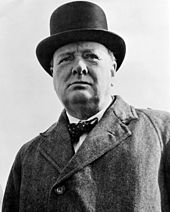
Churchill, thinking of the agreement that his ancestor the Duke of Malborough had formed against Louis XIV, calls “Grand Alliance” the coalition composed of England, the United States and the USSR.
Relations with Italy
Direct negotiation with Hitler was not possible, due to constraints too heavy for England such as their loss of independence or the establishment of a totalitarian government. The United Kingdom and France therefore logically turned at the beginning of the war to Mussolini, a friend and ally of Hitler, in order to obtain an agreement requiring fewer concessions and to “avoid a widening of the conflict and the ruin of Europe” hoping that Italy would be against a “Europe entirely dominated by a victorious Germany”.
Édouard Daladier, the French Minister of Defense, offered to buy Mussolini by addressing his demands, and by ensuring Italy a seat at the planned peace conference. To reach Mussolini, the British considered appealing to the United States, which was more powerful than them, to play the role of intermediary. On May 16, Chamberlain noted in his diary that in the event of a collapse of the French, their only chance of avoiding destruction was Roosevelt.
Churchill also wanted help from the United States, not to negotiate an armistice but to strengthen its position in combat. He doubts whether Mussolini is ready to negotiate by accepting the conditions imposed by Britain but also whether he is trustworthy. He was not prepared to explicitly ask Roosevelt for help as an intermediary with Italy in his letters, and did not inform him of “the unfortunate posture that would be that of Great Britain in the event of the fall of France”. He fears that the United States will judge their case as hopeless and a lost cause, while continuing the resistance would show an honorable image of England and force the United States to help them by its own will.
Relations with the United States
While his predecessor Chamberlain had neglected to interest the United States in the cause of the Allies, Churchill did so in the summer of 1940, and even ten months earlier. As a diplomat, he managed to convince the United States, then neutral in the conflict, and still isolationist: “No lover,” he would say, “has ever looked so much attention into the whims of his mistress as I have done myself into those of Franklin Roosevelt”.
Churchill’s good relations with him facilitated Britain’s access to the supplies it needed (food, oil, and ammunition) through the North Atlantic shipping routes. Also, he was relieved when the American president was re-elected in 1940. Roosevelt immediately implemented a new method for the supply and transportation of military equipment to Britain, without the need for immediate payment: lend-lease. After the attack on Pearl Harbor, Churchill’s first thought, foreseeing the entry of the United States into the war, was: “We have won the war”.
Churchill argued so much for the idea of a special relationship to characterize the relationship between the two countries that it became commonplace, even if in reality things were more complex, the two countries having, for example, divergent visions on decolonization. Churchill, who later wrote a book entitled A History of the English-Speaking Peoples, was also very sensitive to the idea of a community made up of those who spoke the same language.
More generally, he is one of those who work most to adopt the notion of the West, understood as “the home of freedom and democracy invested with the sacred mission of fighting tyranny”. It was with this in mind that he outlined the Atlantic Charter, adopted at a meeting with Roosevelt off Newfoundland on August 12, 1941, that is, before the entry of the United States into the war. The meeting begins with a religious service whose songs Churchill chose, including the Onward, Christians Soldiers.
Relations with the Soviet Union and Poland
When Hitler invaded the Soviet Union, Winston Churchill, a staunch anti-communist, declared: “If Hitler invaded Hell, I would at least say a favorable word for the Devil in the House of Commons,” referring to his policy towards Stalin. Soon, British equipment and tanks were sent, via Arctic convoys, to help the Soviet Union.
The Polish government-in-exile in London and some Poles reproached Churchill for having accepted borders between Poland and the Soviet Union and between Germany and Poland that did not suit them. This annoyed him and he declared in 1944 “we have never committed ourselves to defending the borders of Poland of 1939”, also affirming that Russia “has the right to an impregnable border to the west”. In fact, Churchill sought to avoid mixing populations, as he explained to the House of Commons on December 15, 1944: “Eviction is the method which, as far as we have been able to see, will be the most satisfactory and lasting. There will be no mixing of populations causing endless problems… A reset will be done. I am not alarmed by these transfers, which are more than feasible under modern conditions.
However, the expulsion of Germans was carried out by the Soviet Union from 1940 onwards, in a manner that resulted in much more difficulties and, according to a 1966 report by the West German Ministry of Refugees and Displaced Persons, in the deaths of more than 2.1 million people. Churchill opposed the Soviet invasion of Poland and wrote bitterly about it in his books, but he was unable to prevent it at various conferences.
The Poles also reproached Churchill and the Western world in general for their lukewarm reaction to the Katyń massacre (April-May 1940), where thousands of members of the Polish elite had been executed by the Red Army, which cleared itself by accusing the Nazis. The Prime Minister, informed of the involvement of the Soviets, condemned it in private, but refused to accuse the USSR so as not to threaten the Grand Alliance and prevented an investigation by the Red Cross.
Relations with France
Churchill opposed Marshal Pétain and General Weygand on the idea of an armistice as early as the 11 – June 12, 1940at a meeting in Briare, and again on June 13 in Tours. The Franco-British Union project drawn up by Jean Monnet and Churchill in 1940, which aimed to merge the two countries and their territories, was abandoned on June 16, 1940, following the resignation of Paul Reynaud and the appointment of Marshal Pétain as President of the Council.
Two days later, Churchill authorized General de Gaulle to launch the appeal of 18 June. On June 22, the French government signed the armistice, and the Vichy regime that replaced it became the adversary of the United Kingdom, which supported the Free France, organized in London around de Gaulle. On July 2, 1940, Operation Catapult was launched, aimed at rallying the French fleet or neutralizing it, which created a strong Anglophobic feeling in French opinion (especially after the attack on Mers el-Kébir).
Relations between two men of strong character, with ideas about history, Europe and war quite similar, have had their ups and downs, linked to differences of interest. “De Gaulle may be an honest man, but he has messianic tendencies, he believes he has the people of France behind him, which I doubt”.
In 2000, the archives of the Foreign Office made public a document according to which Churchill and Roosevelt (who saw in the leader of the Free France a future dictator) had for a time wanted to get rid of General de Gaulle politically by offering him the post of governor of Madagascar, in order to put in his place General Henri Giraud, considered more malleable. The project was abandoned when Clement Attlee and Anthony Eden, having heard the news, opposed any action against de Gaulle, arguing that they could not afford to lose the support of the Free French Forces.
If de Gaulle wanted at all costs that France appear victorious at the end of the war, alongside the United States, the United Kingdom and the USSR, his allies did not have the same point of view and deliberately excluded him from the Yalta conference. This strained their relations, especially since Churchill and Roosevelt feared that de Gaulle would eventually decide to ally himself with the Soviets. Nevertheless, Churchill, who understood that the support of another European colonial power was a major asset within the future United Nations Security Council, arranged for France to become its fifth permanent member. Later, after the war, de Gaulle referred to the British Prime Minister as “Great Churchill”.
Relations with India and racist remarks
More than 3 million Bengalis died of starvation during the 1943 famine. Churchill had ordered massive requisitions of food produced in India to supply British troops. According to many historians, Churchill refused to acknowledge the existence of a famine in the country and to provide humanitarian aid.
Many modern Indian and Bengali journalists and historians have accused British Prime Minister Winston Churchill of being indifferent to the misery of Bengal or even of knowingly accepting it. During the famine, Churchill’s only concern was to ensure the proper supply of the British Indian army. The Delhi government had sent a telegram painting a picture of the horrific devastation and the number of people who had died. His only answer was: “Then why isn’t Gandhi dead yet?”. He expressed his contempt for Indians to Leo Amery, Secretary of State for India and Burma, saying, “I hate Indians. They are a bestial people, with a bestial religion.” “Famine or no famine, Indians breed like rabbits”.
Conferences structuring the post-war world
Churchill participated in twelve strategic inter-Allied conferences with Roosevelt, at which Stalin was also occasionally present. Some of them have a profound impact on the post-war world.
The Arcadia Conference, from December 22, 1941, to January 15, 1942, decides on the Germany First strategy and proclaims the United Nations Declaration, which is to lead to the creation of the United Nations. In addition, it was decided to continue the effort on nuclear weapons, a plan for the production of aircraft and tanks, as well as the creation in Washington of a “Combined Joint Chiefs of Staff Committee”. Finally, Churchill and Roosevelt had long conversations concerning the British Empire in general and India in particular.
At the Quebec Conference, from August 17 to 24, 1943, it was decided that the Normandy landings would take place in May 1944. Churchill agreed that it be led by an American, in return for which he obtained that British General Henry Maitland Wilson command in the Mediterranean, and that Louis Mountbatten be promoted to Supreme Allied Commander for Southeast Asia. With U.S. President Franklin D. Roosevelt, he signed a more moderate version of the original Morgenthau Plan, in which they pledged to transform Germany, after the unconditional capitulation, “into a country of an essentially agricultural and pastoral style”.
It was at the Tehran Conference, from late November to early December 1943, that he became aware that the United Kingdom was no more than a small nation. He wrote to Violet Bonham Carter, “I was sitting there with the great Russian bear on my left, and on my right, the big American buffalo. Between the two stood the poor little English bummer”. During this conference in Tehran, with Joseph Stalin and Franklin Delano Roosevelt, the Allied secret services discover Operation Big Leap, a plan to assassinate the participants.
At the Tolstoy Lecture from 9 to October 19, 1944, He slips Stalin an ” ugly little document ” inscribed “1) Romania: 90% USSR, 2) Greece: 90% Great Britain, 3) Yugoslavia: 50%-50%, 4) Hungary: 50% -50%, 5) Bulgaria 90% USSR”, which Stalin approves. Churchill, faithful to the British strategic tradition, was concerned about the fate of Greece where the Special Operations Executive was very active. At the beginning of 1944, the country was, therefore, part of the Western bloc, in which it remained despite the civil war that followed.
At the Yalta conference from 4 to February 11, 1945, Churchill is worried and nervous, because he knows that there are cracks within the Western camp and especially between him, a supporter of realpolitik, and Roosevelt, more idealistic. Nevertheless, Yalta for François Bédarida “only endorses the war card that the belligerents reached in 1945”. Churchill was received with reservations in official British circles, which reproached him for having yielded too much to the Soviets, especially on Poland. He remarked to a friend, Harold Nicolson, that if “the warmongers of the Munich era became supporters of appeasement, it was the former apeasers who became warmongers”.
At the Potsdam Conference of July 17 to August 2, 1945, the proposals for the new borders of Europe and the colonies were officially accepted by Harry S. Truman, the new American president, Churchill and Stalin. Churchill was extremely sympathetic to Truman during his first days in office, calling him “the kind of leader the world needs, when the world needs a leader most”. Churchill was assisted at the beginning of the conference by Clement Attlee, who, after Churchill had been defeated in the general election, represented Britain alone at the time of signing.
Lack of vision for the country’s economic future
Churchill was passionate about matters related to war, geopolitics and diplomacy, and left home affairs to the Conservative John Anderson and Labour. Moreover, like the other political figures in his coalition government, he had neither war economic objectives nor a vision of the post-war economy. For Robert Skidelsky, it was precisely the government’s failure to define an economic vision of the world that precipitated the breakdown of the Conservative-Labour coalition and caused the defeat of the Conservatives, and therefore Churchill, in 1945. During the war, the indifference of the political class and Churchill towards this area left a great deal of latitude to economists who would be able to advance their own projects.
When in 1942 William Beveridge presented his plan on social security, Keynes obtained from the Treasury the constitution of a working group composed of himself, Lionel Robbins and an actuary to ” reprofile” the project so as to make it financially acceptable, but politicians, including Churchill, were little involved in the subject either to criticize or support it. Similarly, the Bretton Woods negotiations were led by Keynes, or rather by the Keynes-Lionel Robbins tandem, without any real involvement of the Prime Minister and more generally of the political staff.
One of the causes of this situation is that Churchill does not have great knowledge, and perhaps not much attraction for economics, especially since he is aware of having made a mistake in the 1920s, when he brought England back to the gold standard. Also, he tends to trust Keynes, with whom he dines regularly at The Other Club. It was Churchill who, in 1942, proposed to the king to raise Keynes to the peerage. In a 1945 radio address during the general election, the Prime Minister gave a speech against the planned economy. Clement Attlee, his Labour opponent, sees the theoretical sources of this intervention in the essay
The Road to Serfdom by the liberal economist Friedrich Hayek. In fact, Hayek and Churchill met only once. Nevertheless, the Conservatives participated in the development of an abridged version of the work – we do not know the real involvement of Churchill in this area – which was published on paper allocated to the Conservative Party for its campaign (England then suffering from shortages, a paper was quotas).
End of the Second World War and resignation
In June 1944, Allied forces landed in Normandy and pushed Nazi forces back into Germany over the next year. For the record, Churchill had planned to attend aboard HMS Belfast the naval bombardment of German batteries on the French coast, on June 6, 1944, and it took two interventions by King George VI to get him to resign.
On March 28, 1945, General Eisenhower informs Stalin that he is stopping his troops on the Elbe, and that therefore the two armies will have to make their junction there. If Stalin and Roosevelt approve of this decision, Churchill is very unhappy, because on the one hand, he has not been officially informed of the decision while a third of the fighting units are British or Canadian, and on the other hand, he disapproves of the decision on the substance believing that the objective is Berlin. Despite his best efforts, Eisenhower’s order was confirmed.
On April 12, 1945, Franklin Delano Roosevelt died, which brought Churchill to tears, but Churchill decided not to attend his funeral. Boris Johnson evokes Churchill’s accumulated grudge against Roosevelt’s overly conciliatory attitude towards Stalin’s claims and the economic vexations suffered by Great Britain at the hands of the United States. François Kersaudy wonders if the Prime Minister has not had illusions about the reality of his relationship with Roosevelt, which he analyzes as being for the American President “an ephemeral marriage of convenience with an antediluvian imperialist”.
On May 7, 1945, at the SHAEF headquarters in Reims, the Allies accepted the surrender of Nazi Germany. On the same day, in a BBC news flash, John Snagge announced that 8 May was Victory in Europe Day. Churchill announced to the nation that Germany had capitulated, and that a definitive ceasefire on all fronts on the continent came into effect one minute after midnight that night. Afterwards, he told a huge crowd in Whitehall: “This is your victory”. The crowd replied, “No, it’s yours,” and Churchill began singing Land of Hope and Glory with the crowd. In the evening, he made another announcement to the nation, stating that Japan’s defeat would materialize in the coming months.
On May 19, 1945, the Labour Party decided to leave the coalition. Churchill called for the dissolution of Parliament and announced that elections would be held on 5 July; The results will not be known until July 26, 1945because of the dispersal of mobilized soldiers. He was therefore able to attend the beginning of the Potsdam Conference, which opened on July 17, 1945; however, he took the precaution of going there with Clement Attlee, the Deputy Prime Minister and his potential successor. The results of the 1945 general election were clear: Labour won 393 seats against 197 for the Conservatives and Churchill, defeated, quickly handed in his resignation to the king.
There are many reasons for her failure: the desire for post-war reform that is spreading among the population, or the fact that they think that the man who led the United Kingdom during the war is not the best advised to lead it in peacetime. Indeed, Churchill is mostly considered a warlord. Moreover, the two Conservative leaders Brendan Bracken and Lord Beaverbrook, whom Clementine Churchill does not like, are not “models of political finesse”. Finally, Churchill, weary, is excessive in his speeches. In any case, when the Japanese surrendered three weeks later, on August 15, 1945, putting a definitive end to the war, he is already no longer in power.
Politics of Winston Churchill after 1945
Leader of the Conservative Opposition
If his wife welcomes the defeat of Winston Churchill, he is rather unhappy. Depressed, he returned to painting during a stay on Lake Como in the autumn of 1945. For six years, he served as Leader of the Official Opposition and paid little attention to domestic politics, preferring world affairs, which he continued to influence. During his March 1946 trip to the United States, he made a speech on the “Iron Curtain”, evoking the USSR and the creation of the Eastern Bloc. He states:
“From Stettin on the Baltic to Trieste on the Adriatic, an iron curtain has descended on the continent. Behind this line are all the capitals of the former states of Central and Eastern Europe. Warsaw, Berlin, Prague, Vienna, Budapest, Belgrade, Bucharest and Sofia; all these famous cities and their populations are now in what I would call the Soviet sphere of influence, and are all subject, in one form or another, not only to Soviet influence but also to the very extensive and in some cases increasing control of Moscow. »
Churchill imprinted on British conservatism a center-right line, called by the British Butskellism, named after ministers Rab Butler, a conservative, and his Labour counterpart Hugh Gaitskell. According to François Bédarida, it is a “symbolic expression of the bipartisan hybrid between center-right and center-left” to which Margaret Thatcher later strongly opposed.
Europe
Churchill was interested in Aristide Briand’s European project from the interwar period. After the Second World War, he was honorary president of the Hague Congress and participated in the establishment of the Council of Europe in 1949. Nevertheless, his vision was not that of Jean Monnet, so he approved that his country did not enter the European Coal and Steel Community, which he considered a Franco-German project.
He elaborated the theory of the three circles: the first circle was constituted by the United Kingdom and the Commonwealth, the second by the English-speaking world around the United States and the third by the United Kingdom and the rest of Europe. He notes that England, which is at the crossroads of the three circles, has a privileged role to play: “We are with Europe, but not part of Europe. We have common interests but we do not want to be absorbed”.
Second term as Prime Minister
Return to government and decline of the British Empire
The 1950 general election significantly reduced the Labour majority in the House of Commons, from 81 majority seats to 3. After the snap general election of 1951, organized by Atlee who sought to widen his room for maneuver, Churchill became Prime Minister again thanks to his alliance with the Liberals. His third government, after the one during the war and the brief government of 1945, lasted until his resignation in 1955.
His national priorities were overshadowed by a series of foreign policy crises, which were partly the result of the already begun movement of the decline of the British army, prestige and imperial power. Being a staunch supporter of Britain as an international power, Churchill often responded to such situations with direct action. For example, he sent British troops to Kenya to deal with the Mau Mau revolt. Trying to preserve what he can from the Empire, he declared: “I will not preside over a dismemberment”. Kenyan populations were forcibly displaced from the fertile highlands to make way for settlers, and more than 150,000 people were held in concentration camps. The British authorities used torture extensively to help crush the rebellion.
War in Malaya
A series of events that became known as the Malay insurgency ensued. In Malaya, a rebellion against British rule has been underway since 1948. Once again, Churchill’s government inherited a crisis, and Churchill chose to use direct military action against opponents. He also tried to build an alliance with those who still supported the British. As the rebellion was slowly defeated, however, it was equally clear that colonial rule by Britain was no longer possible.
Declining health
In June 1953, at the age of 78, he suffered a stroke that paralyzed his left side for a few days while he was at 10 Downing Street. The news is kept secret while officially, the public and Parliament are told that he is suffering from exhaustion. He went to Chartwell where he resided during his period of convalescence, the stroke having impaired his speech and decreased his ability to walk. He returned to politics in October to speak publicly at a Conservative Party conference in Margate.
In the years that followed, however, he had to admit the need to slow down his physical and intellectual activities. He decided to retire in 1955 and was replaced as Prime Minister by Anthony Eden. He nevertheless remained a member of the House of Commons until July 1964, and was “Dean of the House” from October 1959: he was then the sitting Member to have had the longest uninterrupted parliamentary career, since 1924.
Election results
House of Commons
| Election | District | Party | Voice | % | Results | |
|---|---|---|---|---|---|---|
| Partials of 1899 | Oldham | Conservative | 11 477 | 23.6 | Failure | |
| General of 1900 | Oldham | Conservative | 12 931 | 25,3 | Elected | |
| General of 1906 | Manchester North West | Liberal | 5 639 | 56,2 | Elected | |
| 1908 partials | Manchester North West | Liberal | 4 988 | 46,7 | Failure | |
| 1908 partials | Dundee | Liberal | 7 079 | 43,9 | Elected | |
| General Assembly of January 1910 | Dundee | Liberal | 10 747 | 34.1 | Elected | |
| General of December 1910 | Dundee | Liberal | 9 240 | 30.1 | Elected | |
| 1917 partials | Dundee | Liberal | 7 302 | 78,2 | Elected | |
| Generals of 1918 | Dundee | Liberal | 25 788 | 37,5 | Elected | |
| General of 1922 | Dundee | National Liberal | 20 466 | 17.3 | Failure | |
| General of 1924 | Epping | Constitutionalist | 19 843 | 58,9 | Elected | |
| General of 1929 | Epping | Unionist | 23 972 | 48.5 | Elected | |
| General of 1931 | Epping | Conservative | 35 956 | 63,8 | Elected | |
| General of 1935 | Epping | Conservative | 34 849 | 59,0 | Elected | |
| General of 1945 | Woodford | Conservative | 27 688 | 72,5 | Elected | |
| 1950 General | Woodford | Conservative | 37 239 | 59,6 | Elected | |
| General of 1951 | Woodford | Conservative | 40 938 | 63,0 | Elected | |
| General 1955 | Woodford | Conservative | 25 069 | 73,0 | Elected | |
| General 1959 | Woodford | Conservative | 24 815 | 71.2 | Elected | |
Man and posterity
Character
“At times, the spirit of evil takes hold of him, and I consider him a very disobedient little boy, very unbearable and dangerous, a little boy who deserves the whip. Only by thinking of him in this way can I continue to love him. »
— H. G. Wells
Churchill wrote of himself: “it is when I am Joan of Arc that I exalt myself”. William Manchester writes about this: “He was much more an Elijah, an Isaiah: a prophet”. According to the same biographer, an unhappy childhood with parents who were at best indifferent, where only his nanny, Elizabeth Everest, gave him parental love, partly explains Churchill’s chaotic schooling. He writes about it, “As high as he rose, the man who had known, as a child, bullying and beatings always knew how to identify himself with the loser. Deep down, moreover, he was always a loser. He suffered all his life from bouts of depression, sinking into the threatening abysses of melancholy”.
Even if his academic background is average (like that of Franklin Delano Roosevelt), he still has a number of qualities that make him a great politician. Endowed with an excellent memory, he is a speaker who knows how to touch people, makes quick decisions and shows magnanimity in victory. He also has his faults: his sometimes very adventurous projects can go wrong, generating a certain mistrust of the political class towards him. Moreover, he does not always know how to judge men and sometimes lacks “antennae” to understand British society; this patrician side partly explains the eclipses of his career.
Churchill loved parades, banners fluttering in the wind, the sound of the bugle, and lamented that the war had become a matter of “masked chemists and drivers maneuvering the levers of their airplanes, their machine guns”. For him, the war keeps a chivalrous, Arthurian side, “like life for Peter Pan, an immense adventure”.
Politically, his vision of war and peace is totally at odds with that of our time. For Manchester, if ” peace is the norm and war a primitive aberration”, Churchill would think strictly the opposite. Both written and oral, his expression remains profoundly Victorian with expressions such as “I beg you…” or “Let me say”. To Harold Laski, who reproaches him for being a “chivalrous and romantic vestige of eighteenth-century British imperialism”, he replies, “I like to live in the past. I don’t have the impression that the future holds much pleasure for men”.
He likes to dress up, appear, put on a show, and has more hats than his wife. He went to Parliament or Buckingham Palace only in a frock coat.
He loves champagne, cognac and other drinks as well as good food. In the summer, he likes to be invited to villas on the French Riviera (in the interwar period he goes to Maxine Elliott, and to his wealthy cousin by marriage Consuelo Vanderbilt, divorced in 1921 from his cousin Charles Spencer Churchill, 9th Duke of Malborough), or to Biarritz. But he was not interested in dancing or the games of love, and refused or did not see the advances sometimes made to him by women – including Daisy Fellowes.
Financially ” he is a born loser-speculator” and in everyday life at Chartwell, he has the worst difficulties balancing and managing his accounts. In 1938, following a fall in the stock market on Wall Street, he experienced serious financial problems that forced him to consider selling Chartwell; Finally, he managed to find a solution thanks to a loan from Henry Strakosch.
In the literary field, he has a preference for English authors; when it comes to music, he likes popular songs like Ta-ra-ra-boom-der-ay or Hang Out the Washing on the Siegfried Line. In terms of cinema, he has a preference for melodramas, during which he cries a lot. He has seen at least twenty times his favorite film, Lady Hamilton, with Laurence Olivier as Admiral Nelson and Vivien Leigh as Lady Hamilton.
A secondary aspect of Churchill’s personality is his artistic temperament, he is a good painter and a talented writer.
About the “black dog “: great Churchillian evil
Churchill, like his ancestor Marlborough, suffered lifelong bouts of depression. This was, from the years of youth to the last days, a central element of his behavior, although he managed most of the time to camouflage this disease. Plausibly cyclothymic in nature, he went from time to time through phases of despondency, real anxiety attacks that plunged him into a state of misery and discouragement. He himself was so aware of this pathological handicap that he had given this companion of bad days this name of a black dog — “black dog“, an expression dating back at least to the eighteenth-century author Samuel Johnson.
Churchill knows lucidly that idleness leaves the door open to morbid exits of this “black dog”. If, during the first part of his life, he somehow managed to keep him on a leash, he would have suffered from his first episode of depression in 1910 at the age of 35, as suggested by a letter from Churchill that Clementine received in July 1911. Later, the dam broke when he retired from the political scene at the age of eighty-one.
This black dog can be linked to traumatic events from the outside world, such as his dismissal from the Admiralty after the Dardanelles disaster during the Great War, or his rejection by the electorate in July 1945. It is also known that in these two cases, the healing, admittedly slow and painful and never complete or definitive, will be done through painting. On the other hand, given the symptoms of this ailment that Churchill was increasingly experiencing, it could be nothing less than purely associated with such extrinsic causes, which fits the classic profile of unipolar major depression or bipolar.
Experts from the American Psychiatric Association relied on the classification of one of their major work instruments, the DSM-IV-TR manual, to diagnose Churchill as a “persistent depressive disorder” that falls into category 300.4, “dysthymia” — due in large part to a state of permanent sadness, low self-esteem. lack of hope, feelings of guilt, suicidal thoughts to name a few.
Dr. Anthony Storr, who devoted an extensive study of the Churchill case, saw in this depressive nature the source of both the insatiable ambition and hyperactivity of his subject. In fact, at the starting point, there is the psychological trauma dating back to early childhood and caused by the lack of affection and the feeling of dereliction that little Winston suffered deeply and early. In compensation for this lack of love, the young man developed a fierce will to succeed, in order to demonstrate, by exploits both in his own eyes and in the eyes of others, his abilities and talents.
Many clinicians who knew or examined Churchill agreed that he probably had a cyclothymic personality — a term now reintroduced since the late 1970s — that would, as many claim, be biologically and genetically related to bipolar disorder.
In recent years, a new debate on Churchill’s mental health problems has been launched by charities devoted to bipolar problems. For them, there is no doubt that Winston suffered from bipolar disorder. In 2006, Rethink Mental Illness, a mental health charity, defended a statue it had erected in Norwich, exposing a Churchill in a straightjacket, which immediately triggered a public outcry. People were violently outraged that one could have had this affront to dare to establish such a bad link between the Grand Old Man and bipolarity. The director of the institution, through his spokesman, apologized but admitted that he was trying to project an image of a more dignified nature to people with mental disorders, including Churchill.
Winston Churchill’s theory of cyclothymia — linked to bipolarity — remains uncertain. For A. W. Beasley, an orthopedic surgeon specializing in medical history, this is a myth largely inspired by Lord Moran. The still open debate, which takes place mainly between traditional Churchillians, who sometimes speak of seasonal affective disorder, the Mediterranean sun being its best remedy, ADHD or anxiety disorders and bipolar disorder, concerns a diagnosis that could never be definitively decided.
In a book published in 2020, two eminent British medical professors, Allister Vale and John Scadding, believe that Churchill’s depressive aspect was deliberately exaggerated, often by sensationalism.
Amateur painter
Churchill began painting after his resignation as First Lord of the Admiralty in 1915 in order to overcome his depression. Being at the home of her sister-in-law Gwendeline who was doing watercolor and having observed her, she proposed to him to try. He devoted himself to it before preferring oil painting.
A friend of renowned painters, he was guided and influenced by John Lavery, Walter Sickert – who advised him to use photographs as a memory aid – William Nicholson, and his “artistic mentor” the Anglophile Le Havre painter Paul Maze, whom he met at the front in 1916, and with whom he would paint the surroundings of Saint-Georges-Motel. The style of the new painter is Post-Impressionist, and his themes are English landscapes, but also scenes from the Flanders front; subsequently, he also painted the Côte d’Azur.
Invited by his admirer the Duke of Westminster to “Woolsack”, his hunting lodge in Mimizan (Landes), where he had a bathtub installed to his measure, Churchill painted seven paintings, including The Light and the Landes landscapes, the pines leaning over the water.
In 1921 he exhibited at the Druet Gallery, 20 rue Royale in Paris, under the pseudonym Charles Morin, and sold six paintings. The same year, he wrote a small book, Painting as a Pastime; He then adopted the pseudonym Charles Winter and became friends with Paul Maze, whose war memoirs he prefaced in 1934 and became his friend.
According to William Rees-Mogg, if “in his own life he had to suffer the ‘black dog’ of depression, in his landscapes and still lifes there is no sign of depression”.
He is best known for his impressionist landscape scenes, many of which were painted during his holidays in southern France, particularly at the villa “La Pausa” at the home of his friends Reves, at the home of his friend the Duke of Westminster at Woolsack Castle, on the shores of Lake Aureilhan, or in Morocco, where he painted his only work of the war The Minaret of the Koutoubia (1943), which he offered to Roosevelt.
Churchill is estimated to have painted 537 canvases during his lifetime a few months after his death (1965), some appeared in the first so-called transatlantic sale using the Early Bird satellite, organized by Sotheby’s, where some “reached unprecedented heights… £14,000”.
A collection of paintings and memorabilia is kept in the Reves collection at the Dallas Museum of Art. Other works, including Churchill’s beloved Champagne and Cognac Bottle Landscape of Bottles, are on display in his Chartwell home, which he depicted under the snow and where he painted The Goldfish Basin in 1932.
In 2014, Sotheby’s sold in London some of the paintings inherited by his daughter, Mary Soames. He is a middle-level amateur. His historical personality explains the incredible values sometimes reached by his works at public auction. The Goldfish Basin at Chartwell was sold for £ 1.8 million (€2.2 million ) in 2014.
On March 1, 2021, the painting in St. Paul’s Cathedral, London (St. Paul’s Churchyard) painted in 1927 and the painting of the minaret of the Koutoubia Mosque painted in 1943 are auctioned at Christie’s London. The painting of Marrakech, the only one of this series painted in the middle of the war in January 1943 and offered to Roosevelt with whom he was there, then passed into the collection of Brad Pitt and Angelina Jolie, reaches the record sum of £8,285,000.
Churchill: a writer and speaker
Writer
Despite his fame and social origins, Churchill still struggled to meet his expenses and creditors. Until the Parliament Act of 1911, deputies performed their duties free of charge. From that date to 1946, they received a symbolic salary. As a result, many of them have to work in a profession to make a living. From his first book, The Story of the Malakand Field Force (1898), to his second term as prime minister, Churchill’s income was almost entirely provided by writing books and columns for newspapers and magazines. In the 1930s, Churchill derived most of his income from the biography of his ancestor the Duke of Malborough. The most famous of his articles was that published in the Evening Standard in 1936, warning of Hitler’s rise to power and the danger of appeasement.
Churchill wrote his first book on his own, but from Le Monde en crise he dictated the next books to secretaries and, for documentation, he employed research assistants from the University of Oxford. Edward Marsh, his chief of staff, proofread the manuscripts, correcting spelling and punctuation. As a rule, Churchill worked in the morning in his bed where he matured a text that he dictated late at night. To date, he is the only former Prime Minister to receive, in 1953, the Nobel Prize in Literature “for his mastery of historical and biographical description as well as for his brilliant speeches in defense of human values”.
One can easily imagine the surprise that such news can arouse him, especially when one recalls the scathing reproach that his father, Randolph, wrote to him six decades earlier: “I will send you back your letter, that you may from time to time review your pedantic style of retarded schoolboy”. When his prize was awarded, Winston was disillusioned – he cherished the hope of receiving the Nobel Peace Prize. In this award, only money seems to interest the winner: “£ 12,100 tax-free. Not so bad!” he wrote on October 16, 1953, the day after the announcement, to Clementine.
Among his most famous works that have contributed to his international fame are:
- The six volumes of memories, The Second World War, 1948-1954.
- The four volumes of a historical work, A History of the English-Speaking Peoples, 1956-1958, which cover the period from Caesar’s invasion of Britain (55 BC). at the beginning of the First World War (1914).
In the very last years of his life, he regretted not having written the biographies of Julius Caesar and Napoleon Bonaparte.
Speaker
Originally, Churchill was not a speaker and even had speech difficulties. His speeches are not improvised, a forty-minute speech requires between six and eight hours of preparation. For F. E. Smith, “Winston Churchill spent the best years of his life writing improvised speeches.” Similarly, for others, his good words are sometimes worked, sometimes spontaneous – but in these cases the audience often feels them coming because then “his own laughter originated somewhere on the side of his feet”. Of Clement Attlee, his Labour opponent who does not hate his pikes, he once said that he was a “sheep disguised as a sheep”.
If Churchill becomes a great orator, despite everything, he remains better in the monologue than in the exchange. Lord Balfour once remarked: “The artillery of the Right Honourable Gentleman is strong and powerful, but it seems to me hardly mobile”. In general, his speeches begin on a slow and doubtful tempo before giving “free rein, to the essence of his prose: a bold, heavy, stormy, resounding, flowing, interrupted by throbbing and brilliant cadences”.
Churchill likes neither euphemism nor technocratic language. For example, he is opposed to replacing “poor” with “economically weak”, or “household” with “housing unit”. For him, words, as he once said to Violet Bonham-Carter, the daughter of Herbert Henry Asquith, have magic and music of their own. For him, the sound of the word is an important element in the choice of terms used. He likes short words that hit hard and often align adjectives by four with preferences for “unflinching (unshakeable), austere (austere), dark (dark), and squalid (sordid)”. This rhythm is reflected in these statements: “In war: resolution. In defeat: defiance. In victory: magnanimity. In peace: goodwill”.
His rhetoric is sometimes challenged. For Robert Menzies, Prime Minister of Australia at the beginning of the Second World War, “his dominant thinking is the possibility, so attractive to him, that the inconvenient facts disappear on their own”.
Final days and funeral
After leaving the post of Prime Minister, Churchill spent less time in Parliament. He lived his retirement in Chartwell and at his London home at 28 Hyde Park Gate, southwest of Kensington Gardens.
When his mental state and physical faculties deteriorated, he fell into depression.
In 1963, U.S. President John F. Kennedy, acting under authorization granted by an act of Congress, proclaimed him an honorary citizen of the United States, but he was unable to attend the ceremony at the White House.
On January 15, 1965, Churchill suffered another stroke, which was fatal: he died at his home nine days later, at the age of 90, on the morning of January 24, 1965, 70 years to the day after his father’s death.
By decree of the Queen, a state funeral is organized. This is the first state funeral for a non-sovereign figure since those of the Duke of Wellington, Arthur Wellesley of Wellington in 1852. His coffin was laid to rest for three days and three nights at Westminster Hall, where a veritable human stream came to pay tribute to him. Then on January 30, 1965, in a procession on foot composed of different units of the British Army, the coffin resting on a gun carriage fired by Royal Navy sailors was brought to St. Paul’s Cathedral in London. The funeral broke the record for the largest gathering of heads of state in the world, until 2005 at the funeral of Pope John Paul II. 112 leaders are present or represented at the funeral; China is conspicuous by its absence.
After the religious service, the procession heads to the Tower of London where the coffin is mounted on the speedboat MS Havengore which goes up the Thames to London-Waterloo station where it is loaded onto a specially prepared and painted wagon, the Southern Railway Van S2464S, as part of the funeral procession for its journey by rail to Bladon. The Royal Artillery fired nineteen cannon shots, as usual for a head of government, and the RAF staged a flypast of sixteen English Electric Lightning fighter jets. The Pullman car carrying his grieving family was towed by the “Winston Churchill”, a Pacific SR Battle of Britain locomotive No 34051 — the locomotive restored on the 50th anniversary of the ceremony, is currently on display at the National Railway Museum in York.
From the window of the moving wagon, one of Churchill’s oldest assistants sees a man dressed in an old RAF uniform: standing on the roof of a small house, he gives the military salute. In the fields along the railway tracks and at stations encountered along the way, thousands of people stand in silence to pay their last respects. The anthem at the funeral is The Battle Hymn of the Republic.
At his request, Churchill was buried in the family plot of the cemetery of St Martin’s Church in Bladon on which Blenheim Palace, his birthplace, depends.
Posterity
Churchill College
Following the model of MIT, Churchill College was founded by Churchill in Cambridge in 1960.
The Winston Churchill Memorial Trust
When Churchill was 88, the Duke of Edinburgh asked him how he would like to be remembered. Churchill replied: with a scholarship like the Rhodes Scholarship, but for a larger group of individuals. After his death, the Winston Churchill Memorial Trust was established in the United Kingdom and Australia. A Churchill Memorial Day Trust is held in Australia, raising A$4.3 million. Since that time, the Churchill Trust in Australia has supported over 3,000 scholarship recipients in a variety of fields, where merit (either based on experience or potential) and propensity to contribute to the community have been the only criteria. In addition, the “Winston-Churchill International Lyceum of London” opened its doors on January 23, 2015. The high school was built above Winston Churchill’s bunker during World War II.
Tributes in France
On November 11, 1998, a statue of Winston Churchill, made by Jean Cardot, is inaugurated in the presence of the Queen of the United Kingdom, Elizabeth II, the President of the French Republic, Jacques Chirac, and the Mayor of Paris, Jean Tiberi. This statue is located on the sidewalk of Winston-Churchill Avenue.
In June 2017, two bronze statues of Churchill and De Gaulle were installed at the entrance to Calais Richelieu Park in the presence of French and English officials, and Churchill’s grandson.
Film and television
Fictions
The character of Churchill appears in many films and television series. In particular, his character has played:
|
|
It should be noted that among these actors, Richard Burton violently criticized, at the release of the film, the character, questioning his mental health as a man of war by his exterminating remarks against the Germans and Japanese. Similarly, in 2020 the revelations about his racist remarks against colonial peoples provoked acts of vandalization of the statues of the character in Great Britain.
Annexes
Honors
Churchill received many decorations during his lifetime. Its official title is (on the Anglo-Saxon model): Sir Winston Churchill KG, OM, CH, TD, FRS, CP (RU), CP (Can), DL, Hon. RA. He is also a Nobel Prize in Literature and the first honorary citizen of the United States, and has received numerous other awards and honors, including the International Charlemagne Prize in 1955. He was made a Companion of the Liberation in 1958 by General de Gaulle. In a 2002 BBC poll, based on about one million viewers’ votes, 100 Greatest Britons, he was proclaimed “the greatest of them all”. He was also a hereditary member of the Society of the Cincinnati.
References (sources)
|