
Baseball is a team sport derived from the same roots as cricket, which is played on a grass and sand field. It is played with bats to hit a thrown ball, and gloves to catch the ball. The origins of baseball are controversial, but it is indisputable that the first modern rules (the “Knickerbocker Rules“) were codified in the United States in 1845. The game’s European roots, long neglected by U.S. authorities in order to make baseball a distinctly American sport, have long been known to American sports historians. The recent highlighting of a description of a match played in 1755 in Surrey (England) goes in this direction.
| International Federation | WBSC |
|---|---|
| Practicing players | approximately 45,000,000 |
| Reigning World Champions | United States ( Men) Japan (Women) |
 |
|
It is in the United States, however, that this sport is organized and structured. The first championships were created in 1857-1858, professionalism was allowed from 1869 and the National League was created in 1876. Thirty franchises, one of them based in Toronto, Canada, play at the highest level, in Major League Baseball. Since 1903, the World Series has been held in October between the winners of the two leagues that make up MLB.
Managed worldwide by the World Baseball and Softball Confederation (WBSC), this summer sport generally played from spring to autumn is very popular in North America, in some countries of Central America (Nicaragua and Panama), South America (Colombia and Venezuela), the West Indies (Cuba, Dominican Republic, Puerto Rico) and Asia (Japan, South Korea, Taiwan).
Baseball History
Genesis of baseball
The English game of rounders appears as one of the ancestors of baseball. The first reference to rounders is made in an English book by John Newbery in 1744: A Little Pretty Pocket-Book. Another game at the origin of baseball is “The poisoned ball”: consisting of four bases, one of which is called “house”, a pitcher, a batsman and teams of ten or twelve players.
The term “baseball” (or “baseball”, as it was written until the 1920s) was already used in England in the eighteenth century, then entered the language, literature and press in the United States during the 1820s. The first appearance in the press dates back to April 25, 1823, in New York. The term encompasses several games such as rounders, town ball and round ball. These games are practiced in the northeast of the United States (New York, Boston and Philadelphia) but also in the center of the country (Illinois, Ohio and Indiana mainly). However, it was the neighborhoods of Manhattan and Brooklyn that were home to New York teams such as the New York Knickerbockers, giving birth to the first modern version of the game of baseball.
In 1845, the first modern rules (the “Knickerbocker Rules“) were codified by Alexander Cartwright by adapting those of rounders and town ball. They were adopted on September 23, 1845. According to the research of historian Charles A. Peverelly, the Knickerbockers probably began playing formally as early as 1842. Thus, the New York Baseball Club celebrated its second anniversary on November 11, 1845, while a Brooklyn club played at Elysean Field in 1845.
A legend is built from scratch in the early twentieth century making Abner Doubleday the inventor of baseball in 1839 in Cooperstown. A celebration of the centenary of this event was even held in 1939. This legend is refuted as soon as it is published by many connoisseurs of the game such as Will Irvin who publishes an article on this theme in 1909 in the magazine Collier’s. Joe Williams wrote an article in the New York World-Telegram on June 13, 1936 entitled The Myth of Doubleday. Robert W. Henderson published in 1939 works on the links between baseball and rounders and in 1947, Ball, Bat and Bishop which invalidated the conclusions of the Mills Commission (1908) at the origin of this legend. On June 3, 1953, the United States Congress officially credits Alexander Cartwright with the invention of sport because of his instrumental role in codifying the modern game.
Baseball in the United States
In the current state of research, it is impossible to determine precisely the holding of the first match. By convention, the June 19, 1846 game played in Hoboken, New Jersey, served as the first game.
The first club convention was held in New York City in January 1857 with a dozen clubs in Brooklyn and New York. An unofficial championship is set up. It was won by the Brooklyn Atlantics. In March 1858, the National Association of Base Ball Players (NABBP) was formed in New York City by sixteen clubs still from Brooklyn and New York. Until the American Civil War, dozens of New York Game clubs were set up across the United States and adopted the Knickerbocker’s rules. At the end of the war, the sport reached the whole country when soldiers returned home. They were introduced to the game by the New Yorkers of their regiments.
The first vocational training was established in 1869 (Cincinnati Red Stockings) following the authorization of professional status by the NABBP on December 9, 1868. The first major league was formed in 1871 by former NABBP clubs; it is renamed the National Association of Professional BaseBall Players (NAPBBP). The current National League was founded in 1876 and the American League became a major league in 1901. The World Series between the champions of these two leagues was created in 1903.
This American national sport (“national pastime”) experienced a resounding scandal in 1919, that of the Black Sox involving several players of the Chicago White Sox for corruption during the World Series. Judge Kenesaw Mountain Landis is appointed commissioner of major leagues; He remained in office from 1920 to 1944, imposing an iron discipline on the baseball world, but strengthening the power of the owners over the players. The first players’ unions were formed as early as 1885, but it was not until 1966 and the creation of the MLBPA that players made significant progress. Disputes with strikes in 1971, 1982 and 1994 marked the heated relationship between players and owners over their transfer options and the setting of a minimum wage, among other things. The most important strike was that of 1994-1995 which resulted in the cancellation of 938 games and all playoff games and even the 1994 World Series.
Among the most famous players of the years 1870-1945 are Cy Young, Christy Mathewson, Honus Wagner, Walter Johnson, Ty Cobb, Babe Ruth, Lou Gehrig and Joe DiMaggio, among others. These major league stars were all white players because black players were banned from playing in the major leagues in the late 1880s. This agreement between franchise owners was upheld in 1896 by the U.S. Supreme Court (Plessy v. Ferguson). Black players like Satchel Paige then evolved in the “Negro Leagues“, a strong symbol of American segregationist policy.
This situation lasted until 1947 with the arrival of Jackie Robinson to the Brooklyn Dodgers. Robinson was recruited by Dodgers general manager Branch Rickey and made his Major League debut on April 15, 1947. Victim of numerous racist attacks, Robinson stood firm and paved the way for black players in Major League Baseball (MLB). Since 2000, April 15 has been celebrated by MLB as “Jackie Robinson Day“, while his number 42 was retired in 1997 in all MLB franchises.
Since Robinson’s debut, the main players have been Stan Musial, Mickey Mantle, Sandy Koufax, Yogi Berra, Warren Spahn, Hank Aaron, Pete Rose, Cal Ripken, Jr. and Ted Williams. Today, Roger Clemens, Alex Rodriguez and Barry Bonds are among the most famous players. Inaugurated in 1936, the Baseball Hall of Fame honors the memory of the leading players, coaches, umpires, owners and executives of the major leagues, including Negro Leagues. After the election of Andre Dawson on January 6, 2010, 292 personalities were listed, including 239 players (including 35 from the Negro Leagues), 18 coaches, 9 referees and 26 pioneers and managers.
The first reference to the phrase National Pastime dates back to 1889. As a popular sport, American football has competed with baseball for half a century. The switch seems to have taken place in the mid-1960s. In 1965, a poll still gave baseball a clear advantage over American football by 38% to 25% (45% – 23% in 1964). In 1967, American football took the lead for the first time by 39% to 29%. Baseball reached its lowest point in 1975.
That season, the tight final between the Boston Red Sox and the Cincinnati Reds fascinated viewers, reviving public interest in a discipline that had suffered for ten years from a sports image of the past. Since then, attendance has clearly risen to historic records at the beginning of the twenty-first century. In 2007, 79,502,524 spectators attended MLB’s 2,425 regular season games, a record average per game of 32,785 and a 4.5% increase over the record-breaking 2006 season.
In addition, 42,812,812 spectators filled the stands of minor league stadiums in 2007. It is also a record for the Minors. A year of economic crisis, 2009 was marked by a slight drop in attendance. With 73,418,479 spectators in the Major League regular season, the 2009 vintage ranks fifth in MLB history. In 2010, professional American football continued to lead the favorite sports of Americans (31%), ahead of baseball (17%), college football (12%), motorsports (7%), men’s professional basketball (6%), ice hockey (5%), college basketball (4%) and men’s football (4%).
International Baseball
The export of baseball began in the late nineteenth century. In 1864, Cuba saw the first traces of baseball. It was not until 1868 that the first club was created and 1878 for the first championship. Baseball then appeared in the Dominican Republic in 1868, Japan in 1872 (first team founded in 1878 and first national championship in 1920), Mexico in 1877, Panama in 1882, Nicaragua in 1888 (first professional championship in 1956), in Venezuela and Taiwan in 1895 (first professional championship in 1990), in Korea in 1905 (first professional championship in 1982), in the Netherlands in the 1900s (federation founded in 1912 and first championship in 1922). Baseball has the status of national sport in Cuba, Taiwan, Nicaragua, Panama, Puerto Rico or the Dominican Republic among others. In South Korea and Japan, football became a strong competitor.
In Canada, an American-Canadian professional league was in place as early as 1886: the International League, which resulted from the merger of the New York State League, founded in 1885, and the Ontario League, also created in 1885. The International Association had already experimented with the concept of an American-Canadian league in 1877, but the experiment stopped after two seasons. It was not until 1969 that the first Canadian major league franchise was created: the Montreal Expos, transferred in 2005 to Washington. The Toronto Blue Jays, created in 1977, remain the only Canadian MLB team. In the minor leagues, a few Canadian representatives are still present, but many of the leagues that were once American-Canadian become exclusively American. In the Triple-A, the elite minor league, the Pacific Coast League parted ways with its last Canadian franchise in 2002; ditto for the International League in the fall of 2007.
The first baseball game played on French soil took place on March 8, 1889, on the occasion of the Universal Exhibition as part of the Spalding World Tour. It was a game between a selection of National League players and the Chicago White Stockings. Clubs and competitions were founded in Paris before the First World War. The federation was founded in 1924 and the France Championship was established in 1926.
The International Baseball Federation was established in 1938 and recognizes 112 national federations. It organizes the Baseball World Cup. Baseball was an Olympic sport from 1992 to 2008 but lost this status after the Beijing Games. In August 2016, the IOC agreed to add baseball/softball to the program of the 2020 Games.
For half a century, Cuban baseball has lived, like the country under the US embargo, in quasi-autarky. Some Cuban players manage to leave the island, sometimes in an incredible way. The best of them join the Major Leagues. The latest case to date, Aroldis Chapman, a young Cuban pitcher who is making himself beautiful on July 1, 2009, on the occasion of a trip of the national team to the Netherlands. He signed a six-year, $30 million contract with the Cincinnati Reds six months later. These defections do not facilitate the already stormy relations between Cuba and the United States. The common passion for baseball remains a source of positive diplomacy, as confirmed by the declassified American archives, with the establishment of baseball diplomacy in 1975 to warm relations between the two countries. “Beisbol Diplomacy” is also used in Nicaragua, in particular.
Rules of Baseball
Principles of the game
A baseball game is played with two teams alternating in defense and offense. The nine players of one team successively switch to the bat (batsmen) in a precise order (the line-up) and constitute the attack, the nine players of the other team are on the field in defense: a pitcher, a catcher and seven other players (four in the infield: first base, second base, shortstop, third base, and three in the outfield: right field, center field, and left field) spread across the field to catch the ball, and try to eliminate the batsman and any runners present on the course that connects the marble to the bases.
A game is played in nine rounds consisting of two half-innings. A half-inning ended when three batters/runners were eliminated. One inning ends when both teams have switched to offense and defense. In the event of a tie after nine rounds, other innings are played to decide between the two teams. By tradition, the team that receives begins by defending.
The goal of the batsman is to become a runner, most often by hitting a sure hit. A runner aims to touch all the bases in order, first base, second base, third base and finally to touch the marble which earns a point to his team. A runner who is forced to join a more advanced base is said to be “forced”: it is enough to eliminate him that a defender controlling the ball touches the base on which he is forced to go to eliminate it: the batsman is thus always “forced” in first base. A batter whose hit ball is caught by the defense is eliminated and any runners are further “forced” to return to the base where they were during the pitch.
An unforced runner may be eliminated if, while not in contact with a base, he is hit by a defender controlling the ball, either by means of the ball or the hand of the defender controlling it. A runner who touches the first base has the right to return safely on it as long as he does not try to go to second base, however, the runner must imperatively stay in contact with the second and third bases if he does not want to risk elimination, hence the practice of diving, Head or feet forward, in order to increase the contact surface with the base. A runner, usually fast, can also attempt a basic flight. The presence of runners on base allows the defense to perform a double game, or even a triple game, that is to say, eliminate on the same action several opponents.
A batter who sends the ball beyond the limits of the territory of the right balls is allowed, without risk, to run on all bases in order and return to the marble to score a run: it is a home run. Any runners present on the base are “forced” without risk to touch in order the bases remaining to be covered, also scoring a point called grand slam when the bases are full (4 points in all: 3 for the runners and one for the batsman who arrives last).
The pitcher, who is the first defenseman, aims to eliminate the batsmen/runners generally by obtaining from the umpire three judgments of catch (in English “strike”) by serving various throws to the batsman: fast, slippery, curved, deviant, etc. If the pitcher makes three good pitches (catch), the batter is eliminated unless otherwise ruled. The pitcher aims for the catching zone, a virtual volume running from under the batter’s kneecap halfway between the tops of his shoulders and his belt in height. The marble defines the base of the volume of the area.
When the throw has crossed the batting zone, it is judged by the referee. A throw that touches the volume of the grip area is considered a “strike”. A throw outside the catching zone is considered a “ball”. If the pitcher accumulates four “ball” judgments against the same batsman, the latter is forced to safely reach first base: it is a goal-on-balls. The batsman who, in the referee’s opinion, attempted to hit the ball transforms a “ball” judgment into a “catch”, even if the ball does not touch the catching area.
The effort produced by the pitchers is considerable at the level of the shoulder and the pitching arm, requiring several days of rest between two games. Because schedules provide for daily cadences, a team has several (usually four to five) starting pitchers, those who start games. Relief pitchers are those who are called upon, sometimes daily, to finish games. On some occasions, the same pitcher may start and finish the game; This is called a complete match. This is particularly the case for some exceptional matches, such as perfect matches in which no batsman manages to reach first base.
Referees
In baseball, the umpire is the person responsible for following the rules during games. In matches of the 1850s, a single referee positioned next to first base directed the game. This method was abandoned in 1858. Two referees, one at first base and the other in marble, were sometimes used from 1887 to 1912 when the National League finally adopted this provision. A third arbitrator was introduced in 1933 and a fourth in 1952. In the World Series, two umpires were responsible for the game until 1908. A third arbitrator appeared in 1909 and a fourth in 1910. Six referees were on the field during the World Series from 1947 after an abortive attempt in 1925.
In matches where more than one referee officiates, the chief referee is the one who officiates behind the marble. However, all referees have the same powers for compliance with the rules of the game as for discipline.
The referee officiating behind the marble is responsible for monitoring the substitutions. He is in charge of catches and balls as well as games that take place in marble. A gesture of the right arm (see illustration opposite) indicates a grip (strike). If the referee remains without reaction, it is a ball. The marble referee also manages the balls. He must ensure after each contact that the ball is in good condition. If the latter is damaged, the referee takes out of his bag a new ball.
The other referees are on base, in first, second and third base. Those along the lines (1st and 3rd bases) judge the balls off-field and also check that the batsman has not crossed the marble. The main signs used by these referees are the indication of a runner except (arms spread) or withdrawn (same gesture as the referee placed on the marble to signify the balls in the grip zone: a gesture of the right arm elbow bent).
In the playoffs, MLB uses a six-umpire system. The two additional umpires are located on each of the lines delineating the territory of the good balls and false balls and are responsible for judging the catches, as well as the right balls – false balls in the outfield.
MLB umpires are professional. They received $5 per game during the 1870s. Not hesitating to go on strike (1968, 1970, 1978, 1979, 1984, 1987, 1991, 1994-95, crisis of 1999-2002) in order to protect their interests, MLB referees received in 1995 an annual minimum salary of $ 100,000 with a ceiling of $ 282,500.
As in many other disciplines, the referee is the target of much criticism. Electronic refereeing, in particular, to control the catch zone, is used for the training of referees and by some television channels but has no official value. The system was used for a time to evaluate referees, but the refusal of referees to validate this evaluation system caused it to be quickly abandoned. On September 3, 2008, in Tampa Bay during a game between the Rays and the New York Yankees, referees used for the first time the slow motion broadcast on the stadium screens to reverse a decision.
An official marker mainly deals with judging errors, sure shots, optional, etc. Baseball is notorious for its many statistics.
Equipment and outfit
The ball has a circumference of about 23 cm (23.5 cm maximum) and weighs about 140 grams. It consists of a rubber core wrapped in four strings of different sections (the fourth outer layer is made of a very thin string) and these 4 strings are successively wrapped like a ball of wool around the rubber core and this in a very tight way so as to make the ball compact, Hard and resistant to impact when in contact with the bat during a strike, impact whose force is around 400 to 600 kilograms at the point of contact, depending on the speed of the throw and the power of the marble drummer. The whole is covered with two full-grain leather straps dyed white that interlock against each other and sewn with a red thread (108 seams). The method of making the baseball is also cast in the rules.
The bat (or stick) measures a maximum of 1.07 m in length for a maximum diameter of 7 cm. It can be made of solid wood, most often maple or ash, or hollow metal alloy for younger categories. Its weight is variable. For adult players (seniors) the rules make it mandatory to use a bat with a ratio of -3, for example: for a bat with a length of 33 inches, the weight must be at least 30 Oz, so as to sufficiently weigh down the bat according to its size which is related to the height of the player, This prevents powerful hitters from hitting home runs too easily and thus bringing play back to defense. In addition, the only bats allowed in seniors are all wooden (or possibly composite) metal bats are prohibited (too powerful).
The ball-receiving gloves worn by defensive players vary depending on the position occupied. The first gloves were used in 1875. The exact origin of the baseball glove, however, remains unclear. Albert Spalding reports that the first glove he saw used in games was worn in 1875 by Boston first baseman Charles C. Waite.
Batsmen and catchers wear helmets to protect them from violent ball throws to the head. The receiver’s helmet is the most complete and includes a facial grille. The first receiver’s mask appeared in May 1876. Visibility being reduced with this helmet, a receiver who must make a throw toward a teammate to eliminate an opponent removes his helmet with a very quick gesture before throwing the ball again. Batsmen wear a helmet without a face grid but designed to protect the temple facing the pitcher.
Helmets for new batsmen have been mandatory since 1971 in MLB. The last batsman without helmets in MLB was Bob Montgomery in 1979. The other players wear caps: famous Baseball caps. The latter were drawn as early as 1860. They were first made of flannel, then took the form of a Camembert box in the 1870s. The first modern caps appear in the early twentieth century. The visor remained quite short until the 1930s, then lengthened.
Baseball players wear three-quarter pants. Once rather ample, they are now worn close to the body. The so-called traditional jerseys are shirts with buttons. However, many teams, even in MLB, also wear jerseys without buttons. The two traditional colors of the outfits are white and gray but the colors gradually enter the mores. In Major League Leagues, the Oakland Athletics were allowed in 1963 to wear colorful uniforms.
In addition to the helmet with mask, receivers wear over their jersey a breastplate protecting their bust. This equipment was introduced in 1886. Before this date, a slight protection of the bust is worn under the Jersey.
-

Baseball glove -

Receiver protections -
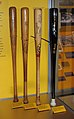
Baseball bats -
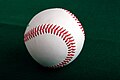
Ball of baseball


Baseball statistics
Baseball has been generating statistics on all gaming events since the late nineteenth century. The journalist Henry Chadwick was instrumental in collecting and disseminating the first statistics. In 1951, Hy Turkin published The Complete Encyclopedia of Baseball, compiling data that had hitherto been inaccessible to fans. In 1969, MacMillan Publishing published its first Baseball Encyclopedia, the first compilation of statistics using computer tools. The Major Leagues have kept official statistics since the beginning of the twentieth century: 1903 for the National League and 1905 for the American League. These official data published by Elias Sports Bureau contain errors that independent statisticians track, such as those of the Society for American Baseball Research (SABR), which has set up powerful computer tools and other databases freely available to researchers.
There are two broad categories of statistics: averages and raw data added together. Among the most important averages are batting average (number of safe hits by at-bats) and earned run average (earned run multiplied by nine and divided by innings pitched) for pitchers. A batsman credited with a .300 batting average (BA or AVG) (noted .300 in the United States) hits three home runs for ten at-bats. A pitcher who has a 3,000 earned run average (3,000 in the United States) allows an average of three runs per game to opposing batsmen. On the raw data side, the most famous records are those for home runs (over a season or career).
Statistics in baseball are compared, studied, related like no other sport. More than the titles acquired or the achievements achieved, they are what give each player the right to enter or not in the posterity of the Hall of Fame. These statistics are particularly exploited in fantasy leagues (or baseball pools ), which have experienced strong development since the 2000s and the arrival of the Internet. The player takes on the role of coach and makes strategic choices with a fictitious budget, then earns points based on the actual performance of the players.
Stages
Field
The field is divided into three parts: the infield (the outfield), the outfield and the territory of false balls. The dimensions of the pitch vary from one stadium to another; Only the infield must follow certain rules. The first goal is 90 feet (27.43 m) from the second base and so on to the marble (fourth base), forming a square called a diamond. The first three bases are located by cushions fixed to the ground while the fourth consists of a plate, usually rubber nowadays, in the shape of a house seen in profile. This pentagon is at the base a square of 17 inches (43.18 cm) side beveled towards the receiver.
The height of the walls of the house is 8.5 inches (21.59 cm), each section of the roof measures 12 inches (30.48 cm) and the tip of the roof rises to 17 inches. Nevertheless, the construction of this figure, as specified by the official rules of both Major League and Little League, is mathematically impossible, because (12, 12, 17) is not a Pythagorean triplet unless the measurements are approximated or to accept that the tip forms an angle of about 90.2° considering that the rules do not explicitly impose a right angle (it is only defined as being aligned with the sides of the diamond, which is a square).
The mound, where the pitcher throws to the marble, is 60 feet 6 inches (18.44 m) from the marble, aligned with the axis of marble and second base.
The outfield includes the space between the goals and the fence. The distance from which the fence is located varies from one stadium to another, but also within a stadium, which is often asymmetrical. For example, the fence on the first baseman’s line (right field) may be 100 m from the marble, the third baseman’s fence (left field) can be 105 m away, and the center field fence may be 120 m away.
In foul ball territory, the rules vary when it comes to safe shots and withdrawals.
Players not present on the field wait in shelters (dugout), a kind of bench of covered substitutes. The warm-up of relief throwers takes place in an enclosed space: the bullpen.
Major stadiums

The first stadiums were not fenced and it was difficult to charge spectators. About fifty playgrounds existed in New York and its immediate surroundings by the 1850s, and it was the Union Grounds in Brooklyn, used by the New York Mutuals, which became the first stadium to be closed in May 1862.
Major stadiums that are no longer in operation include the Polo Grounds, Yankee Stadium and Shea Stadium in New York, Ebbets Field in Brooklyn, Tiger Stadium in Detroit and Comiskey Park in Chicago.
Under pressure from fans, some old stadiums resisted the temptations of demolition such as Fenway Park in Boston and Wrigley Field in Chicago. Dodger Stadium in Los Angeles and the Astrodome in Houston, the first indoor stadium opened in 1965, provided the transition in the 1950s and 60s between old and new stadiums. The Astrodome was replaced in 2000 by Minute Maid Park; between 1994 and 2004, 13 of MLB’s 30 franchises built new stadiums.

Following the example of the Houston Astrodome, some teams succumbed to the temptation to build domed stadiums in the 1970s and 1980s. Thus were born the Kingdome in Seattle, the Metrodome in Minneapolis and the SkyDome in Toronto. Montreal is also trying, despite countless technical problems, to cover its Olympic Stadium. But in the early 1990s, this trend reversed, as several franchises preferred to build new open-air stadiums, combining recent modern possibilities with a look of yesteryear. Oriole Park at Camden Yards in Baltimore and Jacobs Field (now Progressive Field) in Cleveland are two prime examples.
In 2009, the two New York franchises inaugurated their new stadiums: Citi Field and Yankee Stadium. In 2010, the Minnesota Twins abandoned their dome for an outdoor stadium: Target Field. The same movement to start the construction of modern stadiums in medium-sized cities hosting minor league or independent league clubs. Examples include Huntington Park in Columbus, Ohio, Gwinnett Stadium in Lawrenceville, Georgia and Aces Ballpark in Reno, Nevada, all inaugurated in 2009 at the Triple-A level.
Outside the United States-Canada binome, the main baseball stadiums are in Asia and Latin America: Japan (Tokyo Dome in particular) and South Korea (Jamsil Baseball Stadium for example), the Estadio Latinoamericano in Havana in Cuba and the Foro Sol in Mexico City, Mexico, among others. On the European continent, Italy, the Netherlands and Germany are the best-endowed nations in terms of facilities.
Baseball competitions
Major League Baseball (MLB), which operates in the United States with a franchise in Canada, brings together the professional elite. The annual finals are called the World Series and are played in a best-of-seven format between the American League and National League champions. With 27 World Series titles, the New York Yankees dominate the list ahead of the St. Louis Cardinals (11). The defending champions of the 2021 World Series are the Atlanta Braves.
An MLB franchise currently has 25 players. However, a much larger number of players are under contract with MLB baseball franchises. These young players or reserve players play in the minor leagues organized according to levels of play: rookie, A, AA and AAA. The Triple-A level is the highest level under Major League. Outside the framework of the MLB organization, there are also independent leagues in the United States, eight in 2010, and NCAA college competitions including the College World Series. MLB also created, in 2006, the World Baseball Classic, a kind of professional World Cup.
Apart from the United States and Canada, several countries also have professional championships: Japan, South Korea, Taiwan and Mexico in particular. The Cuban championship has been amateur since 1961 following the Cuban Revolution. The Dutch and Italian championships are semi-professional. Created in 1926, the France championship is amateur.
The best European clubs compete every year in a European Cup since 1963 where the Italians and the Dutch logically dominate. In the last edition, the Italian Nettuno Baseball won a four-way final on June 21, 2009, involving two Italian clubs and two Dutch clubs.
At the level of national teams, there has been a World Cup since 1938 and international tournaments such as the Intercontinental Cup or the World Baseball Classic. Each continent is also endowed with competitions such as the European Championship or the Asian Championship, for example. Cuba (25 world titles) and the United States (four world titles, including the 2009 title) are the two best teams in these mainly amateur events.
Baseball is also on the program of several sports games: Olympic Games, Pan American Games or Asian Games, among others. Admitted to the Olympic program in 1992, baseball left the Olympic family after the Beijing Games in 2008. This decision is taken on July 11, 2005, in Singapore during the 117th session of the International Olympic Committee. With three Olympic titles in five tournaments, Cuba dominates the list ahead of the United States (one title in 1996) and South Korea (2008).
In the youth category, the reference competitions are the Little League events. Born in 1939, this movement independent of the International Baseball Federation has 2.6 million players in more than 100 countries, including 359,000 girls. It offers young people from 5 to 18 years old, by age categories, annual pyramid competitions. The best teams from different continents compete in June in international tournaments whose matches have been broadcast on ABC since 1963.
| International Baseball | ||
|---|---|---|
|
||
| Major events |
|
|
| Minor events |
|
|
| Missing events |
|
|
| Africa | ABSA:
|
|
| Americas |
|
|
| Asia | BFA:
|
|
| Europe | CEB:
|
|
| Oceania | OCO:
|
|
Baseball in popular culture
Baseball Culture
Baseball has had many variations from literature to cinema and video games, in particular. The most famous films with a script built around baseball are The Best with Robert Redford which obtained four Oscar nominations, Until the End of the Dream (3 Oscar nominations) with Kevin Costner, Winner of Destiny (11 Oscar nominations) with Gary Cooper in the role of Lou Gehrig, An Extraordinary Team with Tom Hanks and Geena Davis retracing the first steps of the women’s professional league and The Strategist based on the true story of Billy Beane, general manager of the Oakland Athletics played by Brad Pitt. Comedy includes The Indians (1989) and in the documentary category, Ken Burns’ History of Baseball in 1994. Management video games include Out of the Park Baseball and Baseball Mogul.
Baseball cards are also an important part of baseball culture and even American culture. These cards appeared at the end of the nineteenth century in cigarette packets, chewing gum or sweets and the rarest of them today reach significant prices. At this level, the most famous card is that of Honus Wagner of 1909 (reference T206) whose price was established at $ 2.35 million at an auction on February 26, 2007.
The song Take Me Out to the Ball Game (1908) is the anthem of baseball. This title is traditionally played and taken up by the spectators during the break of the seventh round. After the attacks of September 11, 2001, many franchises played God Bless America in the seventh round. 2008, which marks the centenary of the creation of Take Me Out to the Ball Game, gives rise to many celebrations. Francis Driscoll’s collection includes more than 50,000 songs dedicated to baseball, but none have reached the notoriety of Take Me Out, which is on the podium of the most played songs in the United States behind the American anthem and Happy Birthday to You.
Comedians also use baseball to give birth to sketches that have remained famous. “Who’s on First?” remains the most emblematic. Created in the early twentieth century, it is regularly revived, including by the duo Abbott-Costello (1938), and is designated by Time magazine as the best sketch of the twentieth century.
Unclassifiable, the poem Casey at the Bat (1888) was presented in public in May 1889 by DeWolf Hopper at Wallace’s Theatre in New York. Hopper recited this poem more than ten thousand times in public throughout his career. It was broadcast on radio on December 27, 1932. This poem has inspired many imitations and adaptations.
In 2002, Sports Illustrated published a list of the hundred best sports books. Of this selection, Roger Kahn’s The Boys of Summer (1972) was second, Jim Bouton’s Ball Four (1970) was third, and Ring Lardner’s You Know Me Al (1916) was fifth.
Supporters
First called cranks (or kranks) since the 1880s or bugs since 1907, baseball fans inherit the name fans. The term was used as early as the 1880s in the Midwest but replaced cranks and bugs much later in New York. After the matches, these supporters of the first hour carry in triumph the heroes of the match. The atmosphere becomes much more stormy at the end of the nineteenth century with fans not hesitating to enter the field in the middle of the match to explain themselves with players and referees. The National League suffered particularly from these ills and, under the leadership of Ban Johnson, the American League took advantage of them to emerge by draining a more family-friendly audience at the stadium. However, the violence does not go away.
From fights and other assaults against opposing players, umpires and fans, to racist reactions against the first black players lined up in Major League Baseball to the recent urban riots marking the winning of titles, baseball fans remain active when it comes to violence. As always among sports fans, violence concerns only a minority and sometimes even opportunists who have only a vague connection with baseball as in the case of the urban riots that often mark the winning of titles since 1971 and the ransacking of the city of Pittsburgh following the victory of the Pirates in the World Series. This detestable tradition then spread to other sports in North America.
The major league franchises with the largest fan base are the Chicago Cubs, Boston Red Sox, New York Yankees, Atlanta Braves and Los Angeles Dodgers. It is common when these teams travel, even on the other side of the country, that the atmosphere is favorable to them because of the presence of many fans in the stands. Groups of supporters were created at the end of the nineteenth century. At the beginning of the twentieth century, the most famous are Boston‘s Royal (or Loyal) Rooters, the White Sox Rooters, the Pittsburgh Stove League and the Cleveland Bards.
One of the most iconic groups is the Bleacher Bums supporting the Chicago Cubs. Founded in 1966, this group became significant in 1969. Outside the United States, some of the most popular clubs include Leones de Industriales de La Havana in Cuba, Diablos Rojos del México de Mexico in Mexico, Tigres del Licey in Santo Domingo in the Dominican Republic and Yomiuri Giants de Tokyo in Japan.
Baseball fans are usually festive at important games. They willingly participate in the singing breaks, especially during the break of the seventh round when the famous Take Me Out to the Ball Game usually sounds. The ola (wave) was first played in a Major League Baseball stadium in 1984 during a playoff game played in Detroit.
Baseball and media
Baseball was the first sport to receive significant media support in the United States. As early as 1853, the New York Daily Mercury offered a match report following the modern rules of sports journalism. Since 1886, the Sporting News has been called the “Bible of Baseball.” In 1889, Albert Spalding launched his Baseball Guide, which was very effective in popularizing the exploits of champions. This type of guide has existed since 1866.
Nowadays, there are several dozen publications dealing exclusively with baseball. These include Baseball Digest, created in 1942, and Baseball America (1991), the most famous of them. At the same time, baseball has significant spaces in the general press, from the New York Times to the Washington Post and the USA Today in the United States. Ditto in Japan, South Korea or Central America. Among the great writers is Shirley Povich who officiates at the Washington Post from 1923 to 1998.
Radio emerged in the 1920s. The first game was broadcast in 1921, and in 1926, no less than 26 stations broadcast the World Series live. Graham McNamee was the most famous American sports journalist who worked on radio during the interwar period. Red Barber, Mel Allen and Vin Scully then took over. Faced with the conflict generated by the decline in attendance following these first live broadcasts, many American baseball franchises decided to prohibit access to the stadium to radio reporters.
After the success of the 1926 World Series broadcast and the establishment of the first regular contracts in 1929 by the Cincinnati Reds, the franchises signed agreements allowing them to conquer a new audience and ensure financial revenues. It is the same model that is repeated with television. On May 17, 1939, the first broadcast of a baseball game (a college game between Princeton and Columbia) was broadcast on American television. Since 2006, MLB has been broadcasting live via its website all of the more than 2400 games that comprise a full season: MLB.TV. In Europe, ESPN America (formerly NASN) broadcasts an average of one live game each day throughout the MLB season.
Economics of Baseball
From the end of the nineteenth century, the case seems understood for many authors: “Baseball is no longer a sport, it is a business”. Equipment sales, stadium construction, media, ticketing, stadium advertising, merchandise and professionalism have been the order of the day in the United States for more than a century. One of the first major baseball-related companies was Spalding, founded in 1876. Under the leadership of Albert Spalding, his company even set out to conquer the world in the 1880s in order to establish baseball and create new markets for the many products in the Spalding catalog, then exclusively dedicated to baseball. This approach is generally a failure, especially in Europe.
At the level of professional clubs, the financial beginnings are also difficult. In 1877, all the clubs of the National League posted deficits, sometimes significant ($ 8,000 for St. Louis, for example). The instability of the clubs is then in order. Owners do not hesitate to change cities to find a better audience. The situation stabilized at the beginning of the twentieth century.
The union advances of the last thirty years with the four major players’ strikes in 1972, 1981, 1990 and 1994 and the rise of MLB franchise revenues following the explosion of television rights allow players to receive high incomes. The highest-paid player in 2009 is Alex Rodriguez with $ 37 million in revenue ($ 33 million in salaries and $ 4 million in ancillary income) ahead of the other Yankee Derek Jeter, $ 31 million. These two players are the 5th and 8th highest-paid sportsmen in the United States behind golfer Tiger Woods, first in the ranking with $ 90.5 million in revenue. In 2011, the annual minimum salary was $414,000 for a Major League player. The average salary was $2,996,106 per year in 2009.
According to a study by Forbes and Deloitte, Major League Baseball is second in the world in terms of turnover generated in 2009 (3.71 billion euros) behind the NFL (American football with 5.13 billion euros) and ahead of the Formula 1 world championship (3.2 billion euros).
According to Forbes, the New York Yankees generated $441 million in revenue in 2009, while the Pittsburgh Pirates, thirtieth and last in MLB revenue rankings, earned $145 million. In 2009, only two franchises were loss-making (Detroit Tigers and Arizona Diamondbacks), while 24 posted a profit of more than $10 million. The Florida Marlins proved to be the most profitable franchise with a profit of $46.1 million in 2009. The Marlins’ payroll was limited to $48 million to fund the construction of Marlins Ballpark.
The presence of a large baseball market allowed the establishment of professional leagues in Japan (since 1937), South Korea (1982), Taiwan (1989), Mexico (1925) or Colombia (1948), among others.
Women’s Baseball
Women’s baseball teams were formed as early as the 1860s in schools and universities. A non-school women’s club operated in New York City in 1869 in the Perterboro neighborhood. Harry S. Freeman attempted to organize a women’s championship in New York City in the 1880s; without success. W.S. Franklin managed to set up the first women’s championship in New York in 1890. Outside of this league, the most significant team is the Young Ladies Baseball Club, formed in 1883, which tours throughout the United States. They regularly compete against teams of men. These meetings attracted the public and the media but were condemned by the morality of the time. A young girl does not have to play baseball.
Elizabeth Stroud, better known as Lizzie Arlington, made a few professional appearances in the Atlantic League as a pitcher in 1898. A roving team then set up around her. Followed by cohorts of fans, this team knows a popular and media success.
Bloomers Girls, named after the wide pants (bloomer) worn by female players, is a generic name given to female baseball players during the 1890s and the first two decades of the twentieth century. During the interwar period, a few players distinguished themselves such as Mildred Didrikson, who pitched for the Philadelphia Athletics and St. Louis Cardinals in exhibition games in 1934, Lizzie Murphy, who played semi-professional with the men, Slapsie Maxie and Jackie Mitchell.
The first professional league was founded in 1943: All-American Girls Professional Baseball League. It ceased its activities in 1954. The Ladies Professional Baseball took over in 1997 but attendance was very poor and the experiment ceased in 1998. Since then, women have had to content themselves with operating in local amateur competitions. As of 2000, the main organization in the United States is the Women’s National Adult Baseball Association, which includes more than 2,000 teams. The American Women’s Baseball Association took over at the beginning of the twenty-first century under the authority of the IBAF, which launched a plan for the development of women’s baseball.
Women’s baseball has had a full-fledged Hall of Fame since 1998. It is located in Chevy Chase, Maryland.
The IBAF has hosted a Women’s Baseball World Cup since 2004. The United States won the first two editions (2004 and 2006) and the next four crowned Japan.
Softball
Softball is a variation of baseball invented around 1900 by baseball players wishing to continue indoor practice during the winter. Softball has its roots in indoor baseball, invented in 1887 in Chicago by George Hancock. The term softball was coined in 1926. Gambling became a national phenomenon in the United States during the Great Depression of the 1930s. Among the players who have marked the history of the game are Eddie Feigner, nicknamed “The King“, and on the women’s side, Jennie Finch.
The main differences with baseball are the size of the field (smaller), the size of the ball (larger), the distance between the bases (18.3 m in softball compared to 27.43 m in baseball) and the requirement for pitchers to make pitches from below, much slower than in baseball.
Two versions of softball exist: slow-pitch and fast-pitch. The slow pitch is played with ten players per team and the pitcher is forced to describe an arc during his throw, thus slowing down his movement. In addition, basic flights and depreciation are prohibited in slow-pitch. The fast-pitch is played with nine players per team and the pitcher can make faster throws than in slow-pitch.
Competitive softball is mainly played by women and until 2008 was only on the Olympic program in its women’s version. The men were not absent, however, with the first American national championship held in 1933.
References (sources)
|