
Bigfoot or Sasquatch is a legendary creature believed to live in Canada and the United States. The multiplication of testimonies could suggest that it would not be an individual, but several hypothetical creatures.
| Bigfoot | |
|---|---|
| Name | Bigfoot |
| Alternative Name | Sasquatch |
| Mythology | Indigenous |
| Type | Cryptid |
| Subtype | Terrestrial creature |
| Region | Northwestern of the United States southwestern of Canada North of Mexico |
| Countries | The United States Canada Mexico |
| Habitat | Mountains and forests |
The name Bigfoot was given to it by the first settlers during the conquest of the West, because of its presumed large size and especially the gigantic footprints it would leave after its passage. This humanoid being would mainly occupy the large mountain ranges (Adirondacks, Rockies, and Appalachians) as well as highly forested regions sparsely populated by humans (the Everglades). The name sasquatch comes from the halkomelem sésq̓əc, “hairy giant”
The term “Sasquatch” is more commonly used in Canada, particularly in Alberta and the mountain ranges, while in the United States and Europe the term “bigfoot” is preferred. These beings are generally described as hominids. The persistent absence of physical evidence of its existence, however, leads most scientists to consider them folklore.
History of Bigfoot

When the first Europeans landed in the Americas, the Sasquatch was already mentioned by the indigenous peoples who depicted it in their crafts. These First Nations evoke in their myths populations of giants living in the heart of the forests, some being more or less hostile towards humans such as the omah, skoocoom, stiyaha or Genoskwa. These stories can be found throughout the North American continent, from Oregon to Florida, Canada and Alaska. In 1840, the Reverend Elkanah Walker, a Protestant missionary, reported that there were many stories of these giants among Native Americans living in Spokane, Washington. The latter claim that these beings steal salmon and emit a strong smell.
Bigfoot in the 20th century
With the expansion of civilization and the gold rush, the testimonies of the natives multiply. In July 1924, a group of five miners worked to extract a vein of gold in a rugged area of Mount St. Helens (Lewis River). They soon feel observed and find unusual footprints. One of them shoots what appears to be a large animal that manages to flee. At night, their wooden hut is bombarded by stones and branches. In the early morning, the miners resign themselves to leaving the mountain, not without having shot one of these creatures that falls into a ravine. Although the minors do not want publicity, the facts are reported in the press. The site has since become known as Ape Canyon (Gifford Pinchot National Forest).
That same year, a prospector named Albert Ostman was allegedly kidnapped by a group of anthropomorphic creatures while camping in a British Columbia wilderness. After a week of captivity, he reportedly managed to escape the vigilance of his captors after one of them fell ill while swallowing his snuff. He did not tell his story until many years later, in 1957, having until then feared ridicule. The credibility of Ostman’s testimony, however, has been questioned by its proximity to Canadian accounts of the Devil, its divergence from other testimonies on Sasquatch, and by the absence of omissions of details when repeating his account over time, which would go against the normal mechanisms of memory. and betray a fabricated story.
Giant footprints of human form were photographed in 1958 at a California construction site in Bluff Creek.
In 1967, Roger Patterson and Robert Gimlin presented the popular but controversial documentary Bigfoot (also known as the Patterson-Gimlin film). On October 20, while the two men ventured on horseback into the woods of Bluff Creek, California, they saw a large creature on the banks of a dry river. The horses rear, panicked. Patterson sets foot on the ground and pulls his camera out of a satchel. The bipedal being moves away with a rapid step, not without turning several times towards the two men. Supporters of the existence of bigfoot argue that many elements lean towards the credibility of this video; including the gait of the creature often close to that of the gorilla, thesis reinforced by the protuberance of leg bones, emerging one step out of two. In great apes, this particular approach is well known to anthropologists.
In addition, they argue that the disproportionate length of the arms, the bust and head of the animal turning together towards the camera, the weight estimated from the footprints (270 kg), the fast step but also the protruding muscles rule out the hypothesis of a costumed man. Christopher Loft’s documentary, published in 2009, highlighted the work of a team of scientists who found that if a man can imitate the creature’s gait, some postures seem impossible to reproduce (knee flexion), and the technical means of the costumers of the time did not allow to create a costume adapted to its morphology and musculature.
Renowned anthropologists and biologists such as Grover Krantz, Jeffrey Meldrum or Ivan T. Sanderson analyze testimonies and material evidence (footprints, hair) in a serious way.
21st century
A new generation of researchers emerged around the 2000s, such as the Bigfoot Field Researchers Organization (BRFO) or the TcsjrBigfoot. These American researchers, most often simple amateurs or hunters, do not hesitate to go deep into mountain areas very little explored, or even to carry out nocturnal research on rough terrain in the hope of filming or photographing the creature or creatures.
On April 16, 2005, ferry operator Bobby Clarke reported seeing a bigfoot-like creature on the banks of the Nelson River at Norway House, Manitoba, Canada, and was able to film the scene. In July of that year, residents of Teslin, Yukon, as well as Alaska, claimed to have seen a sasquatch. They recovered tufts of hair from bushes. After a DNA analysis, Dr. David Coltman of the University of Alberta announced that it was bison hair.
On December 14, 2006, Shaylane Beatty, a resident of Lac Dechambault, Saskatchewan, Canada, was driving toward the city of Prince Albert when she claimed to have seen a creature near the side of the highway in Torch River. Several men from the village went to the scene and found footprints that they followed in the snow. They found a tuft of brown hair and took photographs of the tracks.
On August 12, 2008, two Americans claim to have found, and stored in a freezer, the corpse of a 270 kg bigfoot. Several press conferences were given, including for CNN. It turned out that the corpse in question was a simple rubber gorilla costume. Both explorers had failed to state that they were selling merchandise related to the legend of Bigfoot.
On November 24, 2012, a team of scientists from DNA Diagnostics led by Dr. Melba S. Ketchum in Nacogdoches, Texas, issued a press release stating that they had confirmed the existence of a new hybrid hominid species living in North America based on DNA analysis from hair samples taken during an alleged encounter with Bigfoot. This study would have allowed the sequencing of twenty mitochondrial genomes and three nuclear genomes. This announcement was later discredited as genetically unconvincing work and published in a journal created 9 days before publication, of which it was the only issue.
Hypotheses and controversies
Cryptozoologists are supporters of the authenticity of sasquatch. They argue that a wide range is not necessarily contradictory to the existence of this species. To ensure its survival, a species needs hundreds, if not thousands, of individuals. Some zoologists and cryptozoologists claim that an area as vast as North America, with its huge patches of land almost impassable most of the time, makes it possible for a species of still unknown anthropoid to live with a thousand representatives, especially if it can easily flee the human being.
No Sasquatch corpses could be found and no specimens captured. The supposed traces found so far (excrement, corpses of animals killed in a way that does not correspond to that of their natural predators or huge footprints left in the ground) have not been enough to convince the scientific community of its existence. The multiplicity of testimonies cannot be accepted as a convincing argument (especially since some have turned out to be hoaxes). According to Boese, “Few scientists accept the likelihood of the existence of such creatures, most consider these reports to be a combination of folklore and hoax.”
Survivors of Prehistory
The Belgian scientist Bernard Heuvelmans, one of the founding fathers of cryptozoology, is a proponent of the theory of the survival of hominid species parallel to Homo sapiens. With its hairy humanoid appearance, powerful hands, receding forehead and developed eyebrow arches, the Sasquatch would be the descendants of an ancestral population separate from present-day humans.
Bigfoot: a Gigantopithecus?
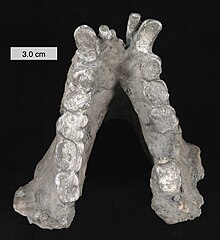
Anthropologist Grover Krantz argues that a surviving population of Gigantopithecus blacki would be the best hypothesis to explain observations made in North America. From analyses of the fossil remains of Gigantopithecus, he deduced that these animals were bipedal. Geoffrey Bourne wrote that Gigantopithecus is a plausible candidate, given that most of its fossils have been found in China, whose forests are very similar to those in the northwestern part of the American continent. Many species have passed from one continent to another through the Bering Strait.
Bourne writes in particular: “Then Gigantopithecus is perhaps the bigfoot of the American continent, as well as perhaps the yeti of the Himalayas.” Anthropologist Bernard G. Campbell, however, argues otherwise: “The fact that Gigantopithecus is extinct has been questioned by those who believe it is the yeti of the Himalayas and the sasquatch of the American northwest coast. But the evidence for the existence of these creatures is not convincing.
The Gigantopithecus hypothesis is generally considered speculative. The majority of anthropologists believe that it was quadruped, and it would be unlikely that it was the ancestor of a bipedal bigfoot. In particular, the weight of G. blacki would have made it difficult for this species to adopt bipedalism. In addition, an analysis of Patterson and Gimlin’s film shows that in planes 369, 370, 371 and 372, it is possible to see a slender mandible, incompatible with the massive one of Gigantopithecus blacki.
Notable independent Bigfoot investigators
David Paulides, a former police officer, collected and documented the testimonies of nearly 45 witnesses who said they had seen Bigfoot.
Sasquatch and Bigfoot in culture
Holidays
The city of Willow Creek (California) organizes every year a large parade in honor of this legendary animal.
Literature
Edward Hoagland’s novel Sept Rivières (Éditions Phébus, 1999) mentions, among other things, the search for bigfoot in the Canadian mountains. He reports in particular the indications given by the Sarsi, Thoadlenni and Sinink Indians.
The novel Himalaya by Nicholas Luard (Random Century Group, London, 1992) tells the story of a girl who finds herself living in a tribe of mysterious anthropoids who are actually yetis.
Cinema
Bigfoot has been at the center of many films, where it is sometimes an antagonist, sometimes a kind and gentle creature. He appears mainly in more or less known TV movies but also in found footage (as in Exist, a film directed by one of the creators of Project Blair Witch, Eduardo Sánchez). Some examples:
- Bigfoot Junior is an animated film released in 2017, which tells the story of a young boy who discovers that his father is Bigfoot and that he has superhuman abilities.
- An American comedy centered on a sasquatch, Bigfoot and the Hendersons, was released in 1987. It inspired a television series of the same genre called Harry and the Hendersons.
- Sasquatch is mentioned in the film Tenacious Din the Pick of Destiny and is the subject of a song by the same group, called “Papagenu” (2002)
- Sasquatch: The Untold by Jonas Quastel (2002)
- The Man Who Killed Hitler and Then The Bigfoot, by Robert D. Krzykowski (2018)
- Big Legend, by Justin Lee (2018)
Bigfoot in television
- In Sanctuary, Bigfoot is a former patient of the DMagnus who became his assistant after she removed several bullets from his body.
- In Marshall and Simon (Eerie Indiana), we can see a bigfoot emptying a trash can in the credits.
- The Sasquatch plays an important role in an episode of the series MacGyver (season 3, episode 4, The Ghost Ship). Native Americans also talk about this legend during this episode.
- In the episode “The Abominable Woodman” of the animated series The Simpsons, Homer is mistaken for a bigfoot after falling into the mud.
- This creature is the subject of the 7th episode of the 4th season of the documentary series Alien Theory which is a series dealing with the arrival of extraterrestrials on our planet.
- In an episode of Futurama (from the same creator as The Simpsons), Fry tries to take a picture of a bigfoot.
- In episode 20 of season 5 of Castle entitled In Search of the Ape Man, Richard Castle and Kate Beckett investigate a murder that will lead them to Bigfoot.
- In episode 7 of season 1 of Malcolm in the Middle, to cover Francis having run away, Malcolm babbles a story of hungry sasquatch hidden in the garden.
- Bigfoot is a robot built by aliens in 5 episodes of The Man Who Was Worth Three Billion (episodes 16 and 17 of season 3, episodes 1 and 2 of season 4, episode 5 of season 5).
- In episode 17 of season 3 of iCarly, Carly, Sam, Freddie and Spencer go in search of Bigfoot at Mount Baker National Forest.
- In American Dragon: Jake Long, the episode “Hairy Christmas” (2006) is dedicated to Bigfoot.
- In Mad Farm, which follows the adventures of the animal protagonists after the film Mad Farm, Bigfoot is a fairly recurring character who hides first because feared by the population, then shows himself in public after people discover that he sings like a diva and as a result, becomes a star. He flies and doesn’t like camera flashes.
- There are numerous appearances of Bigfoot in the sixth episode of the first season of American Horror Stories, a series based on the horror tales of the popular folkore.
Comics
- Carthago Adventures: Bluff Creek: by Christophe Bec and Jaouen Salaün.
- Big Footis a comic book by Nicolas Dumontheuil loosely based on Richard Brautigan’s novel The Hawkline Monster: A Gothic Western about the myth of bigfoot.
- In Marvel comics, a Canadian superhero, a member of the Alpha Division, has this code name because he has the particularity of transforming into this animal.
- Also in Marvel, Hulk and Wolverine fight against bigfoot.
Advertising
- Sasquatch has been used for several years in a Canadian English-language comedy advertising campaign to promote Kokanee beer brewed by Columbia Brewery in Creston, British Columbia, a branch of InBev.
- Sasquatch is also used in an advertisement of the car brand Hyundai. The company uses this legendary animal to introduce its new 2013 car.
Bigfoot in games
- In the fourth and final volume of the Messengers of Time series of gamebooks, the hero and his associate must face a sasquatch and can either confront him face to face or poison him.
- In the video game Red Dead Redemption: Undead Nightmare, the player can activate a mission asking him to hunt several sasquatchs.
- In the parody card game Munchkin 2: Hash Better, we can find a monster named Bigfoot, aka big feet, who crushes and devours the hat of his victims.
- In the game League of Legends, one of the characters is a boy named Nunu, rides a yeti named Willump and has a skin named Nunu Sasquatch.
- In the game Grand Theft Auto V, it is possible to see a sasquatch during a mission aboard a helicopter. In addition, at the end of the game the player can activate a mission asking him to hunt down and kill a bigfoot.
- In The Sims 2, a Bigfoot soberly called Bigfoot walks around the game and it is possible to interact with him, in the unique condition of offering him food every day.
- In the online game The Secret World, you can meet sasquatchs, related to the Wabanaki tribe.
- Sasquatch is a fictional character in the Darkstalkers.
- In Assassin’s Creed III, the main character can complete a side mission of collecting testimonies from border workers, who have spotted a thieving and elusive sasquatch. The creature turns out to be just a very tall man, bearded and dressed in thick furs, living in a cave, arranged and away from men.
- In the video game BIGFOOT, the player must hunt a bigfoot in a forest, capture it and thus find out what happened to a group of missing tourists in this forest.
- In the game Fortnite, it is available as a skin.
- In the board game Unmatched, Bigfoot is one of the fighters available.
Sport
Quatchi, a young Sasquatch hockey and winter sports fan, was one of the mascots of the Vancouver 2010 Olympic Winter Games.
Music
- The sasquatch co-starred in the music video for the song “Triple Trouble” by Beastie Boys.
- He also appeared in the music video Sasquatch and Trippy Mushrooms by Tenacious D.
- ” Sasquatch ” is a song by the progressive rock band Camel released in 1982 on the album The Single Factor.
- “Sasquatch” is a song by rapper Earl Sweatshirt featuring Tyler, The Creator released in 2013 on the album Doris.
- “Sasquatch” is a 2013 single by Ice Cube.
- “Bigfoot” is a 2015 song by Dutch DJ duo W&W.
References (sources)
|