
In Greek mythology, Cerberus (Greek: Κέρβερος Kérberos, “demon of pit”), also known as Cancan Cerberus or Cancerberus, was the dog of the god Hades; a three-headed monster in the most common tradition, called Veltesta (left head), Tretesta (central head) and Drittesta (right head); or fifty-headed according to Hesiod, with a serpent instead of a tail.
The monstrous dog was the son of Echidna and Typhon, and guarded the gate of the kingdom of Hades (the Greek underworld) and ensured that the dead did not leave and that the living could not enter.
| Creature | |
|---|---|
| Group | Mythology |
| Subgroup | Legendary dog |
| Characteristics | Three headed dog Hellhound Guardian of the underworld (Hades) |
| Habitat | Entrance to the Underworld (Hades) |
| Close animals | Dog Wolf |
| Origins | |
| Origin | Greek mythology |
| Region | Cape Tenare, Ancient Greece |
| First mentioned | Theogony (Hesiod, 8th century BC) |
| Status | Chained by Heracles, then freed |
| Primary works | The Twelve Labors of Hercules |
Cerberus Etymology
The etymology of Cerberus’ name is uncertain. Ogden refers to attempts to establish an Indo-European etymology as “still unsuccessful”. It has been claimed to be related to the Sanskrit word सर्वरा sarvarā, used as an epithet of one of Yama’s dogs, from a Proto-Indo-European word *k̑érberos, meaning “spotted”. Lincoln (1991), among others, criticizes this etymology, which was also rejected by Manfred Mayrhofer, who proposed an Austroasiatic origin for the word, and Robert S. P. Beekes. Lincoln notes a similarity between Cerberus and the dog from Norse mythology Garm, relating both names to a Proto-Indo-European root *ger- “growl” (perhaps with the suffixes -*m/*b and -*r). However, as Ogden observes, this analysis actually requires Kerberos and Garmr to derive from two different Indo-European roots (*ker– and *gher- respectively), so it doesn’t actually establish a relationship between the two names.
Although probably not Greek, Greek etymologies have been proposed for Cerberus. An etymology given by Servius (Virgil’s commentator of the late fourth century) – but rejected by Ogden – derives Cerberus from the Greek word creoboros meaning “flesh-eater”. Another suggested etymology derives Cerberus from “Ker berethrou”, meaning “evil of the pit”.
Descriptions of Cerberus
Descriptions of Cerberus vary, including the number of their heads. Cerberus used to have three heads, though not always. Cerberus had several multicephalic relatives. His father was the multi-snake-headed Typhon, and Cerberus was the brother of three other multi-headed monsters, the multi-headed serpent-headed Hydra of Lerna; Orthrus, the two-headed dog that guarded Geryon’s cattle; and the Chimera, which had three heads: that of a lion, that of a goat and that of a snake. And, like these close relatives, Cerberus was, with rare iconographic exceptions, multicephalous.
In Cerberus’ earliest description, Hesiod’s Theogony (c. VIII–VII centuries BC), Cerberus has fifty heads, while Pindar (c. 522 – c. 443 BC) gave him one hundred heads. However, later writers almost universally give Cerberus three heads. An exception is the Cerberus of the Latin poet Horace which has only one dog’s head, and one hundred serpent’s heads. Perhaps trying to reconcile these opposing traditions, the Cerberus of Apollodorus has three dog heads and the heads of “all kinds of snakes” along his back, while the Byzantine poet John Tzetzes (who probably based his account on Apollodorus) gives Cerberus fifty heads, three of which were dog heads, the rest being “heads of other beasts of all kinds”..
In art, Cerberus is most commonly depicted with two (visible) dog heads, never more than three, but occasionally with only one. In one of the two earliest depictions (c. 590-580 BC), a Corinthian cup of Argos (see below), now lost, Cerberus appeared as a normal one-headed dog. The first appearance of a three-headed Cerberus occurs in a Laconian cup of the mid-sixth century BC.
Horace’s numerous serpent-headed Cerberi followed a long tradition that Cerberus was part serpent. This is perhaps already implied as early as Hesiod’s Theogony, where Cerberus’ mother is half-serpent Echidna, and his father the serpent-headed Typhon. In art, Cerberus is often shown as part serpent, for example, the lost Corinthian cup showed snakes protruding from Cerberus’ body, while the Laconia cup from the mid-sixth century BC gives Cerberus one snake per tail.
In the literary record, the first certain indication of Cerberus’ serpentine nature comes from the rationalized account of Hecataeus of Miletus (fl. 500-494 BC), which makes Cerberus a great venomous serpent. Plato refers to the composite nature of Cerberus, and Euphorion of Chalcis (third century BC) describes Cerberus as possessing multiple serpent tails, and presumably in connection with his serpentine nature, associates Cerberus with the creation of the poisonous plant aconita. Virgil has snakes writhing around Cerberus’ neck, Ovid Cerberus has a poisonous mouth, “vile snake-like” necks, and “hairs interwoven with the threatening serpent”, while Seneca grants Cerberus a mane made up of snakes, and a single snake’s tail.
Cerberus received other diverse traits. According to Euripides, Cerberus not only had three heads, but also three bodies, and according to Virgil he had multiple backs. Cerberus ate raw meat (according to Hesiod), had eyes that flashed fire (according to Euphorion), a three-tongued mouth (according to Horace), and a keen ear (according to Seneca)..
Heracles captures Cerberus and takes him out of hell

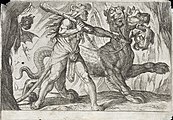
The last of Heracles’ twelve labors was to capture Cerberus. He traveled first to Eleusis to be initiated into the Eleusinian mysteries and thus learn how to enter and leave Hades alive. He could be initiated into them after being purified by having killed the centaurs. Then, he found the entrance to the underworld in Tenaro. He was accompanied by Athena and Hermes. Thanks to Hermes’ insistence and his own fierce appearance, Charon took him in his boat across the Acheron.
While in the underworld, Heracles freed Theseus, but the earth trembled when he tried to free Pirithous, so he had to leave him behind. Both had been imprisoned for attempting to kidnap Persephone. He had magically fastened them to stone thrones, so that their skins were attached to them. This magic was so strong that when Heracles pulled Theseus to free him, part of his hips were stuck to the rock, which would explain why the Athenians had remarkably thin hips.
Some versions say that, to take Cerberus, Heracles simply asks permission from the god Hades, and he agrees on the condition that Heracles does not harm the dog. But in other versions, Heracles shoots an arrow at Hades. After this, in some versions Heracles fights the dog and drags it out of Hades, passing through the cave Achaerussia. In others, Heracles treats the fierce dog with kindness, and the dog, being treated in this way for the first time, meekly accompanies him outside.
Theories about its origin
The constellation Pisces was not always associated with the two fish, as the original starfish was Pisces Austrinus. It was also believed that they were two people, united (which in some stories were transformed into fish, which ended up evolving into simple fish). Both would be united under the ecliptic, the area believed to represent the underworld. The ecliptic, the transit of the sun, cuts this link. One of them is practically outside (the westernmost) and the other seems to remain attached to the ecliptic and head downwards (the easternmost). However, part of the former remains united.
That the person Heracles managed to free from his trap in the underworld is Theseus indicates the knowledge that the myths about him relate him to the queen of the Amazons, and that therefore they must appear in the next story as Heracles’ companion. This emphasis on continuity is possibly related to the fact that the constellation representing the following story also partially appears above Pisces.
Under Pisces is the constellation of the Whale, a creature that is usually considered a sea monster or precisely a whale. However, it is equally possible to see it as two closed doors with their posts and a group of three stars behind the center of both. Since they face the ecliptic and are very close to it, these doors would be those of the underworld, which would be under the ecliptic. The guardian of the gates of Hades was traditionally Cerberus, who had three heads, an association that requires the use of the three main (though comparatively faint) stars of the modern constellation of Fornax as a tail.
Since Cerberus was considered a permanent element of Hades, little could happen to him that harmed him. Since there was no other constellation in this region, little more history could be given to it other than that of doing something non-permanent, such as moving it to the other side of the doors.
Alternatively, an earlier version might not have included the story of Theseus imprisoned, which might have been a later reworking of the constellations’ role in the story. In such a case, the branch of Pisces that does not escape the ecliptic could have been intended to represent the consequent ascent of Cerberus (but still bound, and thus having to return at the end).
Defeats
Cerberus was defeated several times:
- Heracles’ last test was to capture Cerberus. There are several versions of this capture that are detailed above.
- Orfeo used his music to calm him down and put him to sleep.
- Hermes managed to put him to sleep using water from the River Lethe.
- In Roman mythology, Aeneas lulled him to sleep using drugged honey cakes.
- In a later Roman story, Psyche also slept him in the same way as Aeneas.
Archaeology
In October 2013, a team of Italian archaeologists led by Francesco D’Adria found a 1.5-meter-tall statue of Cerberus in the ruins of ancient Hierapolis in Turkey. This finding has confirmed the hypothesis that a cave found in 2012 was Plutonium, a “gateway to the Underworld” as described by Strabo.
Genus of snakes
In 1829, the French naturalist Georges Cuvier gave the name Cerberus to a genus of Asian snake.
Plant genus
In 1753, the Swiss naturalist Carl Linnaeus gave the name Cerbera to a genus of apocynaceous plant native to tropical regions of Asia, Australia, Madagascar, the Seychelles and the islands of the Pacific Ocean.
Later artistic evocations
 |
 |
 |
 |
 |
Cerberus in popular culture
Literature
- In Agatha Christie’s The Capture of Cerberus (1947), Hercule Poirot’s character investigates in the cabaret “the Hell”, watched over by a dog named Cerberus.
- In Harry Potter and the Sorcerer’s Stone (1997) by K. Rowling, the bushy dog is inspired by Cerberus. The character is also present in the film and video game adaptation.
- In Amos Daragon: The Key to Braha (2003) by Bryan Perro.
- In Percy Jackson, The Lightning Thief (2005) by Rick Riordan.
- In the sagas Demonica and The Horsemen of the Apocalypse (2008-2019) by Larissa Ione. In Volume 1 of the Horsemen of the Apocalypse entitled “War”, Cerberus saves Cara from certain death.
- In Le cerbère blanc (2020) by Pierre Raufast.
- In The Prophecy of Dreams (2020) by Aloïsia Nidhead.
Cinema
- In the animated film Hercules (1997), Cerberus appears as Hades’ companion and guard dog.
- In Scooby! (2020) by Tony Cervone, the characters investigate a ghost dog named Cerberus.
- In Ghostbusters: The Legacy (2021), Cerberus and the Master of the Keys are Gozer’s two protectors.
Television
- In the TV movie Cerberus (2005) by John Terlesky.
- In the series Teen Wolf (2011–2017), with Sheriff’s Deputy Jordan Parish.
Cerberus in Video games
- In The Master of Olympus: Zeus, Cerberus is the creature attached to Hades. By building a sanctuary dedicated to Hades, Cerberus protects the player’s city from enemy invasions.
- In Devil May Cry 3: Dante’s Awakening, Cerberus is a three-headed dog controlling ice. He is the second boss of the game.
- In World of Warcraft, the character Guarm from the Judgment of the Valiants raid is a three-headed dog.
- In Kingdom Hearts and Kingdom Hearts 2.
- In Titan Quest: Immortal Throne, Cerberus is one of the monsters to face.
- In the Mass Effect series, Cerberus is the name of a powerful terrorist organization that aims for the supremacy of humanity in the universe, at the expense of other species.
- In League of Legends, the appearance of Nasus Infernal, when in his ultimate form, shows him with three red dog heads with flaming mouths.
- In Final Fantasy XIV: The Dark World.
- In Kid Icarus Uprising, one of Medusa’s three lieutenants is named Cerberos.
- In Smite, Cerberus is one of the playable characters.
- In Hades.
- In Assassin’s Creed Odyssey, the player faces Cerberus in episode 2, “The Torment of Hades”, of the second DLC, “The Fate of Atlantis”.
- In the God of War series, several monsters appear under the name Cerberus, taking the form of three-headed dogs.
References (sources)
|