
The unicorn is a legendary single-horned creature. Its controversial origin results from multiple influences, especially descriptions of animals such as the rhinoceros and antelope, from the accounts of explorers. The first attested representations of unicorn animals date back to the Indus civilization. The Sanskrit account of Ekashringa and trade routes may have played a role in their spread to the Near East.
| General Information | |
|---|---|
| Name | Unicorn |
| Group | Creature of bestiaries and legends |
| Characteristics | Single horn in the middle of the forehead White Pure and Beneficial |
| Habitat | Forests |
| Close | Qilin, Karkadann, Re’em, Shâdhavâr, Camphruch, Pirassouppi |
| Origin | Tales of Ancient Exploration |
| Region | Europe |
| First mention | Ekasringa / Ctesias |
Known in the Christian West since Greek antiquity by accounts of travelers in Persia and India, under the name of “monoceros”, the Western unicorn is distinguished from its Asian sisters by its appearance, symbolism and history. Under the influence of the Physiologus, Western bestiaries and their miniatures describe it as a very ferocious forest animal, symbol of purity and grace, attracted by the smell of virginity. The story of his hunt, during which a virgin girl helps hunters capture her, spreads throughout the Christian West as well as part of the Muslim world.
The physical representation of the Western unicorn is fixed between the horse and the white goat in the late Middle Ages. It is endowed with an equine body, a goatee, split hooves, and especially a long horn in the middle of the forehead, straight, spiral and pointed, which is its main characteristic, as in the series of tapestries The Lady with the Unicorn.
The unicorn became the most important imaginary animal of the Christian West from the Middle Ages until the end of the Renaissance. Belief in its existence is omnipresent, thanks to the trade in its “horn” and its presence in some translations of the Bible. Objects presented as authentic “unicorn horns” are exchanged, and are credited with the power to purify liquids from poisons and cure most diseases. Gradually, these objects are identified as narwhal teeth, an Arctic marine mammal.
The existence of the unicorn, however, remained debated until the mid-nineteenth century. This legendary beast has always interested theologians, doctors, naturalists, poets, people of letters, esotericists, alchemists, psychologists, historians and symbolists. Its symbolic aspect, very rich, associates it with the duality of the human being, spiritual research, the experience of the divine, the virgin woman, love and protection. Carl Gustav Jung devotes forty pages to him in Psychology and Alchemy.
Since the late nineteenth century, the unicorn has been one of the typical creatures of fantasy and fairytale stories, thanks to works such as Lewis Carroll’s Through the Looking Glass, Peter S. Beagle’s The Last Unicorn, Ridley Scott’s Legend, or Osamu Tezuka’s Unico. Its modern imagery moves away from medieval heritage, to become that of a large “magical” white horse, with a single horn in the middle of the forehead. Its recent association with fictional universes such as, among others, My Little Pony, gives it a more cheeky image. It is often a pretext for parodies in popular culture, including through the cult of the invisible pink unicorn.
Etymology and terminology
According to the Académie française, the feminine noun unicorn is a borrowing from the Italian l’alicorno, with agglutination and faulty cut of the elided definite article (l’al- > lal– > la l-). The dictionary Le Robert supports this same theory, the name “unicorn” being probably a borrowing of the fourteenth century from Italian, itself an altered form of Christian Latin unicornis.
Another, older theory (attested from 1694), was that the Latin unicornis could have given the word “unicorn” directly, after removing the letter “u”, and transforming the “n” into “l”. Indeed, the use of “unicorne” is attested in the French language before the generalization of “unicorn”, especially in a medieval song by Thibaut de Champagne.
According to linguist Henriette Walter, the word “unicorn” comes from two successive errors: the pronunciation “unicorne”, under the influence of Latin and the English word unicorn, made believe that it is “an icorne”, with the indefinite article, hence the icorne with the definite article, which gave “unicorn”. But according to the Académie française, it is the English name that is a borrowing from the old French “unicorne”, and not the other way around.
The Latin unicornis, meaning “with one horn” (from unus, “one” and horned, “horn”), is the literal translation of monokeros (μονόκερως) in ancient Greek, with the same meaning.
Many creatures from legends and tales of explorers are named or nicknamed “unicorns”, their only common point being the description of a single horn. This is the case of the Chinese qilin, better known in Japan as kirin, the Russian indrik, the re’em of the Bible, the tragelaphus of Aristotle, the Karkadann and the Persian Shâdhavâr, the Kartazonos (καρτάζωνος) of Claudius Elian (derived from Odell Shepard from the Sanskrit “Kartajan” “, meaning “lord of the desert”), from the camphruch and pirassouppi of André Thevet. After its discovery, the marine mammal at the origin of the trade of “unicorn horns” in the West, the narwhal, acquired the nickname “unicorn of the sea”. The narwhal being perceived as the aquatic version of the legendary land animal, this nickname endures. Elasmotherium, an extinct large rhinocerotidae seen as a possible origin of Asian unicorns, is nicknamed the “giant unicorn”.
Unicorn Origin
The unicorn has fascinated the Western world for centuries. The legends and universal representations of single-horned animals, in East and West, and especially the mystical and esoteric dimension of the unicorn, carried by “artists, storytellers and dreamers” inclined to meditation, are a source of mystery and inspiration. Works that feature a unicorn often have a strong symbolic charge, like the tapestries and bestiaries of the Middle Ages. Theories about its origins are more or less serious, so much so that the American professor and poet Odell Shepard humorously suggests in his book The Lore of the Unicorn, published in 1930, that it must have come from Atlantis or the mountains of the Moon.
One debate concerns the influence of Asian unicorn creatures, perhaps known since prehistoric times, on the Western unicorn whose image was forged in the Middle Ages. The theory of an Eastern influence is defended by the psychoanalyst and scholar Carl Gustav Jung (in Psychology and Alchemy), by the art historian Richard Ettinghausen, by the essayist and Tibetologist Francesca-Yvonne Caroutch, by the writer Roger Caillois, and by some studies linking Eastern and Western narratives and representations. This theory is refuted, among others, by Odell Shepard, by the French theologian Jean-Pierre Jossua (who considers the Indian and Chinese parallels made by Jung and Caillois not very credible) and by the doctoral thesis in social sciences of Bruno Faidutti. According to the latter, the work of Carl Gustav Jung led to a tendency towards syncretism, and thus the attribution of the name “unicorn” to distinct creatures.
Oriental origin

The existence of depictions of single-horned animals in the Indus civilization has been a source of controversy since at least the late nineteenth century. The oldest known image of a unicorn animal (as of 2013) is from the northern Indus Valley. Dated to around 2600 BC, its profile does not match any known horned animals in the region (such as buffalo or rhinoceros). This motif is found over 700 years, disappearing around – 1900. It fulfills a symbolic function. There is no evidence that it was later transmitted to West Asia or Tibet, but archaeologist Jonathan Mark Kenoyer postulates that it may have been physically transmitted to the Near East through merchant travel, and influenced legends in Western Asia.
According to Francesca-Yvonne Caroutch, the unicorn has been known in Asia since the pre-Buddhist period. Integrated into Chinese mythology under the name of Qilin, it would be mentioned in the Annals of Bamboo, and would become a cosmic symbol in the Mesopotamian civilization, fertility and fertility in the Indo-Aryan civilization. It would be present in ancient cosmogonies and religious and philosophical texts as well Chinese as Indian or Persian, especially in the Himalayas, Mesopotamia, and pre-Hellenic Crete. She cites one-horned creatures in the Bundahishn, Atharva-Veda, the Epic of Gilgamesh, the Rāmāyana and the Mahâbhârata of Ancient India.
Jonathan Mark Kenoyer believes that there is no evidence of a direct connection between these examples of unicorn creatures in Asian space. Some links between Indian unicorn animals and Western unicorns are based on translation errors or biases, such as the phrase Khaggavisāṇa in Pāli, translated as “similar to the horn of the rhinoceros”, but revised (2014) by “similar to the rhinoceros”. A cave painting of a bovine animal in a cave in Paphlagonia has sometimes been misinterpreted as that of a unicorn, due to the presence of a line that was more likely used as a route guide.
Some Persian bas-reliefs depicting an ox seen in profile (with a single horn visible) may have played a role in spreading the legend of the unicorn: Ettinghausen believes that these representations influenced the image of the Persian Karkadann, thus explaining the representations and mentions of unicorn animals in the medieval Arab world. He adds that the “strategic position” of the Muslim world in relation to India, China, and the Christian West has favored the spread of the legend of the unicorn. For him, the depictions of unicorn animals in the Arab world are of Indian origin, India being the most likely origin for the reason of the fight between the rhinoceros and the elephant.
The Indian tale of the “horned hermit”, or “Ekasringa “, Sanskrit literature derived from the Jātaka (accounts of the Buddha’s previous lives) and the Mahabharata, features a solitary hermit called Ekashringa, which means “One Horn”. It tells the journey of a mystic meditating and living in the forest, among animals. By drinking from the same source as a divine antelope, he gives birth to a child with a single horn on his head and supernatural powers.
This tale is often cited for its influence on the Western unicorn: certain elements would be found in Persian beliefs, themselves at the origin of Greco-Roman stories about the Monoceros. Ettinghausen also believes that this tale influenced Arab scholars. According to Caroutch, different versions exist in Japan, China, India and Persia. The tale of Ekashringa would have, still according to Caroutch, forged after many revisions the legend of the wonderful appearance of an animal wearing a unique ivory horn, which can only be captured by a young girl.
Western origin
Odell Shepard points out the difficulty of tracing the history of the Western unicorn beyond the accounts of Ctesias, to the fourth century BC. To the credit of a prehistoric origin, one of the naturalistic paintings of the Lascaux cave had been described as a “unicorn” because of two straight lines evoking a horn on its forehead. This is probably the deformed reproduction of a lynx.
Misunderstood observations of real animals largely explain the multiple descriptions of the Western unicorn, but the history of this creature is long and complex, especially because of its symbolism. Creation of the early Middle Ages, the Western unicorn is a chimera. It does not come from Greco-Roman mythology or a religion since it has no connection with the creation of the world, heroic gestures, or the founding of a city.
It is born from a mixture of oral and written traditions, travel accounts (from Ctesias in the vi century BC to the nineteenth century) and descriptions of naturalists. For Bruno Faidutti, its origin is to be found in the first bestiaries inspired by the Physiologus and in Greco-Roman texts, themselves derived from observations of exotic animals. According to Odell Shepard, the legend of the Western unicorn comes from the mixture between the description of Ctesias, which made it a ferocious animal that could not be hunted by conventional techniques, and the account of its capture by a virgin in the Physiologus.
Real animals at the sources of the legend
It is common for explorers to confuse known animals with a single-horned creature. For Odell Shepard, the Monoceros of Ctesias mixes stories about the Indian rhinoceros, whose horn is traditionally credited with therapeutic properties, about the evening primrose (or wild ass), renowned in antiquity for its speed and combativeness (cited for example in Xenophon’s Anabasis), and about the antelope of Tibet. The discovery of the survival until relatively recent times of some extinct species of woolly rhinos such as those of the genus Elasmotherium suggests that this kind of animals may also have influenced the legend (either during their lifetime or by their imposing skeletons).
Narwhal
The narwhal has played, despite itself, a central role in the long belief in the Western unicorn. The large single spiral tooth of this marine mammal has long been sold as “unicorn horn” in Europe, from the late Middle Ages to the Renaissance, especially in the sixteenth century, providing material evidence of the existence of the legendary animal. The first mention of a horned narwhal is in the Atlas Minor, a scholarly work dated 1607. Another detailed description of the narwhal appeared in 1645 thanks to Thomas Bartholin, but without making a link between “sea unicorn” and terrestrial unicorn.
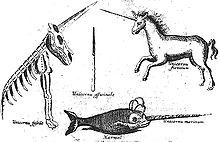
In 1704, a drawing in the Museum Museorum by Michael Bernhard Valentini, the first study of the collections of Europe, compared the object then sold as a medicinal “unicorn horn” (unicornu officinale), a representation of narwhal (unicornu marinum), a reconstructed skeleton of a “fossil unicorn” (probably an Elasmotherium) and an equine representation of the unicorn, titled unicornu fictium.
The narwhal tusk remained for a long time considered as a horn and not as a tooth, probably because of the refusal of the asymmetry stated by Carl von Linnaeus in his Systema naturae. The narwhal has since been called the “sea unicorn”. It is accepted from the eighteenth century that most of the “unicorn horns” sold as antidotes are actually narwhal teeth. The discovery of the narwhal collapsed the course of the “unicorn horns” and put an end to their trade, but the belief in the existence of the unicorn persisted, even among some scholars, until the middle of the nineteenth century.
Rhinoceros and Elasmotherium
Confusion between the unicorn and the rhinoceros is common, especially in antiquity and the Middle Ages, due to mistranslations from Latin. The Indian rhinoceros, smaller than the African, is the only extant land animal to possess a single horn, along with the Javan rhinoceros. The animal described by Pliny the Elder in the first century comes close. In addition, rhinos are seen in Rome as early as the first century BC. The Etymologies of Isidore of Seville, in the sixth century, are a source of confusion with the rhinoceros, since the author describes the capture of the Monoceros with the help of a virgin, as well as a furious fight against the elephant. Marco Polo describes a rhinoceros in Java as a unicorn, in the Visement du monde.
Ulisse Aldrovandi suspects Marco Polo’s mistake: “As for the Monoceros of Paul of Venice (Marco Polo), I don’t think anyone can blame me for seeing a rhinoceros there. Indeed, they are quite similar, according to the marks he gives them: its size close to that of the elephant, of course, but also its ugliness, its slowness, and its pig head, characteristics that describe the rhinoceros well”. The horn of rhinos is reputed to have medicinal properties, just like that of the unicorn. This confusion is common, especially among scholars who write false travel accounts based on the sources of classical antiquity.
There is also a group of extinct animals, the genus Elasmotherium, whose species were a kind of huge Eurasian rhinoceros native to the steppes until the end of the Pleistocene, and present in Europe and Russia. Sometimes nicknamed the “giant unicorn,” this type of animal had a very large horn unique in the middle of the head, usually located between the eyes.
According to Willy Ley, the description of this animal could have been transmitted orally in some Russian legends; Fossilized remains may also have fueled the legend (such as dinosaur fossils for dragons). The testimony of an Arab traveler of the tenth century, Ibn Fadlan, suggests the survival of Elasmotherium during historical times, since its description corresponds to the karkadann of Persia, and the unicorn zhi of China. The extinction of Elasmotherium may be more recent than previously assumed, although dating it to 30,000 years in the past remains controversial.
The woolly rhino may have disappeared only 8,000 years ago, but it had two horns on its nose (like the current white rhinoceros).
Antelopes
Various varieties of antelope, including oryx and eland, may have contributed to spreading the legend of the unicorn, notably through the trade in their horns, attested in Tibet with the local antelope. Claude Élien refers to this type of animal by describing a black and ringed horn in the Monoceros. The Arabian oryx, a white antelope with two long, thin horns pointing backwards, resembles a one-horned horse when viewed from the side and from a distance. Aristotle attributes to him a single horn in his History of Animals, as does Pliny the Elder, in his Natural History (Book XI, Chapter CVI).
Living mammals with a horn or antler
Sometimes only one of the two horns of a mammal develops. The two horns can also mingle and merge, giving the impression that the animal is wearing only one. A few single-horned animals are well-attested. Natural but extremely rare, they do not constitute a species, their cases being teratology. These cases have been documented since ancient times. F. Y. Caroutch quotes in particular the ram of Pericles:
“One day,” it is said, “the head of a ram who had only one horn was brought to Pericles from his rural domain. When the soothsayer Lampon saw this horn that had grown, solid and vigorous, in the midst of the beast’s forehead, he declared: “The power of the two parties which divide the city, that of Thucydides and that of Pericles, will pass into the hands of one man, the one in whom this prodigy appeared.” Anaxagoras, on the other hand, opened the skull and showed that the brain had not occupied its full place: it had taken the elongated shape of an egg and had slipped from the entire skull to the precise place where the horn was rooted.”
Plutarch, Life of Pericles
The soothsayer Lampon interprets this omen as the victory of Pericles’ party over Thucydides’ party, but the philosopher Anaxagoras dissects the skull and shows that it is a malformation. These cases remain known today, since the Natural Science Center in Prato, Italy, has been home since 2007 to a deer with a single antler in the middle of the forehead: the director of the park said on this occasion that this type of birth could be at the origin of the legend of the unicorn, even if the diseases that cause it such as Holoproencephaly do not usually allow the survival of the animal until adulthood.
Artificial creations

The artificial creation of mammals with a unique horn or wood may have played a role in the belief in the unicorn. However, Bruno Faidutti denies that these cases could have had a real influence on the construction of his image. Cases of artificially created “unicorns” are documented in the West, the East, and Africa. Unlike the Western unicorn, Asian artificial unicorns are originally angora goats whose horns are bound by iron and fire. This artificial horn is short, resembling two braided candles. This practice has since disappeared, due to its cruelty to animals.
In the West, the best-known case of an “artificial unicorn” is that of fossil bones unearthed in Einhornhöhle (in the Harz Mountains, Germany). These bones were described by the mayor of Magdeburg, Otto von Guericke, as a unicorn in 1663. This so-called unicorn, a motley assemblage of a woolly rhinoceros skull and mammoth bones on which a narwhal tusk is attached, has only two legs. The skeleton was examined by Gottfried Wilhelm Leibniz, who doubted the existence of the unicorn and attested to it in a 1690 publication, bringing it notoriety. However, it is quickly considered a hoax.
Much more recently, in 1982, the horns of a goat named Lancelot were artificially modified to form one. He is presented as “a living unicorn” in several American circuses. Its creators take credit for the rediscovery of a lost technique. Faced with protests from animal rights activists, they eventually remove the animal. Another goat with modified horns appears in a Washington theme bar in 2006.
Description of the unicorn
Western and Asian “unicorns” differ in their description, their only common feature being the presence of a single horn, which is the most important characteristic of the unicorn.
Western Unicorns
According to Bruno Faidutti, the Western unicorn “had a soul before having a body”, its symbolic meaning (feminine purity) having preceded the relative uniformity of its physical appearance (white color, appearance of a small horse, long spiral and straight horn). Roger Caillois describes it as an alliance between the fine mount of damsels and the horn of the narwhal, which sits among the royal treasures. Greek authors did not visually represent the Monoceros, the source of inspiration for medieval bestiaries. The generalization of both the goat and horse form and the color white in artistic representations result from symbolism and allegories attributed to the unicorn in the Middle Ages. The white coat of this unicorn that acquires from the horse its size and nobility is essential for an animal symbol of purity and modesty.
The unicorn has not always been described as a peaceful animal: its attraction to virgin girls and its phallic attribute can also make it a virile symbol, supported by the contained violence sometimes attested in this animal, which according to some authors does not hesitate to kill the girl who seeks to approach it if she is not a virgin.
The problem of differences in the description of the unicorn in the Western world has arisen since antiquity, when there are up to seven “unicorn” animals: the rhinoceros, the wild ass, the “Indian ox”, the oryx, the bison, the “Indian horse” and the Monoceros proper. Bartholomew the Englishman (XIII century) notes this disparity:
“Some have a horse’s body, a deer’s head, a boar’s tail, and have a black horn (…) They are often called Monoceros or monoceron. Another variety of unicorns is called eglisseron, that is, horned goat. It is tall and tall like a horse, but like a deer; its horn is white and very pointed (…) Another species of unicorn is similar to an ox, stained with white spots; Its horn is black and brown, and it charges its opponent as a bull does.”
Bartholomew the Englishman, Book of the Properties of Things (Early XIII Century)
Differences in descriptions of unicorns provided by Renaissance explorers lead either to refute its existence or to assume multiple species. The single horn is not always the common point between all these animals, since there are also mentions of two-horned unicorns. In the mid-sixteenth century, accounts of explorers also mention aquatic unicorns, such as the Pirassouppi and the Camphruch.
Eastern Unicorns
The Karkadann (from Kargadan, Persian: كرگدن “lord of the desert”), a unicorned animal of Persia whose physical description is extremely variable and whose name means “rhinoceros”, is named among others in the Arabian Nights, and mentioned by Ibn Battuta. Like the Western unicorn, its hunting is reputed to be dangerous. It can be captured, and is the subject of representations of fierce fights against other animals, especially the elephant (in the xiii and xiv centuries). Its horn has various medicinal uses, and is very valuable.
The qilin, nicknamed “Asian unicorn”, is often depicted in ancient art as an ox-tailed reptile close to the deer, wearing two fur-covered horns on its forehead, sometimes only one in the texts. Its symbolism is very positive, since it represents the arrival of the great sages, especially through its association with Confucius. A symbol of insight, it is traditionally depicted in Chinese courts of the imperial system on the hanging separating the courtroom and the magistrate’s chambers. It is one of the five sacred animals associated with the elements along with the azure dragon, the vermilion bird, the white tiger and the black tortoise. In its Japanese version, it is called Kirin. This name is also present in Turkish. In Tibet, two unicorn animals often surround the Dharma wheel replacing the deer.
The shadhavâr, sometimes referred to as the “Persian unicorn”, is a carnivorous and treacherous creature of Arab folklore, similar to a gazelle carrying a single horn that branches, symbolically closer to mythological sirens than to the Western unicorn. Its first representation appears in a fifteenth-century manuscript attributed to the Persian Al-Qazwini (1203-1283).
The history of the unicorn
Unicorn animals have been described since Greco-Roman antiquity, but the unicorn does not belong to any living popular legend, and does not mark the plastic arts, creative narratives, or mythology of antiquity. It appears only in travel accounts and descriptions of animals copied on top of each other. His image is fixed at the end of the Middle Ages, his invention can be dated to the beginning of the Renaissance of the Christian West, when entire works are dedicated to him. Through its omnipresence in the art and stories of the literati, the European unicorn forms the most important imaginary animal of the time.
Greek sources
Greek sources are related to natural history. Most of these texts attest to the existence of a unicorn animal in India. The oldest text in Western literature evoking the unicorn dates from between -416 and -398. It is due to the Greek physician Ctesias, who resided seventeen years at the court of Persia, with Darius II and Artaxerxes II. On his return to Greece, he wrote a History of India named Ἰνδικά / Indiká of which fragments remain brought back in the ninth century by Photios I of Constantinople. They describe, among the fabulous peoples and animals of “India”:
“[…] wild donkeys the size of horses, and even larger ones. They have white bodies, purple-colored heads, bluish eyes, a horn with a cubit-long forehead. The lower part of this horn, starting from the forehead and going up to two palms, is entirely white; the middle one is black; The upper one is purple, of a beautiful red, and ends in point. They are made into drinking vessels. Those who use it are not prone to convulsions, epilepsy, or poisoning, provided that before taking poison, or after taking it, they drink from these vessels water, wine, or any other liquor. Domestic or wild donkeys from other countries, like all solipeds, have neither the ossicle nor the vesicle of the fiel. The Indian donkey is the only one that has them. Their ossicle is the most beautiful I have ever seen; It resembles in figure and size that of the ox. It is heavy like lead and red to the bottom like cinnabar. This animal is very strong and very fast at running. The horse, nor any other animal, can reach it.”
Ctesias, Ἰνδικά
Ctesias seems to firmly believe in the existence of the animal he describes. In the fourth century BC, the philosopher Aristotle classifies animals by the number of their horns and hooves, perhaps relying on Ctesias. He distinguishes two that would have a horn, the Indian donkey and the oryx:
“We can still notice that some animals have horns, and others do not. Most of those with horns have split hooves, such as ox, deer and goat; An animal with an unsplit hoof with two horns has never been observed. But there are a small number of animals that have a single horn and unsplit hoof, like the Indian donkey. The oryx has only one horn, and it has a split hoof.”
Aristotle, Περι ζώων μορίων
Around 300 BC, Megasthenes was sent as ambassador to the court of Chandragupta Maurya, King of India, at Pataliputra on the banks of the Ganges. He stayed there for about ten years, and wrote his book Indica. He describes a solitary mountain animal called “Kartazoon” or “kartajan” after the language of the country. For the first time, this unicorn animal is described as gentle with other animals. Quarrelsome towards his family, his aggressiveness only softens during the mating season. Its horn is used as a remedy for poisons. Strabo quotes him as saying that “there are in the wilds of India horses with the head of deer surmounted by a single horn.”
As Richard Ettinghausen notes, the Greek sources of Claudius Ptolemy and Aristotle were transmitted to Arab scholars. Al-Jahiz (776-867) and Sharaf al-Zamān Ṭāhir al-Marwazī (1056-1124) refer to it in their own writings.
Roman sources
The belief continues in Roman times, Julius Caesar himself attesting to the presence of a kind of unicorn deer in the Hercynian forest. The description of Pliny the Elder, in the first century, serves as the basis for many later works:
“The wildest beast of India is the Monoceros; he has the body of the horse, the head of the deer, the feet of the elephant, the tail of the boar; a low roar, a single black horn two cubits high that stands in the middle of the forehead. They say they don’t take him alive.”
Pliny the Elder, Naturalis Historiæ
In the second century, Philostratus the Athenian takes up the account of Ctesias in his Life of Apollonius of Tyana, without giving credence to the medicinal virtues of the horn:
“In the marshes along the river we take evening primroses. These animals have a horn on their foreheads, which they use to fight like bulls, and this with great courage. The Indians make cups of these horns, and attribute to them wonderful properties: it is enough to have drunk from one of these horns to be safe from all day long from all disease, not to suffer a wound, to cross the fire with impunity, to have nothing to fear from the most violent poisons: these cups are reserved for kings, and kings alone hunt evening primrose. Apollonius says he saw one of these animals, and cried out, “Here is a singular animal!” And when Damis asked him if he believed in the tale of evening primrose horns, he replied: “I will believe it when I am shown one of these kings of India who is not mortal. When a man can present to me, or present to the first comer a cup which, far from engendering diseases, keeps them away, how can we suppose that he does not begin by pouring himself in long strokes until he gets drunk? And in truth no one could find it bad to get drunk at such a cup.”
Philostratus of Athens, Τὰ ἐς τὸν Τυ α νέα Ἀπολλώνιον
At the beginning of the third century, Claude Élien may have taken up the accounts of Ctesias, or those of Megasthenes:
“I learned that onagers were born in India whose size is not smaller than that of horses. Their whole body is white, except for their heads, which are close to purple, and their eyes, which diffuse a dark blue color. They have on the forehead a horn that reaches well a cubit and a half long: the base of the horn is white, the tip bright red, and the middle part of a deep black. (…) according to Ctesias, Indian donkeys that possess a horn (…) are faster than donkeys, and even faster than horses and deer (…). Here is how far the strength of these animals goes: nothing can resist their blows and everything gives way and, if necessary, is completely crushed and mutilated. They even frequently tear the sides of horses, rushing on them, and make them come out the entrails (…). It is practically impossible to capture an adult alive, and they are shot with spears and arrows (…).”
Elian, Περὶ ζῴων ἰδιότητο
Influence of Alexandrian scholars
According to Odell Shepard and Jean-Pierre Jossua, scholars in Alexandria place the unicorn at the heart of Christian symbolism. In the third century, many stories about animals with morals circulated. The first Christian bestiary, the Physiologus, originated there. He exerted considerable influence on the spread of the legend of the unicorn in the Western world.
The Physiologos (in Latin Physiologus), a collection of short stories probably written in ancient Greek in Egypt in the second century, tells for the first time of the capture of a monoceros by hunters using a young virgin as bait, among other descriptions of animals and imaginary creatures. The text is presented as a hunting technique, not as a myth. Its description could be older. The various authors of the Physiologos were able to create from scratch the story of the capture of the unicorn by a virgin woman as a symbol of the incarnation of Christ.
This story can also find its source in the symbolism of sexual attraction between the phallic horn of the unicorn and the pure, moralized virgin adapted to a Christian vision. Finally, according to Odell Shepard, this account could be a pure creation of Christian allegorists. The account of the Physiologus is translated into a very large number of languages, including Arabic, Syriac, Latin, Armenian, Old High German, Icelandic, Old French, Provençal, Ge’ez, Italian and Old English. Translated into Latin in the fourth century, it inspired countless authors of Western bestiaries in the Middle Ages:
“The psalmist says, “My horn will be carried to the heights like that of the unicorn.” The Physiologist said that the unicorn has the following nature: it is a small animal that resembles the kid, and is quite peaceful and gentle. He wears a single horn in the middle of his forehead. Hunters cannot approach him because of his strength. So how is he captured? They send an immaculate virgin to him and the animal comes to curl up in the bosom of the virgin. She nurses the animal and takes it to the king’s palace. The unicorn, therefore, applies to the Savior. “For in the house of David our father has raised a horn of salvation.” The angelic powers could not master him and he settled in the womb of Mary, the one who is truly always a virgin, and the Word became flesh, and he settled among us.”
Physiologos
The most widespread Latin version quotes hunting in the same way, ending this short account with a Christian morality: “The same is true of our Lord Jesus Christ, spiritual unicorn, who, descending into the womb of the Virgin, took flesh in her, was taken by the Jews and condemned to die on the cross. In this regard David says: And he is loved as the son of the unicorns [Ps. 28:6]; and again in another psalm he says of himself, ‘And my horn shall be raised up like that of the unicorn.’ [Ps. 91:11]
Cosmas Indicopleustès, a merchant from Alexandria who lived in the sixth century and traveled to “the Indies”, wrote a cosmography in which he quoted the unicorn. He provides a representation from four copper figures, which he is said to have seen in the palace of the King of Ethiopia:
“The unicorn is formidable and invincible, having all its strength in the horn. Whenever she thinks she is being pursued by several hunters and about to be caught, she leaps on a steep rock and launches herself from above; during her fall she turns around; Her horn cushions the shock and she remains unharmed.”
Cosmas Indicopleustès, Χριστι α νικὴ Τοπογρ α φί α
According to Ettinghausen, this “tale” could be inspired by observations of wild Persian goats or antelopes.
Unicorns in the Middle Ages
All medieval stories and their illustrations evoking the unicorn are of Christian inspiration. The Monoceros is studied sporadically in the eleventh century, without leaving any noticeable traces. From the end of the twelfth century and the beginning of the thirteenth century, the unicorn became one of the favorite themes of bestiaries and tapestry (to a lesser extent, sculptures) in the Christian West. However, it appears only in works for scholars, a tiny part of the medieval population. It is not mentioned in folk folklore tales and songs. It is also found on some stained glass windows, the oldest known of which are in the Basilica of San Saba, in Rome.
Unicorn creatures are mentioned and depicted in the medieval Muslim world. The classical Arabic-speaking Persian philosopher Abu Hayyân al-Tawhîdî speaks of a creature named Manāfi, which can only be captured by a young virgin woman. The description of the hunting technique sometimes contains references to Allah. The Physiologus was indeed broadcast in Arabic. Richard Ettinghausen cites the medieval folk belief that the reputation of the unicorn horn for detecting poisons comes from Arab medicine, but there is no written source to attest to this.
Bestiaries
The first European unicorns appeared in bestiaries inspired by the Physiologus, despite efforts by some religious to prohibit its dissemination. The influence of Greco-Roman texts, such as that of Pliny the Elder, is less. The unicorn acquires Christian symbolism justifying its presence in religious works, although it comes from pagan descriptions. Depending on the version, the young woman wishing to attract a unicorn must sometimes be a nun, of noble birth, pure of heart, of great beauty, virgin of any contact with a man, or hold a mirror. The unicorn is credited with the power to recognize virgins by smell, or through its own magical gifts. The theologian Alain de Lille explains this attraction of unicorns for virgin women via the theory of humors: the unicorn, “hot” by nature, is irresistibly attracted to a “frigid” girl.
Quoting the Physiologus, Pierre de Beauvais compares Jesus Christ to “a celestial unicorn that descended into the womb of the Virgin,” and was taken, then crucified because of his incarnation. The horn adorning the forehead of the unicorn is a symbol of God, the cruelty of the unicorn means that no one can understand the power of God, its small size symbolizes the humility of Jesus Christ in his incarnation.
The Liber Subtilitatum de Divinis Creaturis (Book of the Subtleties of Divine Creatures) of the abbess Hildegard of Bingen, written in the twelfth century, is both the richest of the medieval bestiaries and the furthest from the Greek tradition, since it focuses on the properties of animals. She recommends an ointment made with unicorn liver and egg yolk against leprosy. Wearing a unicorn leather belt is supposed to protect against plague and fever, while leather shoes of this animal would keep foot diseases away.
The Divine Bestiary of William the Cleric of Normandy, in the thirteenth century, contains one of the most detailed accounts:
“[…] She is so reckless, aggressive and bold that she attacks the elephant with her hard and sharp hoof. Her hoof is so sharp that, no matter what she hits, there is nothing she cannot pierce or split. The elephant has no way to defend itself when the unicorn attacks, it hits it like a blade under the belly and disembowels it entirely. It is the most formidable of all the animals that exist in the world, its vigor is such that it fears no hunter. Those who want to try to take her by trickery and bind her must spy on her while she plays on the mountain or in the valley, once they have discovered her lodging and carefully noted her traces, they go to look for a damsel whom they know to be a virgin, then make her sit at the lodging of the beast and wait there to capture her. When the unicorn arrives and sees the girl, she immediately comes to her and lies down on her lap; then the hunters, who are spying on her, rush forward; they seize her and bind her, then they lead her before the king, by force and as fast as they can.”
Guillaume Le Clerc de Normandie, Bestiaire divin
Brunetto Latini (1230-1294) gives in his Book of Treasure the description of a formidable unicorn whose body resembles that of a horse, with the foot of the elephant, a deer’s tail and a terrible voice. Its unique horn is extraordinarily sparkling and four feet long, it is so strong and sharp that it pierces without difficulty anything it hits. The unicorn is cruel and fearsome, no one can reach it or capture it with a trap. The description of the hunt is the same as in the other bestiaries.
Philippe de Thaon provides around 1300 an interpretation that is intended to be Christian:
|
Old French “La met une pulcele, |
English “A maid is placed, |
Giovanni da San Geminiano speaks in his Summa de Exemplis et Rerum Similitudinibus Locupletissima of a smell of virginity that makes the unicorn sweet as a lamb when it takes refuge in the bosom of a young virgin.
Stories of Marco Polo

Marco Polo’s The Devising of the World (1298) contains several references to the unicorn. He describes an animal:
“(…) Hardly smaller than an elephant, with the hair of the buffalo, the foot like that of the elephant, a very large black horn in the middle of the forehead. He does no harm to men or beasts with his horn, but only with his tongue and knees, for his tongue is covered with very long and sharp thorns. When he wants to destroy a being, he tramples him and crushes him on the ground with his knees, then licks him with his tongue. He has the head of a wild boar and the door always tilted towards the earth. It gladly dwells in the mud and mud among lakes and forests. It’s an ugly beast, disgusting to behold.”
Marco Polo, Devisement du monde
This description is very similar to that of the Sumatran rhinoceros, small, hairy and regularly covered with mud: Sumatra is indeed one of the regions visited by the explorer.
It is also to Marco Polo that we owe the description of an ancient breed of unicorn horses in India, allegedly descended from the famous Bucephalus of Alexander the Great:
“Horses descended from the semen of King Alexander’s single-horned horse, named Bucephalus, could be found in this province [India]; who were all born with a star and a horn on their foreheads like Bucephalus, because the mares had been covered by this animal in person. But the whole race of these was destroyed. The latter were in the power of an uncle of the king, and when he refused to allow the king to take one, the king had him put to death; but in rage at the death of her husband, the widow annihilated the said race, and here she is lost.”
Representations of Bucephalus wearing a black horn on his forehead, symbol of power and divinity, appear in the Middle Ages. Bucephalus is supposed to feed on human flesh, like Diomedes’ cavales, but only Alexander can ride it, symbolically reminiscent of the legend of the unicorn tenderized by a virgin.
Medieval tales
Several medieval tales, charged or not with a moral, quote the unicorn. The Tale of the Unicorn and the Serpent, narrated by Jacques de Voragine between 1261 and 1266, features a man named Barlaam, who lives in the desert near Senaah where he often preaches against the illusory pleasures of the world. Instructing Jehoshaphat, the king’s son, he told him the following parable:
“Those … who covet bodily delights and let their souls die of hunger, are like a man who would flee as quickly as possible before a unicorn that will devour him, and who falls into a deep abyss. Now, when he fell, he seized a shrub with his hands and set foot on a slippery and crumbly place; He sees two rats, one white and the other black, busy constantly gnawing the root of the shrub he has seized, and soon they will have cut it. At the bottom of the abyss, he sees a terrible dragon vomiting flames and opening its mouth to devour it; In the square where he has set foot, he distinguishes four aspics that show their heads. But, looking up, he sees a little honey flowing from the branches of this shrub; then he forgets the danger to which he is exposed, and indulges entirely in the pleasure of tasting this little honey. The unicorn is the figure of death, who pursues man incessantly and aspires to take him.”
The Lady with the Unicorn and the Knight with the Lion, a courtly tale by Blanche of Navarre, dated from the early fourteenth century, tells that a beautiful and chaste princess receives a unicorn from the God of love, and calls herself “the white lady that the unicorn guards”. She marries a lord who one day goes on an adventure and captures, then tames a lion. The Lady is told that her knight is dead, a bad lord takes the opportunity to kidnap him. The knight with the lion, returns, sets out to attack the castle of the kidnapper, frees his lady and both leave the cursed castle, the lady mounted on her unicorn and the knight on his lion.
From the Renaissance to the eighteenth century
During the Renaissance, the unicorn joined medical treatises about the use of its “horn”, as well as biblical studies discussing its presence in sacred texts, in addition to works describing animals, travel accounts where explorers claim to have met it. Some treatises on alchemy, astrology, heraldry, and commentaries on Greco-Roman texts, also mention it.
Trade and uses of unicorn horn
Since the late Middle Ages, the famous “unicorn horn” has been associated with magical powers and counterpoison virtues that make it one of the most expensive and renowned remedies during the Renaissance. Its main medicinal use is related to its purifying power, first mentioned in the thirteenth century. The horn is then sought by all the royalty of Europe to purify the dishes of poisons; It is believed that she starts smoking in contact with a poisoned dish.
These legends about its properties, circulating since the Middle Ages, are at the origin of the flourishing trade of these objects, which become more and more common until the end of the eighteenth century, when their real origin is known. The twisted “unicorn horn” is exchanged, circulated, and consumed in different ways. The course of the “unicorn horn” reached its peak in the middle of the sixteenth century, where it is considered the best counterpoison existing with the bezoar stone. Its price continued to fall in the following years, to collapse in the seventeenth century, when the discovery of the narwhal became known.
Travel and exploration stories
From the late Middle Ages to the Renaissance, at the time of the great explorations, many travelers claim to have seen unicorns. They make very precise descriptions, often contradictory, which lead interpreters to believe that these unicorns form a family including different races or to doubt the reality of their existence. The stories of explorers sometimes agree to locate unicorns. India is very often cited, as is Ethiopia. According to Faidutti, these two countries form the “chosen lands of unicorns”.
Isolated testimonies mention several places in the Middle East, Madagascar, the Caucasus, Southeast Asia and, more exceptionally, the east coast of the United States, as well as Greenland and Antarctica. The unicorn survives the different phases of exploration of the Renaissance, unlike other “fabulous” animals such as the dragon and the griffin, which join mythologies and folk tales. When the regions where unicorns are supposed to live are fully explored, other stories mention the beast in even more inaccessible places, such as Tibet, South Africa, and especially central Africa.
During a stay in Mecca in 1503, the Italian explorer Ludovico de Verthema reported seeing two unicorns in an enclosure. They would have been sent to the Sultan of Mecca by a king of Ethiopia as a pledge of alliance, as the most beautiful thing in the world, a rich treasure and a great wonder. “The largest is made like a one-year-old foal, and has a horn about four palms long. It has the color of a brown bai, the head of a deer, the short collar, the short hair and hanging on one side, the leg light as a deer. His foot is split like that of a goat and he has hair on his hind legs. It is a proud and discreet beast.”
Ambroise Paré quotes the surgeon Louis Paradis, who describes a unicorn in these terms: “its hair was beaver color, very smooth, the neck slender, small ears, a horn between the ears very smoothed, of obscure color, swarthy, of length of one foot only, the head short and dry, the muzzle round, similar to that of a calf, eyes big enough, having a very fierce look, dry legs, feet split like a doe, tail round and short like that of a deer. It was all the same color, except for a front foot which was yellow.”
In 1652, Thomas Bartholin described “an animal the size of an average horse, gray in color like a donkey, with a black line along the entire length of the back, and a horn in the middle of the long forehead of three spithams”. In 1690, Antoine Furetière’s Universal Dictionary gives this definition of unicorn: “It has a white horn in the middle of the forehead, five palms in length …”. A Portuguese traveler described Ethiopian unicorns in these terms: “The unicorn, found in the mountains of Beth in Upper Ethiopia, is ash-colored, and resembles a foal of two years, except that it has a goat’s beard, and in the middle of the forehead a horn of three feet, which is polished and white like ivory and striped with yellow stripes, from top to bottom.”
The Portuguese Jesuit Jerónimo Lobo researched the sources of the Nile, when he reported his encounter with unicorns in an account, dated 1672: “It was there that the real unicorn was seen… For the unicorn, it cannot be confused with the rhinoceros which has two horns, not straight but curved. It is the size of a horse of mediocre size, of a brown hair pulling on the black; It has black horsehair and tail, short and sparse horsehair… with a straight horn five palms long, of a color that pulls on white. It always dwells in the woods and hardly ventures into open places. The peoples of these countries eat the flesh of these beasts as of all others.”
According to Olfert Dapper and Arnoldus Montanus (1673), “horse-like animals, but with split hooves, dru hair, a long, straight horn in the middle of the forehead, the tail of a pig, the black eyes and neck of a deer are supposed to live.” Later in the same work, Dapper and Montanus describe “wild horses with a forehead armed with a longhorn, with a deer’s head, having the hair of a weasel, short neck, a mane hanging on one side only, thin legs, goat hooves.”
Aquatic Unicorn Descriptions
In the middle of the sixteenth century appear stories of explorers mentioning strange aquatic unicorns. At the end of the sixteenth century, the cosmographer André Thevet described the Pirassouppi, a “kind of unicorn with two horns”, which he located in Arabia. The Portuguese navigator Garcias da Horto mentions, between the promontory of Good Hope and that of the Currents, an amphibious animal with the head and hair of a horse, a horn two long spans, mobile, turning sometimes to dextrous, sometimes to senestrian, rising and lowering. This animal fights furiously against the elephant, its horn is highly prized against venoms. Written in Portuguese, his account was translated into French in 1602.
The Camphruch, observed by André Thevet in 1575, is close to the animal described by Horta. While traveling in Indonesia, he describes an aquatic unicorn whose snout is like a seal and a cat. The front of the body is similar to that of a doe, with an abundant gray mane that covers the neck. The animal has a long twisted horn and its hind legs are webbed. The camphruch hunts fish by impaling it on its horn, which has the particularity of being mobile and being able to cure poison, which makes it highly sought after. A few years later, the name was simplified to Camphur in encyclopedias.
Scholarly works and encyclopedias
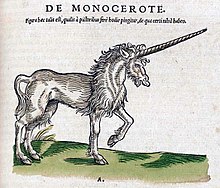
Scholarly works devoted to the unicorn appeared from the end of the sixteenth century to the nineteenth century. In multiple encyclopedias, the unicorn coexists with real animals. These works mostly avoid any reference to medieval bestiaries, and are based on the multiple stories and testimonies, often disparate, of explorers who allegedly crossed unicorns. They talk about the existence of the animal, its appearance and properties. Conrad Gessner’s Historia animalium, published in 1551, considered one of the first compilations of natural history, has been reprinted extensively. It devotes six pages to the unicorn and especially to the medicinal properties of its horn, but does not pronounce on the reality of the existence of the animal. In 1607, the Reverend Edward Topsell published in London The History of Four-Footed Beasts, a barely modified English translation of the Historia animalium.
Ulysses Aldrovandi (1522-1607), a naturalist from Bologna whose oldest known copy of De quadripedibus solipedibus dates from 1616, became the reference in zoology by replacing the work of Gessner. He explains how a Jewish merchant in Venice demonstrated the authenticity of a unicorn horn by confronting it with poisonous animals, separates the “horned donkeys ” De asinis cornutis from the “unicorns proper” (De monocerote sive unicorni proprie dicto), and remains neutral on the question of the existence of unicorns.
Jan Jonston’s Historia naturalis de quadrupedibus (1652) presents eight species of unicorns, with Latin names. At least two of the illustrations in the plate accompanying the description bear some resemblance to rhino species.
Between 1735 and 1744, Carl von Linné mentions unicorns without believing in it in his Systema naturae, in an appendix entitled “Animalia Paradoxa“, and which mainly includes legends to which some still gave some credit at the time; this section will be abandoned from the 6th edition (1744). He thus settles the account of unicorns: “Monoceros [rhinoceros] of the ancients, horse’s body, feet of a ‘wild animal’, straight horn, long, twisted in a spiral. It is an invention of painters. The Monodon of Artedi [= narwhal] has the same type of horn, but the other parts of its body are very different.”
In 1751, it is Baron d’Holbach who is the author of the article “Unicorn” in The Encyclopedia, short and cautious:
“fabulous animal: it is said to be found in Africa, & in Ethiopia; that it is a fearful animal, inhabiting the depths of the forests, bearing on its forehead a white horn five palms long, the size of a mediocre horse, of a brown hair pulling on the black, & having short hair, black, & little provided on the body, & even on the tail. The unicorn horns shown in different places, are either horns of other known animals, or pieces of turned ivory, or fish teeth.”
He adds that the “bony substance, like ivory or a horn torso and lined with spirals [sometimes brought back from Siberia] does not belong to the fabulous animal to which the name of unicorn has been given; But […] it comes from the cetacean animal, which is called narhwal.” ; other alleged unicorn horns, sometimes found during excavations in Europe, are according to him the remains of ancient giant fish (actually fossils of Elasmotherium).
The constellation of the Unicorn
The constellation Unicorn is said to have been named by the Dutch astronomer Petrus Plancius in 1613, and mapped by Jakob Bartsch in 1624. It would appear on works of 1564 and Joseph Scaliger reports having seen it on an ancient Persian celestial globe. According to Camille Flammarion, it is a modern constellation that is not associated with any mythology, but named by simple analogy with the image of the legendary unicorn at that time.
XIX century
In parallel with the evolution of the belief in its existence, the unicorn gradually joins a rich imaginary bestiary that places it at the bottom of a forest or in a parallel country, in the company of fairies. The Valiant Little Tailor, a tale collected by the Brothers Grimm, features a frail young man from the people who must kill or capture a ferocious unicorn in the forest, and succeeds by cunning. Lewis Carroll’s 1871 novel Through the Looking Glass is about the unicorn in Chapter 7. The Lion and the Unicorn clash there, in reference to the heraldic symbols of England and Scotland.
Gustave Flaubert poetically describes the unicorn in The Temptation of Saint Anthony:
“I have ivory hooves, teeth of steel, head the color of purple, the body the color of snow, and the horn of my forehead bears the bariolures of the rainbow. I travel from Chaldea to the Tartar desert, on the banks of the Ganges and in Mesopotamia. I go beyond the ostriches. I run so fast that I drag the wind. I rub my back against the palm trees. I roll in the bamboo. With a leap, I jump rivers. Doves fly above me. A virgin alone can restrain me.”
Gustave Flaubert, The Temptation of Saint Anthony
A late folklore (1834), based on homophony, has it that a lord of Maine once returned from a distant expedition with a unicorn, and lost it. He reportedly started yelling, “My unicorn! My unicorn! “, hence the name of the village: Malicorne-sur-Sarthe. Victor Segalen describes in his unfinished symbolist work, La Queste à la Licorne, presented as a medieval manuscript of the late fifteenth century, the journey of Messire Beroald de Loudun to find the unicorn in East and West. He describes her as a “very perfect white run”.
The unicorn is found on many watermarks from the end of the nineteenth century to the first half of the xx century. They possess symbolic interpretations inspired by the signs of recognition of secret societies, such as the Cathars, alchemists, anti-Christian, Masonic or Rosicrucian societies.
XX century and XXI century
According to Faidutti, the work of Carl Gustav Jung (1944) particularly disseminated the idea that the unicorn is an imaginary archetype that has existed at all times and in all civilizations. However, Jung’s book focuses more on seeing the unicorn as a universal representation of the dual, changing, double and paradoxical nature of the human psyche.
The unicorn is now associated with the culture of the imaginary, probably because it provokes daydreaming. Very popular in New Age currents and among fairy artists, although without biological existence, it can be described more accurately by a majority of people than real animals such as the platypus and the dodo. It inspires an abundant production, including toys, decorations of children’s rooms, posters, calendars, or figurines, especially for little girls.
Although it is not mentioned anywhere, or extremely marginally, in the material of Brittany, the unicorn is frequently associated, in the collective imagination, with Merlin, the forest of Brocéliande, and Celtic legends.
On November 29, 2012, several periodicals announced that, for an apparent propaganda purpose, the North Korean authorities claimed to have discovered a former unicorn den in Pyongyang. The Guardian indicates, however, that the information was relayed with an error: the unicorn being specific to Western legends, it is a mistranslation of the word “Qilin”. North Korean archaeologists suggested, not that this legendary creature actually existed, but that they had discovered a site associated with the legend of King Jumong.
Nowadays, even if no scientist believes in the existence of unicorns, they are sometimes used as a methodological example in biology, among other things to model the distribution of the population of a cryptic species. Young children’s attraction to unicorns inspired a doctor, who tells a story of a unicorn horn spike (sting?) while performing venipuncture on his young patient.
Evolution of belief

Several factors explain the longevity of the belief in the unicorn. Its appearance is more likely than that of mythological creatures such as the chimera or the griffin. The written mention of unicorns in some translations of the Bible forms an argument of authority in favor of its existence, especially during the Renaissance. His “horn” circulates among apothecaries. Since almost no one had the opportunity to see exotic animals in Europe, scholars of the time admitted the existence of the Monoceros in a distant country. Some texts are likely lies, with several doctors claiming to have seen terrestrial unicorns or tested the medicinal properties of their horn.
Bruno Faidutti identifies two historical periods marked by a lively debate around the existence of the unicorn in the Christian West: a semantic debate related to the classification of animal species from the late sixteenth century to the seventeenth century, and a debate mainly related to the observation of unicorn antelopes in Africa in the nineteenth century. From about 1550 to 1620, the debate was, according to him, “extremely open, and the opinions expressed very varied and often skeptical”. The controversy resurfaced from 1785; The “fabulous” character of the unicorn is really consensual only at the beginning of the twentieth century. Since then, syncretism has led to a tendency to feed a reconstructed and fantasized vision of the unicorn, and to defend a mystical vision, in a quasi-political way (?).
Biblical interpretations
The introduction of the unicorn in some Bible translations is partly responsible for its inclusion in Christian mythology and medieval symbolism. In the books of the Hebrew Bible, the Hebrew word re’em (רְאֵם), equivalent to the Arabic rim today translated as “wild ox” or “buffalo,” appears nine times as an allegory of divine power. The translators of the King James Bible and those of Martin Luther’s Bible render the word “re’em” as “unicorn” and “einhorn,” respectively, which mean “unicorn.”
In the third century B.C. and second century B.C., when the Hellenized Jews of Alexandria translated the various Hebrew books into a Greek version called Septuagint, they used to translate re’em the word “monoceros” (μoνoκερως), which they must have known from Ctesias and Aristotle. From the second century, rabbinic Judaism rejected the Hellenistic tradition and returned to Hebrew (the Masoretic text). But the Septuagint becomes the Old Testament of Christianity: in its Latin version, the Vulgate, the word is translated either as unicornis or rhinocerotis. According to Yvonne Caroutch, Kabbalists would have noticed (?) the letters of the unicorn (as Re’em): resch, aleph and mem, those of the horn being (Queren) qoph, resch and nun.
This passage is frequently quoted to justify the indomitable character of the unicorn:
“Will the (re’em) want to serve you, spend the night at home in front of the manger?
Will you tie a rope to his neck, will he harrow the furrows behind you?”Job (39:9-10)
The Book of Daniel uses the image of a goat with a large horn between its eyes in the context of a metaphor for the kingdom of Alexander the Great.
Aeneas Sylvius Piccolomini, the future Pope Pius II, seems to believe in the existence of the unicorn (1503). Several Renaissance thinkers, including Conrad Gessner, imagined that the unicorn could not have climbed into Noah’s Ark at the time of the Flood. According to a Russian tale, the unicorn refuses to climb into the Ark and prefers to swim, sure of survival. In forty days and as many nights, she receives tired birds on her horn.
As the waters begin to recede, the eagle lands on its horn. The unicorn, exhausted, sinks and drowns. According to Talmudic tradition, the great horn of the unicorn, a sign of pride, prevents it from finding a place in the Ark. According to interpretations of Hebrew tradition, the unicorn does not take place in Noah’s Ark, but its qualities allow it to survive the Flood. Some more recent versions add that she achieves this by becoming the narwhal. In the engraving opposite, taken from a copy of Flavius Josephus’ Judaic Antiquities published in 1631, the unicorn is the only animal not to be in a pair among those that Noah is about to save from the waters.
Questioning the existence of the unicorn
The first texts questioning the existence of the unicorn appeared in the middle of the sixteenth century. In 1562, François Rabelais, also a doctor, evokes the unicorn in a humorous way in Pantagruel. In 1566, the Venetian Andrea Marini published Discorso contro la falsa opinione dell’Alicorno (English: Discourse against the false opinion of the unicorn), a critical work in which he expressed surprise that the trade in unicorn horns came from England and Denmark.
Ambroise Paré notes in his Discourse of the Unicorn, in 1582, a strong disparity in the descriptions of the animal, presented as sometimes a deer, sometimes a donkey, a horse, a rhinoceros, even an elephant, with important physical differences both for the color (white, black or brown coat) and the size of the horn, as well as the shape of the feet. He calls the unicorn “a fabulous thing.”
Ambroise Paré also questioned the use of unicorn horn as a counterpoison, and carried out an experiment during which he placed a toad, then reputed to be venomous, in “a vessel full of water where the unicorn horn had dipped”. He finds the animal three days later, “as cheerful as when he had put it there”. His book thus multiplies the examples and proofs inspired by the experimental method to refute the existence of the unicorn, and especially to combat the medicinal use of its horn, widespread at the time.
In 1751, Baron d’Holbach’s resolutely skeptical, even incredulous article in the influential Encyclopédie of Diderot and d’Alembert probably completed ridiculing this belief in European society. Thirty years later, Buffon barely mentions it again (“the unicorn, […] which most Authors regard as a fabulous animal”) in his no less influential Histoire Naturelle, générale et particulier (Supplement, Volume VI, 1782).
Defenses of the existence of the unicorn
Ambroise Paré’s work attracted the wrath of certain theologians and doctors. The Reply to Ambroise Paré’s Discourse on the Use of the Unicorn (1583), an anonymous and hateful text, compares him to Lucifer and states that “If there are unicorns… it is not for what Sacred Scripture says, but for what really and in fact there is, Sacred Scripture says it”.
A French apothecary holding a cabinet of curiosities, Laurent Catelan, devoted in 1624 his History of nature, hunting, virtues, proprietez and use of the lycorne to the defense of the existence of unicorns, opposing the arguments of Ambroise Paré to his own. He attributes to unicorns a violent and ferocious character, the ability to feed on poisons that concentrate in their horn, a sense of smell to recognize virginity and poisoned water, and a horn itself poisoned inside, attracting to it all the poisons present in the water out of sympathy. According to him, the unicorn faints with joy when it meets a virgin and starves itself if captured.
In 1797, G. Reusser published five pages “On the Existence of the Unicorn” in the Magasin encyclopédique. In 1836, J.F. Laterrade publishes a “Notice in refutation of the non-existence of the unicorn”. The same debate took place in German, with J.W. von Müller publishing the 60 pages of Das Einhorn von geschichtlichen und naturwissenschaftlichen in 1853.
The seventh volume of La Revue de l’Orient, in 1845, provides an encyclopedic description of the unicorn. In 1853, the explorer Francis Galton sought it in southern Africa, offering strong rewards for its capture: “The Bushmen speak of the unicorn, it has the shape and size of an antelope, with in the middle of the forehead a single horn pointing forward. Travelers to tropical Africa have also heard of it, and believe in its existence. There is room for species still unknown or poorly known in the broad terra incognita belt in the center of the continent.” Odell Shepard quotes a trained scientist, who believes he discovered a unicorn painting in South Africa around the same time. Victor Gay’s Glossaire archéologique du Moyen Âge, published in 1883, is, according to Faidutti, the last French-language work to mention the unicorn as real.
Belief in a “spiritual” existence
If no one believes in the physical existence of the unicorn anymore, a belief in “spiritual” unicorns persists today in the New Age current. The American esotericist D. J. Conway proposes to invoke a unicorn as a guide to fairy land, to achieve spiritual growth and an improvement in its moral values. Diana Cooper and Tim Whild present the unicorn (2016) as an immaterial guardian angel, an “energetic being” and a “spiritual guide”. Adela Simons argues (2014) that unicorns live on a different vibrational frequency than humans, and that their (alleged) presence in the Bible is proof of their existence. Shamanist and psychotherapist Steven Farmer cites the unicorn among the totem animals, attributing to its appearance the message of the need to pursue artistic activities.
Symbolism of the unicorn
Before Carl Gustav Jung devoted forty pages to it in Psychology and Alchemy in 1944, the unicorn did not interest so much psychoanalysts and symbolologists. Often associated with the forest, it is above all close to the woman, as demonstrated by multiple stories describing her in the company of a young virgin. Its white coat is reminiscent of the moon, a symbol of femininity. Its purity and chastity are opposed to the lion, the beige or golden coat and the flamboyant mane, solar and masculine animal par excellence. According to medieval bestiaries, the unicorn has the elephant as its natural enemy, and later opposes the lion.
The “letter of the Priest John”, a forgery of the late twelfth century, tells the fight between a lion and a unicorn in these terms “The lyon occit them many subtly, because when the unicorn is tired, it is costé ung tree, and lion goes around and the unicorn the cuyde fraper of its horn and it strikes the tree of sy grant Virtues, which Puys cannot oster, so Lyon kills her.”
Spirituality and religion
Jean-Pierre Jossua highlights the success of the religious symbolism of the unicorn. The Physiologus compares Jesus Christ to “a spiritual unicorn,” the horn of the creature to the oneness of the divine nature of Christ, and the small size of the unicorn to the humility of Christ. The following bestiaries bring the young virgin woman accompanying the unicorn closer to Mary. A British interpretation from 1929 sees in the unicorn horn the unity between God and his son Jesus.
According to the authors of the Dictionary of Symbols, the unicorn can refer to Christ or the Virgin. Its horn symbolizes a spiritual arrow, a solar ray and a sword of god, divine revelation and the penetration of the divine into the creature. According to the moral of a Tuscan bestiary dated 1468, “the unicorn symbolizes violent and cruel men whom nothing can resist, but who can be defeated and converted by the power of God.”
Jung also mentions an ancient alchemy treatise by Priscillian, according to which God is “unicorn”: “Unicornis est Deus, nobis petra Christus, nobis lapis angularis Jesus, nobis hominum homo Christus “. According to various authors, the horn of the unicorn captures the Holy Spirit and fertilizes the Madonna in the “Annunciations to the Unicorn”, symbolizing the incarnation of the Word of God in the womb of the Virgin Mary. The iconography of the unicorn hunt focuses on the persecution of Christ, the betrayal of Jesus Christ, his flank pierced by a spear as in the biblical episode of the Passion.
For Francesca-Yvonne Caroutch, all unicorns would be spiritual creatures born from the projection of the intimate, fundamental experience of the return of unity. It is the animal of tradition par excellence, it links the earth to the sky, the visible to the invisible, the telluric and cosmic forces, the conscious and the unconscious, the opposites, the polarities, it is power and verticality. She works on subtle energies, thanks to the inner eye. According to the Dictionary of Symbols, the unicorn alone is power, pomp and purity, an active purity and a miraculous sublimation of carnal life.
Duality
From the time of Christian interpretations, the unicorn has assumed opposite symbols, since it can represent Jesus Christ or represent a danger to flee in the Psalms. This duality of the unicorn is evoked by Voltaire:
“This unicorn you saw him ride is the ordinary mount of the Gangarids; It is the most beautiful, the proudest, the most terrible and the sweetest animal that adorns the earth.”
Voltaire, Œuvres Complètes
According to Caroutch, the ambivalent nature of the unicorn, designating the fusion of polarities, allows it to be sun or moon, sulfur or mercury, fertility or virginity. According to the dictionary of symbols, works of art that present two unicorns clashing refer to a violent inner conflict between two of its values: virginity and fertility. According to Jung, the unicorn, as a symbol of the dual and changing nature of every living being, appears in ecclesiastical allegory in various forms to represent an alchemical “complexio oppositorum” (set formed by opposites) or “materia prima” which, being double or hermaphrodite is destined to transform. In the same way, Jung parallels the unicorn with the symbolism of the serpent among the Gnostics, a serpent that represents the essence of everything whose changing and multifaceted nature corresponds “to a key idea in alchemy”.
Seen as a pure and indomitable animal, the unicorn’s power to detect impurities refers (according to d’Astorg) to the fascination that purity exerts on corrupt hearts. For Caroutch, he is a fierce creature, watching over the garden of knowledge. Androgynous, the unicorn evokes the restoration of the Edenic state. She is the tantric animal that transmutes defilements and one of the Gnostic animals that proposes liberation through knowledge.
The unicorn is one of the few horned animals that is not presented as evil, although there are also demonic depictions of it. They usually have a curved horn, and let themselves be ridden by demons or witches. At least two Western texts present dangerous and threatening unicorns: the Christian version of the legend of Barlaam and Jehoshaphat, and the tale of the Valiant Little Tailor. According to Carl Jung, the unicorn can symbolize evil, that is, the unconscious, because it is from the beginning a fabulous and monstrous animal.
Love and sexuality
The unicorn also symbolizes love: Bertrand d’Astorg sees in the unicorn the great lovers who refuse the fulfillment of the love they inspire and share. When depicted with her horn raised to the sky, she evokes power and fertility. Its sexual symbolism is explicit, as this animal is female and virgin, but its phallic horn is a male attribute. According to the Dictionary of Symbols, this horn can symbolize a stage of differentiation and sexual sublimation. It is comparable to a frontal rod, a psychic phallus referring to spiritual fecundity. Gilbert Durand returns the horn of the unicorn to the virile power. The unicorn is sometimes associated with lasciviousness and lust, as evidenced by some statues and bas-reliefs where she places her horn between a woman’s bare breasts.
Alchemy
According to Faidutti, the unicorn appears rarely and rather late in the rich bestiary of alchemical symbolism. A representation of the unicorn and the Virgin appears in one of the sixteenth-century versions of the illuminated manuscript of the Aurora consurgens. It also appears, with different meanings, in two books of emblems of the turn of the sixteenth century and the seventeenth century.
In the alchemical poem De lapide philosophico (On the philosopher’s stone) attributed to a certain Lambspring, first published in 1598 and illustrated in 1625, the forest/deer/unicorn triad allegorically represents the three parts of man body/soul/spirit which, in Paracelsian theory, are used to represent the three constituent “principles” of matter: mercury, sulfur and salt. The winged deer is also associated with the unicorn. In an illustration of Johann Daniel Mylius’ Philosophia Reformata (1622), the unicorn under a rose bush symbolizes one of the seven stages of the great alchemical work.
Jung evokes the belief that young virgins calm the unicorn, which he compares with the image of a wounded lion on the lap of a queen, to say that the unicorn, like the lion, symbolizes the wild and penetrating masculine force of the “spiritus mercurialis” while the young virgin or queen, symbolizes the feminine and passive aspect of this same mercury. The deer is a symbol of philosophical mercury, associated with the gold of the unicorn, lion, eagle and dragon. According to Francesca-Yvonne Caroutch, the unicorn is one of the favorite emblems of alchemists, because it neutralizes all venom, all poison, it works for alchemical transmutation by spiritualizing matter.
Alternately sun and moon, seed and matrix, the unicorn would embody the solve and coagula, to dissolve the body and coagulate the mind, spiritualize the body and give body to the spirit. According to Caroutch, in the hermetic tradition, the unicorn would be associated with the work with white, and the carbuncle visible under its single horn would announce the phoenix of the work in red. Only an accomplished sage would be sure to recognize the unicorn, for it can detect anything altered, unclean, polluted, or evil. According to the dictionary of symbols, it points to the path to philosophical gold to Western hermeticists.
Psychoanalysis
Carl Gustav Jung’s work on the unicorn inspires a wide variety of interpretations, notably contrasting the Jungian approach to the Lacanian approach in the field of dream interpretation. Hélène Renard describes the dream unicorn as a source of strength during temporary difficulties, based on the book Le Mystère de la Licorne by Francesca-Yvonne Caroutch.
During a 1960 conference, Serge Leclaire, Jacques Lacan’s first disciple, recounts the dream of one of his analysers. This dream is known in psychoanalysis as “Dream with the Unicorn”: “The deserted square of a small town: it is unusual; I’m looking for something. Liliane – whom I do not know – appears, barefoot, who tells me: it has been a long time since I have seen such fine sand. We are in the forest and the trees look curiously colored with bright and simple hues. I think there must be a lot of animals in this forest, and as I’m about to say, a unicorn crosses our path; The three of us walk towards a clearing that we can guess below.”
In a first analysis, Leclaire extracts from what he calls an unconscious text or hieroglyphic text, that is to say, a chain consisting of the words Lili-beach-sand-skin-foot-horn, whose radical contraction gives Li-corne. This starting point, considered not to exceed the preconscious level, gave rise to a subsequent deepening by its author and to numerous comments and interpretations by various psychoanalysts.
Pictorial representations of the unicorn
According to Jean-Pierre Jossua, the success of unicorn representations is based on the image of the couple they form in association with a young virgin woman. The unicorn inspires many representations in the Christian West: in his book Spiritalis unicornis, catalog of medieval representations, the Franciscan Jürgen Werinhard Einhorn (Einhorn meaning ” unicorn” in German) lists several thousand images of unicorns for the Middle Ages alone. The woman-unicorn association continued after the Middle Ages; the French painter Gustave Moreau (1826-1898) uses ppel in an erotic perspective.
According to Bruno Faidutti, the two most popular medieval artistic themes are the scene of hunting the unicorn and purifying the waters with its horn. A minor, less popular artistic theme is that of the unicorn’s fight against the elephant and/or lion. In medieval bestiaries and fifteenth-century iconography, the unicorn is readily associated with men, women and wild beasts, or ridden by sylvans. Symbolism and allegories favor the color white. It was during the Renaissance that the unicorn became a finer creature, closer to the size of the horse than to the goat, keeping only the cloven hooves and the goatee in memory of its past as a “kid”. The white coat of this unicorn that acquires from the horse its size and nobility is essential for an animal symbol of purity and modesty.
In the Muslim world, composite unicorn animals are attested, often in the guise of the winged unicorn, sometimes combining feline attributes. The representations of a winged unicorn also give it the symbolic attributes of Pegasus.
Medieval miniatures
| Representations of unicorn hunting in medieval bestiaries | |
|---|---|
 |
 |
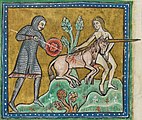 |
 |
 |
 |
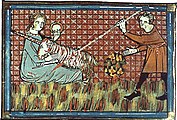 |
 |
According to Jean-Pierre Jossua, the story of the Physiologus gives rise to an abundant imagery of unicorns, especially in medieval miniatures. He believes that this imagery of seduction of a wild animal, evoking sensuality and tenderness, is for much in the success of the medieval unicorn, the accompanying religious text being from his point of view rather superficial.
Early medieval unicorns inspired by the descriptions of Physiologos and Ctesias rarely resemble a “white horse”, which can be close to goats, sheep, deer, even dogs, bears, and even snakes. Their colors vary, and include blue, brown and ochre. Their size is closer to that of the kid than the horse. Manuscripts based on the Christian Topography of Cosmas Indicopleustès bring the unicorn closer to a black or white goat, with a goatee and a long straight horn. The scene of unicorn hunting became widespread in the twelfth century.
As Bruno Faidutti points out, the majority of medieval miniatures use a staging inspired by the Physiologus: the beast is seduced by a treacherous virgin, while a hunter pierces its side with a spear. Linked to the virginity of young girls, this scene of “capturing the unicorn” seems to come from the culture of courtly love, respect for women, delicate hobbies, music and poetry:
Tapestries

According to Faidutti, the unicorn is emblematic of Renaissance tapestries, especially those of the workshops of Flanders, which most often depict it in the company of a lady or animals. The two most famous are probably The Lady with the Unicorn and The Unicorn Hunt, which inspire many commentaries and more or less serious works.
The Unicorn Hunt is a series of seven tapestries executed in the late fifteenth century, which depict a group of nobles chasing and capturing a unicorn. Their origin remains controversial. The series was purchased by John Davison Rockefeller, who donated it to the Cloisters Museum, where it is located today.
The six tapestries of The Lady with the Unicorn, dated from the same period, are exhibited at the Musée de Cluny in Paris. Probably commissioned for Antoine Le Viste, they are the most famous pieces of this museum and attract many visitors. The circumstances of their order remain unclear, but they may have constituted wedding gifts. On each of them, a lion and a unicorn are represented to the right and left of a lady. These tapestries are the subject of much speculation at the time of their rediscovery and restoration, in the nineteenth century.
Five of these representations illustrate a meaning, presumably by following a progression from the most material to the most spiritual. The sixth tapestry, on which one can read the formula “To my only desire” on a tent, is more difficult to interpret, but seems to be a moralizing representation of a “sixth sense”. The fifth hanging of St. Stephen, in the same museum, shows the body of the Saint exposed to beasts, including a unicorn. There are other Brussels hangings with unicorns, such as that of William Tons the Elder, dated 1565.
Modern fairytale representations
The appearance of the unicorn in the works of the nineteenth century and later, inspired by the fairyland, further accentuates the proximity with the white horse, since it sometimes loses its goatee and its cleft hooves. Depicted as a solitary, pure and beneficial creature, inspired by New Age ideology, the unicorn now wears a white, gold or silver horn on its forehead. It is described as “a magical horse with a horn”, sparkling under the light of the moon, this golden or silver horn refers to the fairy world and magic.
Bruno Faidutti and Yvonne Caroutch cite Bertrand d’Astorg’s description as an example:
“It was a white unicorn, the same size as my horse but with a longer and lighter stride. Her silky mane flew over her forehead; The movement sent shiny shivers down his coat and his thick floating. His whole body exhaled an ashy light; Sparks sometimes burst from his hooves. She galloped as if to carry high the terrible horn where pearly ribs curled in regular twists.”
Heraldry and logos
The unicorn is an imaginary heraldic figure. According to Michel Pastoureau, until the fourteenth century, it was almost absent from coats of arms, probably because of the isolation of heraldic culture (?). She is most often depicted as white. Its silhouette was closer to that of the kid originally, approaching the horse only from the fifteenth century, but retaining a characteristic goatee. It is mainly used as a support in the outer ornament of the shield. It is much rarer within the ecu, although there are examples in Germanic countries.
Bruno Faidutti cites the coat of arms of the knight of the round table Gringalas the Strong, of sand with a silver unicorn and ancornée of azure, as one of the oldest known examples of a coat of arms with a unicorn. This animal becomes one of the emblems most used by lords and knights from the seventeenth century.
It symbolizes their virtues. According to a treatise on the London coat of arms published in 1610, “her nobility of spirit is such that she prefers to die than be captured alive, in which the unicorn and the valiant knight are identical.” Similarly, Marc de Vulson de La Colombière (1669) wrote that “this animal is the enemy of venoms and impure things; It can denote a purity of life and serve as a symbol for those who have always shunned vices, which are the true poison of the soul.” Bartolomio d’Alvano, captain in the service of the Orsini, takes advantage of this symbolism by embroidering a unicorn plunging its horn into a spring on its standard, with the legend “I hunt poison”.

In the coat of arms of Great Britain, the lion represents England and the unicorn represents Scotland. The combined presence of these two creatures symbolizes the imperial union of the two crowns. Lewis Carroll quotes an English children’s song, in On the Other Side of the Looking Glass, recalling the origin of these weapon holders:
The Lion and the Unicorn were fighting for the crown: The lion beat the unicorn all around the town
In France, the unicorn appears in the coat of arms of the city of Amiens and is the emblem of the Amiens Sporting Club, a professional football club of the same city, in Picardy. It is depicted on the logo of the club, which plays its home matches at the Stade de la Licorne. The unicorn is also present in the coat of arms of the Norman city of Saint-Lô, and that of the Alsatian city of Saverne, which inspired a famous brewery.
With the development of printing, the unicorn became the animal most represented on paper watermarks, and the most widespread after the phoenix in brands and printing signs, throughout Europe. Bruno Faidutti assumes that it symbolizes the purity of the paper, and therefore that of the printer’s intentions.
The unicorn in the popular culture
The unicorn remains a source of inspiration for authors and creators of popular culture, including works from imaginary literature, fantasy cinema, wonderful, fantasy and tabletop role-playing.
In Lord Dunsany’s The Daughter of the King of the Elves, the encounter with unicorns marks the entrance to an enchanted kingdom. In The Last Unicorn, a 1968 fantasy novel by American Peter S. Beagle, a unicorn is living peacefully in her forest when she hears two hunters say she will be the last. She goes in search of other unicorns, confronts a witch, is transformed into a woman, and regains her original appearance after a fight against a bull of fire. She frees her fellows before returning to her forest. The animated film adaptation of the novel was released in 1982. According to André-François Ruaud, this work, oscillating between marvelous and naïve, met with a “stunning success”, although it took thirty years for the publication of its French translation.
In Les Dames à la Licorne, published in 1974, René Barjavel and Olenka de Veer imagine that Fulk I of Anjou married a unicorn, from which the kings of England and Europe are descended. The Sign of the Unicorn by Roger Zelazny is part of the cycle of the Princes of Amber. The world of Narnia has unicorns; in The Lion, the White Witch and the Wardrobe, the first film in the adaptation series released in 2005, Peter Pevensie rides a unicorn during the first battle.
Anne McCaffrey created a science fiction series around Acorna, a humanoid unicorn found drifting in a spaceship. According to an article in NooSFere, the unicorns of fantasy novels “do not completely escape the inevitability of violence, because they are only evoked in tragic contexts”. Thus, in the first volume of the Harry Potter saga, the murder of the unicorns reveals the presence of Voldemort; Unicorns in this fictional universe are distinguished by the properties of their blood, which is an elixir of long life.
In comics, The Secret of the Unicorn, in the series of Tintin by Hergé, refers to a ship named The Unicorn, whose figurehead represents such a creature. Unico, a manga by Osamu Tezuka, features a small unicorn with many magical powers, which she uses in favor of a person who loves her and loves in return.
In cinema, Carol Reed’s The Child and the Unicorn (1955) evokes childish beliefs. In the film Blade Runner (1982), the main character dreams of a unicorn, equivalent to the electric sheep mentioned in the text. The unicorns of the film Legend (1985), which are one of the main subjects, are played by thin white horses; symbolizing the balance between good and evil, they live in forests and by rivers; it is thanks to a unicorn horn that the demon Darkness is defeated.
Nico the Unicorn is a 1996 American children’s novel by Frank Sacks, from which a film was made in 1998. It tells the story of an eleven-year-old boy disabled since a car accident, who saves a ponette from a circus, which gives birth to a unicorn endowed with magical powers. In U, a French animated film released in 2006, the discovery of love separates a young girl from her unicorn.
On television, She-Ra, the princess of power, introduces Éclair, Adora’s horse who transforms into Fougor, a winged unicorn with speech. The American animated series Princess Starla and the Magic Jewels shows teenage knights of Avalon riding unicorns. In My Little Pony, unicorns are one of the three main races populating the world of Equestria, along with ponies and pegasus. In the Pokémon universe, Galopa is close to a fire unicorn.
The unicorn is part of the bestiary of role-playing games. Included in the bestiary of Dungeons & Dragons, a number of Dragon magazine distinguishes one main species, the deer unicorn, and ten Subspecies. Most live to protect forests, their abilities come from their horn. The unicorn is one of the mounts of the Sylvan elves in the universe of Warhammer.
In recent years, the unicorn is particularly represented in internet culture, often in a parodic way, as evidenced by the cult of the invisible pink unicorn (parody of religion, based on the paradox that the unicorn is both pink and invisible), the offbeat web series Charlie the Unicorn and Planet Unicorn, the derivative works of My Little Pony: Friends are magical or the universe of Robot Unicorn Attack, a very kitsch platform video game developed in Flash, which seems directly taken from a little girl’s dream. According to Amélie Tsaag Valren, her image has suffered a symbolic decline since the 1980s, as unicorns lose the richness of their original legend in popular culture productions. They are perceived as cute creatures, who make little girls fantasize. In everyday language, the word “unicorn” has become a metaphor for the extraordinary.
References (sources)
|