
Maria Salomea Skłodowska-Curie, better known as Marie Curie or Madame Curie (7 November 1867 – 4 July 1934), was a Polish physicist and chemist. A pioneer in the field of radioactivity, she is the first and only person to receive two Nobel Prizes in different scientific specialties: Physics and Chemistry. She was also the first woman to hold the position of professor at the University of Paris and the first to receive a burial with honors in the Panthéon in Paris on her own merits in 1995.
| Personal Information | ||
|---|---|---|
| Birth name | Maria Salomea Skłodowska | |
| Birth date | November 7, 1867 | |
| Birthplace | Warsaw (Russian Empire) | |
| Death date | July 4, 1934 (66 years) | |
| Death place | Passy (France) | |
| Cause of death | Aplastic anemia | |
| Grave | Pantheon in Paris | |
| Family | ||
| Parents | Władysław Skłodowski Bronisława Boguska | |
| Spouse | Pierre Curie (married on July 26, 1895; Widow on April 19, 1906) | |
| Children | Irène and Ève Denise | |
| Education | ||
| Educated in | The Sorbonne | |
| Dissertation | Recherches sur les substances radioactives (1903) | |
| PhD supervisor | Henri Becquerel Gabriel Lippmann | |
| Professional information | ||
| Occupation | Scientist | |
| Area | Physics and Chemistry | |
| Known for | Discovery of radium and polonium | |
| Positions held | Professor | |
| Employer | Ecole Supérieure d’Études d’Études d’Industriose de Physique du Étèle Industrielle de Paris Ecole supérieure de Paris Faculty of Sciences of the University of Paris Institut du Radium of the Pasteur Institute and the University of Paris | |
| Doctoral students | André-Louis Debierne, Émile Henriot, Marguerite Catherine Perey | |
| Member of |
|
|
| Distinctions | Willard Gibbs Prize (1921), Nobel Prize in Chemistry (1911), Matteucci Medal (1904), Nobel Prize in Physics (1903), Davy Medal (1903 ) | |
| Signature |  |
|
She was born in Warsaw, in what was then the Tsardom of Poland (a territory administered by the Russian Empire). She studied clandestinely at the “floating university” in Warsaw and began her scientific training in that city. In 1891, at the age of 24, she followed her elder sister Bronisława Dłuska to Paris, where she completed her studies and carried out her most outstanding scientific works. She shared the 1903 Nobel Prize in Physics with her husband Pierre Curie and physicist Henri Becquerel. Years later, she won the 1911 Nobel Prize in Chemistry alone.
Although she received French citizenship and supported her new homeland, she never lost her Polish identity: she taught her daughters her mother tongue and took them on visits to Poland. She named the first chemical element she discovered, polonium, as her country of origin. Her achievements include the first studies on the phenomenon of radioactivity (a term she coined), techniques for the isolation of radioactive isotopes, and the discovery of two elements—polonium and radium.
Under her direction, the first studies in the treatment of neoplasms with radioactive isotopes were carried out. She founded the Curie Institute in Paris and Warsaw, which remain among the leading centers of medical research today. During the First World War, she created the first radiological centers for military use. She died in 1934 at the age of 66, in the Sancellemoz sanatorium in Passy, from aplastic anemia caused by exposure to radiation from radio test tubes that she kept in her pockets at work and in the construction of the mobile X-ray units of the First World War.
Childhood and Studies of Marie Curie in Poland
She was born on November 7, 1867, in Warsaw (the capital of the Russian partition of Poland). She was the fifth child of Władysław Skłodowski, a high school teacher in physics and mathematics, and Bronisława Boguska, a teacher, pianist and singer. Maria had four older siblings: Zofia (1862–1876), Józef (1863–1937), Bronisława (1865–1939) and Helena (1866–1961). Both her father’s and her mother’s families had lost their property and fortunes during Polish nationalist uprisings in patriotic investments aimed at restoring the country’s independence.
This forced the new generation—Maria, her older sisters, and her brother—into a difficult struggle to get ahead in life. At that time, most of Poland was occupied by the Russian Empire, a country which, after several nationalist revolts violently put down, had imposed its language and customs. Together with her sister Helena, Maria attended clandestine classes offered in a boarding house in which Polish culture was taught. Her paternal grandfather, Józef Skłodowski, had been a respected teacher in Lublin, where he taught the young Bolesław Prus, who would become a leading figure in Polish literature. Władysław Skłodowski was a teacher of mathematics and physics—disciplines in which his daughter was interested—and went on to run two boys’ gymnasiums in Warsaw.
When the Russian authorities suppressed laboratory instruction from Polish schools, Władysław moved much of the apparatus and instruments home and instructed his children in their use. Eventually, Władysław was fired by his Russian supervisors due to his Polish sentimentality and forced to take on low-paying positions. The family also lost money on a bad investment and had to make up for their income with overnight children’s accommodation in the house.
Maria’s mother, Bronisława, had run a prestigious boarding school for girls in Warsaw, but resigned after the birth of her last daughter. She died of tuberculosis in May 1878, when Maria was ten years old. Maria’s early years were marked by the death of her sister Zofia as a result of typhus contracted by one of the children staying at home. Władysław was an atheist, but Bronisława was a devout Catholic; Following the death of her mother and sister, Maria questioned her Catholic faith and became an agnostic or, as her daughter Ève claimed, an atheist like her father Władysław.
When she was ten years old, Maria Skłodowska attended boarding school J. Sikorska; She then moved to a girls’ institute, graduating on June 12, 1883, with a gold medal. After a collapse (possibly from depression), she spent the following year in the countryside with her father’s relatives and in 1885 with her father in Warsaw, where she received some tutoring. She was unable to enroll in a regular institution of higher education because she was a woman, so she and her sister Bronisława joined the underground “floating university” (Polish: Uniwersytet Latający), a patriotic institution of higher education that admitted female students.
She made an agreement with her sister Bronisława: she was to help her financially with her medical studies in Paris in exchange for similar assistance two years later. Because of this, Maria worked as a private teacher in Warsaw and—for two years—as governess of a landowning family in Szczuki, the Żorawskis, relatives of her father. While working for that family she fell in love with one of her students, Kazimierz Żorawski, a future mathematician. Her parents rejected the idea of her marrying a poor relative and Kazimierz could not oppose them.
According to Giroud, this frustrated relationship had a strong impact on both. In early 1890, Bronisława—who a few months earlier had married Kazimierz Dłuski, a Polish physician and political and social activist—invited her sister to join them in Paris. Marie did not accept the proposal because she could not afford the university tuition; It would take her a year and a half to raise the necessary funds. She was able to raise some of the money with the help of her father, who was able to secure a more lucrative position again.
During that time, Maria continued to study, read books, correspond with professional relatives, and educate herself on her own. In early 1889, she returned to her father’s home in Warsaw. She continued to work as a governess and remained there until the end of 1891. Also, she continued to study at the “floating university” and began her practical scientific training (between 1890-1891) in a chemical laboratory of the Museum of Industry and Agriculture at Krakowskie Przedmieście 66, near the historic center of Warsaw. The laboratory was run by her cousin Józef Bogusky, who had worked as an assistant to Russian chemist Dmitri Mendeleev in St. Petersburg.
Early years in France

At the end of 1891, she left for France. In Paris, Maria (or Marie, as she would be known in that country) spent time in lodging with her sister and brother-in-law before renting a garret in the Latin Quarter, near the university, and continued her studies in physics, chemistry and mathematics at the University of Paris, where she had enrolled at the end of 1891.
Although she had acquired knowledge in a self-taught way, she had to strive to improve her understanding of the French language, mathematics and physics to be at the level of her peers. Among the 776 students of the Faculty of Sciences, in January 1895, there were only 27 women. Its professors were Paul Appell, Henri Poincaré and Gabriel Lippmann, renowned scientists at the time. She subsisted on scarce resources and fainting from hunger. She studied during the day and taught at night, earning little for her subsistence.
In 1893, she received her degree in physics and began working in the industrial laboratory of Professor Lippmann. In the meantime, she continued her studies at the University of Paris and obtained a second degree in 1894. To finance her university education, she accepted a scholarship from the Alexandrowitch Foundation, which was awarded to her by an acquaintance named Jadwiga Dydyńska. During her stay in the French capital, she developed a special interest in amateur theatre.
In one of the performances of La Pologne, qui brise les chaînes (lit., Poland, the one that breaks chains) she befriended pianist Ignacy Jan Paderewski. She began her scientific career in 1894 with an investigation of the magnetic properties of various steels, commissioned by the Society for the Promotion of National Industry (Société d’Encouragement pour l’Industrie Nationale). In that same year, she met Pierre Curie. The interest they both had in science brought them together. At the time, Pierre was an instructor at the Ecole Supérieure de Physics et de Chemistry Industriale in Paris (ESPCI).
They were introduced by Polish physicist Józef Kowalski-Wierusz, who had learned that Marie was looking for a laboratory with more workspace, something Kowalski-Wierusz believed Pierre had access to. Although the latter did not have a large laboratory, she was able to find a larger workplace at ESPCI for her to work on. They developed a strong friendship in the laboratory, to the point that Pierre proposed, but at first, Marie did not accept as she intended to return to Poland. However, Pierre stated that he was willing to follow her to that country, even if it meant having to teach French to survive.
It would be a precious thing, a thing I wouldn’t dare expect, if we could spend our lives close to each other, mesmerized by our dreams: your patriotic dream, our humanitarian dream, and our scientific dream.
Letter from Pierre Curie to Maria Skłodowska.
Meanwhile, Marie returned to Warsaw for the summer holidays of 1894, where she visited her family. She continued to work for a year in Poland with the hope that she would get an academic position in her scientific specialty in her native country, but the Jagiellonian University of Krakow refused to hire her because she was a woman.
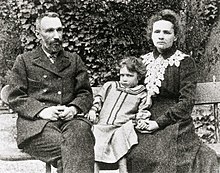
A letter from Pierre convinced her to return to Paris for a doctorate. To motivate her, in the letter, he commented that he had researched magnetism, received his doctorate in March 1895 and promoted to professor at ESPCI. Back in France, Marie and Pierre were married on 26 July 1895 in Sceaux, in a simple wedding without a religious ceremony in which, between some friends and immediate family, they were given money instead of gifts. Marie wore a dark blue suit, the same one she wore for many years as a lab suit. Later, Marie said she had found a new love, partner and scientific collaborator she could trust.
The Doctorate of Marie Curie and new chemical elements
After winning the second degree, her next challenge was the doctorate. The first step was the choice of the topic of her thesis. After discussing it with her husband, she decided to focus on the work of physicist Henri Becquerel, who had discovered that uranium salts emitted rays of an unknown nature. This work was related to the recent discovery of X-rays by physicist Wilhelm Röntgen, although the properties behind that phenomenon were not yet understood. In the spring of 1895, Becquerel accidentally discovered the ability of double uranyl potassium sulfate (chemical formula: K 2[UO 2(SO4)2](H 2 O)2) to blacken a photographic plate and showed that this radiation, unlike phosphorescence, did not depend on an external source of energy, but seemed to arise spontaneously from uranium itself.
Influenced by these two important discoveries, she chose uranium rays as a possible field of research for a thesis and with the help of her husband investigated the nature of the radiations produced by uranium salts. She initially intended to quantify the ionization capacity emanating from the radiation of uranium salts and took as a basis Lord Kelvin’s laboratory notes in late 1897. For the experiments, she employed a technique created fifteen years earlier by Pierre and his brother Jacques Curie, who had developed a modified version of the electrometer. With that device, Marie Curie discovered that uranium beams cause the air around a sample to conduct electricity.
Using this technique, their first result was that the activity of uranium compounds depended only on the amount of uranium present. She hypothesized that this radiation was not the result of an interaction of molecules, but came from the atom itself. This hypothesis was an important advance in refuting the old assumption that atoms are indivisible. In 1897, their daughter Irène was born. To support her family, she began teaching at the École Normale Supérieure. The Curies had no laboratory of their own and most of their research was conducted in a shed owned by ESPCI. This room, formerly a faculty medical dissection room, was poorly ventilated and not waterproof.
They were not aware of the harmful effects of continuous exposure to radiation in their continuous work with substances without any protection, since at that time no radiation sickness had been associated. The faculty did not sponsor their research, but received subsidies from metallurgical and mining companies and from various foreign organizations and governments. Marie Curie’s systematic studies included some uranium ores (pitchblende, torbernite or autunite).
Its electrometer showed that pitchblende was four times more radioactive than uranium itself, but torbernite had a reading twice as high. When looking at the chemical composition of torbernite —Cu(UO 2)2(PO4)2· (8-12) H2O— speculated that only uranium was the radioactive element in that ore; Marie Curie decided to use natural torbernite instead of the artificial one that was available in the laboratory and recorded that the synthetic sample of the mineral emitted less radiation.
She concluded that, if her earlier results that the amount of uranium was related to radioactivity were correct, these two minerals would contain small amounts of other substances much more radioactive than uranium. She undertook a systematic search for additional radiation-emitting substances and around 1898 discovered that thorium was also radioactive. Pierre became more and more concerned about her overwork. In mid-1898 they took a break to spend more time together: according to historian Robert William Reid:
The research idea was her own; no one helped her formulate it, and although she took it to her husband for his opinion she clearly established her ownership of it. She later recorded the fact twice in her biography of her husband to ensure there was no chance whatever of any ambiguity. It [is] likely that already at this early stage of her career [she] realized that […] many scientists would find it difficult to believe that a woman could be capable of the original work in which she was involved.
The idea of the research was her; No one helped her formulate it, and although she showed it to her husband for his opinion, she made it clear that she owned the research. Later, she recorded that fact twice in her husband’s biography to make sure there was no possible ambiguity. It is likely that in this early stage of her career she realized that […] many scientists found it difficult to believe that a woman could be capable of such an original work as the one in which she was involved.
She was aware of the importance of quickly publishing her findings and taking a place in the scientific community. For example, two years earlier, Becquerel presented his finding to the Academy of Sciences a day after the experiment and took full credit for the discovery of radioactivity, even receiving a Nobel Prize that would have gone to Silvanus Thompson, who had done a similar study that he did not publish in time.
Following in Becquerel’s footsteps, she wrote a brief and simple explanation of her work; the paper was presented to the Academy on 12 April 1898 by its former professor, Gabriel Lippmann, on behalf of Marie Curie. However, like Thompson, she suffered a setback in her career when she learned that her work on the radioactive emission of uranium-like thorium had been published by Gerhard Carl Schmidt two months earlier at the German Physical Society.
At the time, none of her colleagues had seen that Marie Curie’s paper described the radioactivity of pitchblende and torbernite as superior to uranium: “The fact is very remarkable and gives rise to the belief that these minerals might contain some element that is much more active than uranium.” She would later recall that she felt a “passionate desire to verify this hypothesis as quickly as possible.” On April 14, 1898, the Curies weighed a 100 g sample of pitchblende and ground it with a mortar. At the time, they didn’t realize that what they were looking for was only present in such minimal quantities that they would eventually have to process tons of that mineral.
They also developed a method of radioactive indicators with which they would identify the radiation capacity of a new element. In July 1898, the couple jointly published an article in which they announced the existence of an element they called “polonium”, in honor of Poland – a country that at that time was divided between three empires. In the autumn of 1898, Marie suffered from inflammation of her fingertips, the first known symptoms of the lightning disease that would accompany her for the rest of her life.
After a summer vacation in the Auvergne region, on November 11 the couple resumed the search for another unknown element. With the help of Gustave Bémont, they quickly managed to obtain a sample with radioactivity 900 times greater than that of uranium. On December 26, 1898, the Curies announced the existence of a second element, which they called “radium”, derived from a Latin word meaning lightning. In the research, the word “radioactivity” was coined.
To definitively prove their discoveries, the Curies tried to isolate polonium and radium in their purest form. They decided not to use pitchblende because it is a complex mineral and the chemical separation of its components was an arduous task. Instead, they used a bismuth ore and a barium ore with high levels of radiation. In the first ore, they observed that an unknown element was chemically similar to bismuth, but had radioactive properties (polonium). However, radium was more difficult to obtain: its chemical relationship with barium is very strong and they discovered that pitchblende contains both elements in small amounts. In 1898, the Curies obtained traces of radium, but it was still out of reach to extract considerable quantities and without barium contamination.
They undertook the work of separating salt from radius by differential crystallization; of one ton of pitchblende, they separated one decigram of radium chloride in 1902 and, with that material, Marie Curie was able to determine the atomic mass more precisely. They also studied the radiation emitted by the two elements and indicated, among other things, that they have a radioactive glow, that the radio salts emit heat, have a color similar to porcelain and glass, and that the radiation produced passes through the air and the body to convert molecular oxygen (O2) into ozone (O3).
In 1910, the Curies isolated radium in its pure state, but were unsuccessful with polonium because that element has a half-life of 138 days. Between 1898 and 1902, the Curies jointly or separately published a total of 32 scientific papers, including the one announcing that when humans are exposed to radium, diseased and tumor-forming cells were destroyed faster than healthy cells. In 1900, Marie Curie was the first woman to be appointed professor at the École Normale Supérieure and her husband received a professorship from the University of Paris. In 1902, Władysław died and his daughter returned to Poland for burial.
The French Academy of Sciences financially supported Marie Curie’s work. Twice (in 1900 and 1902) she was awarded the Prix Gegner and 4000 francs. In 1903, she received 10,000 francs for the Prix La Caze. In March 1902, the Academy extended its research with radium by borrowing 20,000 francs. On 25 June 1903, Marie Curie defended her doctoral thesis (Investigations into Radioactive Substances) directed by Becquerel before a tribunal presided over by Lippmann. She obtained her doctorate and laude mention.
That month, the Curies were invited by the Royal Institution of Great Britain to give a speech on radioactivity, but she was prevented from speaking because she was a woman and only her husband was allowed to do so. The following year, Marie Curie’s dissertation was translated into five languages and reprinted seventeen times, including a version edited by William Crookes published in Chemical News and Annales de physique et chimie. Meanwhile, a new industry based on the radium element began to develop.
The Curies did not patent their discovery and derived little economic benefit from this increasingly profitable business. In 1903 the couple began to suffer from their first health problems, but doctors only kept them under observation. On November 5, 1903, the Royal Society of London awarded the couple the Davy Medal, which is awarded annually to the most important discovery in the field of chemistry. Pierre traveled alone to London to receive the award.
Nobel Prizes
The Royal Swedish Academy of Sciences awarded Marie Curie the Nobel Prize in Physics in 1903, together with her husband and Henri Becquerel, “in recognition of the extraordinary services rendered in their joint investigations into the radiation phenomena discovered by Henri Becquerel”. She was the first woman to receive such an award. At first, the selection committee intended to honor only Pierre and Henri, denying recognition to Marie for being a woman.
One of the members of the Academy, the mathematician Magnus Gösta Mittag-Leffler, warned Pierre of the situation and Pierre said he would reject the Nobel Prize if Marie’s work was not also recognized. In response to the claim, they included her in the nomination. The Curies did not go to Stockholm to receive the award in person, as they were too busy with their work and because Pierre, who did not like public ceremonies, was feeling increasingly ill.
Because Nobel Prize winners were required to be present to give a speech, the Curies eventually traveled to Sweden in 1905. They received $15,000, which allowed them to hire a new lab assistant. After the Swedish prize, the University of Geneva offered Pierre a position of professor with better remuneration, but the University of Paris rushed to grant him a professorship and the chair of Physics (where he had already taught since 1900), although the marriage did not yet have a suitable laboratory.
Following Pierre’s complaints, the university relented and agreed to give them a new laboratory, but it would not be ready until 1906. The laureates made headlines in the French press, but, according to Susan Quinn, Marie’s role in radio research was grossly underestimated or tended to be overlooked because of her Polish origin. In December 1904, Marie Curie gave birth to her second daughter, Ève, after suffering a miscarriage probably caused by radioactivity. Years later, she hired Polish governesses to teach her daughters their mother tongue and sent them (or took with her) on a visit to Poland.
On April 19, 1906, Pierre died in an accident in Paris. While walking in the heavy rain on rue Dauphine (in Saint-Germain-des-Prés), he was struck by a horse-drawn carriage and fell under the wheels, resulting in a fatal fracture to his skull. Marie was greatly affected, but wanted to continue with her late husband’s work and refused a lifetime pension. In the following years, he suffered from depression and relied on Pierre’s father and brother (Eugene and Jacques Curie, respectively). On May 13, 1906, the Department of Physics of the University of Paris decided to offer her the position that had been created for her husband. She accepted it in hopes of creating a world-class laboratory as a tribute to her husband.
She was the first woman to hold the position of professor at that university and the first director of a laboratory at that institution. Between 1906 and 1934, the university admitted 45 women without applying the above gender restrictions in their hiring. Her desire to create a new laboratory did not stop there. In her later years, she directed the Radium Institute (now Curie Institute), a radioactivity laboratory created for her by the Pasteur Institute and the University of Paris. The initiative for its creation arose in 1909 when Émile Roux, director of the Pasteur Institute, expressed his disappointment that the University of Paris was not providing Marie Curie with a proper laboratory and suggested that she move to the Pasteur Institute.
Only in this way, with the possible departure of one of its professors, the university council agreed and finally the “Curie pavilion” became a joint initiative of the two interested institutions. In 1910, assisted by the chemist André-Louis Debierne, she was able to obtain one gram of pure radium; she also defined an international standard for radioactive emissions which, years later, was named Curio in her honor.
In 1911, the French Academy of Sciences discussed whether Curie would fill the position of the late Désiré Gernez (1834–1910), but did not elect her as a member by one or two votes. At that time, Curie was already a member of the Swedish Academy of Sciences (1910), the Czech Republic (1909) and Poland (1909), the American Philosophical Society (1910) and the Imperial Academy of St. Petersburg (1908) and an honorary member of many other scientific associations.
In an extensive article in the newspaper Le Temps, published on December 31, 1910, Jean Gaston Darboux—the secretary of the Academy—publicly defended Marie Curie’s candidacy. During the Academy elections, she was smeared by the right-wing press that criticized her for being a woman, a foreigner, and an atheist. According to Susan Quinn, at the plenary session of the Institut de France on January 4, 1911, the members of the Council clung to the tradition of not allowing female members and revalidated the decision with a majority of 85 votes against 60 in favor.
Five days later, in a secret meeting, a committee was created to handle nominations for the vacant post: they admitted Édouard Branly, an inventor who had assisted Guglielmo Marconi in the development of wireless telegraphy. The socialist newspaper L’Humanité called the Academy a “misogynistic institution”; for his part, the conservative Le Figaro wrote that “[…] one should not try […] to turn a woman into man immediately!”
More than half a century later, in 1962, a doctoral student at the Curie Institute, Marguerite Perey, was the first woman elected to the French Academy of Sciences. Although she was a scientist famous for her work for France, the public’s attitude towards Marie Curie tended towards xenophobia – as had happened during the Dreyfus affair, as she was rumored to be Jewish. Later, her daughter Irène commented that the public hypocrisy of the French press portrayed her mother as an unworthy foreigner who was nominated for a French honor rather than someone from another country receiving the Nobel Prize on behalf of France.
In 1911 the press revealed that, between 1910-1911 after the death of her husband, Marie Curie had a brief affair with the physicist Paul Langevin, a former student of Pierre who was married, although he had separated from his wife months earlier. Curie and Langevin were meeting in a rented apartment. Langevin’s wife soon noticed and threatened to kill Marie. At Easter 1911, Marie Curie and Paul Langevin’s correspondence was stolen and, in August of that year, Langevin’s wife filed for divorce and sued her husband for having “sexual relations with a concubine in the marital home.”
This resulted in a journalistic scandal that was exploited by her academic adversaries. Curie (who was in her early 40s at the time) was five years older than Langevin and was branded in the tabloids as a “foreign Jewish home breaker.” When the scandal broke, Marie Curie was at a conference in Belgium; on her return, she met an angry crowd in front of her house and had to take refuge, with her daughters, in the house of her friend Camille Marbo. On the other hand, international recognition for her work had grown much more and the Swedish Academy of Sciences, which omitted the Langevin scandal from the vote, awarded her the 1911 Nobel Prize in Chemistry (alone).
This award was “in recognition of her services in the advancement of chemistry by discovering the elements radium and polonium, isolating radium, and studying the nature and compounds of this element.” She was the first person to win or share two Nobel Prizes. The French press barely covered the event. A delegation of renowned Polish scholars, led by novelist Henryk Sienkiewicz, encouraged her to return to Poland and continue her research in her native country. This second award allowed her to convince the French government to support the Radium Institute, completed in 1914, where research in chemistry, physics and medicine would be carried out.
A month after accepting the award, she was hospitalized for depression and a kidney ailment that underwent surgery. For most of 1912, she avoided public appearances. She traveled with her daughters under pseudonyms and asked friends and family not to give information about her whereabouts. She spent time in England with a friend and colleague, physicist Hertha Marks Ayrton. She returned to her lab in December, after a hiatus of about 14 months. In 1912, the Scientific Society of Warsaw offered her the position of director of a new laboratory in that city, but she rejected the post on the grounds that the Radium Institute should be completed in August 1914 and in the newly baptized rue Pierre Curie.
Moreover, in 1913, she improved her health and was able to explore the properties of radium radiation at low temperatures with physicist Heike Kamerlingh Onnes. In March of that year, she received a visit from Albert Einstein, with whom she made a summer excursion in the Swiss Engadina. In October, she participated in the second Solvay Congress and, in November, traveled to Warsaw, but the visit was underestimated by the Russian authorities. The Institute’s progress was interrupted by World War I because most researchers enlisted in the French army; Activities resumed fully in 1919.
World War I
On August 1, 1914, days after the outbreak of World War I, Irène (17) and Ève (10) had moved to L’Arcouest (Ploubazlanec) under the care of friends of their mother. Marie remained in Paris guarding the Institute and the radium samples. The Government considered that the assets of the Radium Institute were a national treasure and that they should protect them, so Curie temporarily moved the laboratory to Bordeaux. She was unable to serve Poland and decided to collaborate with France. During the war, field hospitals lacked experienced staff and appropriate X-ray machines, so she proposed the use of mobile radiography near the front lines to assist battlefield surgeons. She said wounded soldiers would be better cared for if surgeons had X-rays in time.
After a rapid study of radiology, anatomy and automotive mechanics, she acquired X-ray equipment, vehicles and auxiliary generators and designed mobile radiography units, which she called “Ambulances Radiologiques“, but which later became known as the “little Curie” (petit Curie). She became the director of the Radiology Service of the French Red Cross and created France’s first military radiology center, operational in late 1914. Assisted from the beginning by her daughter Irène (18 years old) and a military doctor, she directed the installation of twenty mobile radiography units and another two hundred radiological units in the provisional hospitals in the first year of the war.
Later, she began instructing other women as helpers. In July 1916, she was one of the first women to obtain a driver’s license, applying for one to personally operate mobile X-ray units. In 1915, she produced cannulas containing “radium fumes,” a colorless, radioactive gas emitted by radion—later identified as radon—and used for the sterilization of infected tissues. She provided the chemical element for her own supplies. It is estimated that over a million wounded soldiers were treated with its X-ray units. Busy with this work, she did little scientific research during this period. Despite her humanitarian contributions to the war efforts of the French, she never received formal recognition from the French government during her lifetime.
Immediately after the beginning of the war, she tried to sell her Nobel Prize gold medals and donate them to war activities, but the Bank of France refused to accept them, so she had to buy war bonds with the money from her prizes. At the time she said, “I’m going to give up what little gold I own. To this, I will add the scientific medals, which are useless to me.
There is something else: out of sheer laziness I had allowed my second Nobel prize money to stay in Stockholm in Swedish kroner. That is the main amount of what we possess. I would like to bring it here and invest it in war loans. The state needs it. I just have no illusions: that money will probably be lost.” She was also an active member of the committees dedicated to the Polish cause in France. After the war, she summarized her experiences in a book entitled La Radiologie et la Guerre (1919).
Postwar period
In 1920, on the 25th anniversary of the discovery of radium, the French government benefited Marie Curie with a stipend previously in the name of Louis Pasteur (1822-1895). In 1921, she planned a trip to the United States to raise funds for radium research. The Institute’s inventories had been drastically reduced as a result of therapeutic treatments in World War I and the quoted price per gram of radium, at that time, was US$100,000. On May 4, 1921, Marie Curie traveled with her two daughters and accompanied by journalist Marie Melony aboard the RMS Olympic. Seven days later, they arrived in New York City, where she was greeted by a large crowd. Upon her arrival, the New York Times published on its front page that Madame Curie intended to “end cancer.” “Radium is the cure for any type of cancer,” she said on page 22 of the newspaper.
During her stay, the press put her scientific character on the back burner and was instead regularly praised as a “healer”; Marie Curie also made many public appearances with her daughters. The purpose of that trip was to raise funds for research on radium. The publisher Mrs. William Brown Meloney, after interviewing her, created the Marie Curie Radium Fund and raised enough money from travel advertising to buy the chemical element. President Warren G. Harding received her at the White House and symbolically handed her a gram of radium collected in the North American country.
Prior to the meeting, recognition abroad had grown, but was overshadowed by the fact that she had no official French distinctions to wear in public. The French government had offered her the Legion of Honour, but she did not accept it. In the United States, she received nine honorary doctorates, although she turned down one in the field of physics that Harvard University offered her because she “had done nothing important [in that science] since 1906.” Before boarding the RMS Olympic on June 25 upon her return to Europe, she said: “My work with radio, […] Especially during the war, it seriously damaged my health, making it impossible for me to visit all the laboratories and schools in which I had a deep interest.”
In October 1929, she visited the United States for the second time. During this stay, President Herbert Hoover gave her a check for $50,000, which was used to purchase a radio for the Institute’s Warsaw branch. She also traveled to other countries giving lectures in Belgium, Brazil, Spain and Czechoslovakia. Four members of the Radium Institute received the Nobel Prize, including Irène Joliot-Curie and her husband, Frédéric. Over time, it became one of the four major radioactivity research laboratories, along with Ernest Rutherford’s Cavendish Laboratories, Stefan Meyer’s Institute for Radium Research (in Vienna), and Otto Hahn and Lise Meitner’s Emperor William Institute of Chemistry.
In August 1922, Marie Curie became a constituent member of the League of Nations International Commission for Intellectual Cooperation. That year, she became a member of the French National Academy of Medicine. In 1923, she published a biography of her late husband, titled Pierre Curie. In 1925, she visited Poland to participate in the groundbreaking ceremony of the Radium Institute in Warsaw. The laboratory was equipped with the radium samples acquired on its second trip to the United States. The Institute opened in 1932 and Bronisława Dłuska was appointed director. These distractions from her scientific labors and the publicity surrounding it caused her much inconvenience, but provided the resources necessary for her work. From 1930 until her death, she was a member of the IUPAC International Committee on Atomic Weights.
Death of Marie Curie
Only a few months after her last visit to Poland in the spring of 1934, she died on 4 July in the Sancellemoz sanatorium, near Passy (Haute-Savoie), from aplastic anemia, probably contracted by the radiation to which she was exposed at work. The harmful effects of ionizing radiation were not known at the time and experiments were conducted without appropriate safety measures. For example, she carried test tubes with radioactive isotopes in her pockets and stored them in a drawer on her desk, commenting on the weak light these substances emitted in the dark.
She was also exposed unprotected to X-rays while serving as a radiologist in field hospitals during the war. Although long periods of radiation exposure caused chronic illnesses (such as partial blindness from cataracts) and eventually her death, she never recognized the health risks that radiation exposure could cause. She was buried next to her late husband in the cemetery of Sceaux, a few kilometers south of Paris. Sixty years later, in 1995, her remains were transferred, along with those of Pierre, to the Panthéon in Paris.
On April 20, 1995, in a speech delivered at the solemn ceremony of admission, the then president François Mitterrand stressed that Marie Curie, who had been the first doctor of science, professor at the Sorbonne and also received two Nobel prizes, was again so by resting in the famous Pantheon in Paris for “her own merits”. In 2015, two other women were also buried in the cemetery on their own merits. Because of radioactive contamination, her documents from the 1890s are considered too dangerous to handle; Even her cookbook is highly radioactive. Their works are kept in lead-lined boxes and those who wish to consult them should wear protective clothing. In the last year of her life, she worked on a book (Radioactivité), which her daughter and son-in-law published posthumously in 1935.
Her eldest daughter, Irène (1897-1956), won the 1935 Nobel Prize in Chemistry (a year after her mother’s death) with her husband, for the discovery of artificial radioactivity. The couple’s second daughter, Ève Denise Julie (1904-2007), a journalist, pianist and children’s rights activist, was the only member of the family who did not pursue science.
She wrote a biography of her mother (Madame Curie), which was published simultaneously in France, England, Italy, Spain, the United States and other countries in 1937; it was a bestseller in those countries. The journalist Charles Poore, in a review published in the New York Times, criticized Madame Curie for its sweetened wording, omission of important details such as Marie’s relationship – then widow – with Paul Langevin – her husband’s former student and who was married – or the many problems and insults she had to endure from some important French scientific circles – such as the rejection of her admission to the French Academy of Sciences – and the press sensationalistic.
Legacy
The historian Tadeusz Estreicher, in Polski słownik Biograficzny (1938), assures that the physical and social aspects of the work of the Curies contributed substantially to the world development of the twentieth and twenty-first centuries. Leslie Pearce Williams, a professor at Cornell University, concludes that:
The result of the Curies’ work was epoch-making. Radium’s radioactivity was so great that it could not be ignored. It seemed to contradict the principle of the conservation of energy and therefore forced a reconsideration of the foundations of physics. On the experimental level the discovery of radium provided men like Ernest Rutherford with sources of radioactivity with which they could probe the structure of the atom. As a result of Rutherford’s experiments with alpha radiation, the nuclear atom was first postulated. In medicine, the radioactivity of radium appeared to offer a means by which cancer could be successfully attacked.
The result of the Curie’s work was a time of transformation. The radioactivity of radium was so great that it could not be ignored. It seemed to contradict the principle of conservation of energy and thus forced a rethinking of the foundations of physics. At the experimental level, the discovery of radium provided men like Ernest Rutherford with the sources of radioactivity with which they tested the structure of the atom. As a result of Rutherford’s experiments with alpha radiation, the atomic nucleus was postulated first. In medicine, radium’s radioactivity seemed to offer a means by which cancer could be successfully attacked.
Françoise Giroud believes that while Curie’s work helped revise established ideas in physics and chemistry, it also had an equally profound effect on the social sphere. To achieve her scientific achievements, Marie Curie had to overcome the obstacles she encountered on her way as a woman, both in her native country and in her new homeland. Giroud emphasizes that aspect of her life and career in Marie Curie: A Life, in which she addresses her role as a feminist pioneer.
Although the women’s rights movement in Poland praised Marie Curie’s work, historian Natalie Stegmann says she did not engage with these groups or support their goals. According to Estreicher, she was known for her honesty and moderate lifestyle. Having received a small scholarship in 1893, she returned to Poland in 1897, when she could already earn money for her subsistence.
She spent much of her first Nobel Prize money on her friends, family, students, and research associates. In an unusual decision, she intentionally refrained from patenting the radium isolation process, so that the scientific community could investigate it without hindrance. Estreicher says Marie Curie insisted that monetary donations and prizes should be given to the scientific institutions to which she was affiliated rather than to herself. The Curies had a habit of refusing prizes and medals, as happened with the Legion of Honor. Albert Einstein commented that Marie Curie was probably “the only scientist who was not corrupted by fame”.
Tributes and references in popular culture
Marie Curie has become an icon in the scientific world and has received tributes from all over the world, including in popular culture. In a 2009 poll conducted by New Scientist magazine, she was voted “the most inspiring woman in science.” Curie received 25.1% of the votes cast, almost double that of Rosalind Franklin (with 14.2%).
Poland and France declared 2011 the “Year of Marie Curie” and the United Nations established that it would also be the International Year of Chemistry. On December 10 of that year, members of the New York Academy of Sciences celebrated the centenary of Marie Curie’s second Nobel Prize, accompanied by Princess Madeleine of Sweden. Marie Curie was the first woman to win a Nobel Prize, the first person to win two Nobel Prizes, the only woman to win them in two areas, and to win them in scientific areas. Among the awards she received are:
- Nobel Prize in Physics (1903, with her husband Pierre Curie and Henri Becquerel);
- Davy Medal (1903, with Pierre);
- Matteucci Medal (1904, with Pierre);
- Actonian Prize (1907);
- Elliott Cresson Medal (1909);
- Nobel Prize in Chemistry (1911);
- Franklin Medal of the American Philosophical Society (1911).
She received numerous honorary degrees from universities around the world. In Poland, she received honorary doctorates from the Lviv National Polytechnic University (1912), the University of Poznań (1922), the Jagiellonian University (1924) and the Warsaw Polytechnic (1926). After, in 1920, she became the first female member of the Royal Danish Academy of Sciences and Letters.
In 1921, in the United States, she was granted membership of the Society of Women Scientists Iota Sigma Pi. In 1924, she became an honorary member of the Polish Chemical Society. Marie Curie’s 1898 publication with her husband and collaborator Gustave Bémont of their discovery of radium and polonium was honored with the Citation for Chemical Breakthrough Award from the Division of History of Chemistry of the American Chemical Society presented to the ESPCI in Paris in 2015. Among the entities that have been named in her honor are:
- Curium (symbol Ci), a unit of radioactivity, was named after her husband (although the commission that decided on the name never stated clearly whether they did so honoring Pierre, Marie, or both).
- In 1946, the discoverers of the element with atomic number 96 named their finding curium (Cm), in honor of the Curie couple.
- Three radioactive minerals also bear the Curie name: Band-Aid, sklodowskite and cuprosklodowskite. Marie Curie received numerous honorary degrees from universities around the world.
- The European Union’s Marie Skłodowska-Curie Actions fellowship program for young scientists wishing to work in a foreign country.
- In 2007, a metro station in Paris was named after the Curies couple.
- A nuclear research reactor in Poland was named Maria Reactor.
- The asteroid 7000 Curie, discovered on November 6, 1939, by Fernand Rigaux) is also named after her.
- The McDonnell Douglas MD-11 commercial aircraft (registration PH-KCC).
- In 2011, the Warsaw Bridge across the Vistula River was named after her.
- In January 2020, Satellogic, a high-resolution analysis and imaging company for Earth observation, launched a ÑuSat-type microsatellite; The Wildebeest 8, also known as Marie, was named in her honor.
- The lunar crater Sklodowska is named in her memory.
- In 1971 the Pierre and Marie Curie University (originally Université de Paris 6) was established from the faculties of Science and Medicine that were dismembered from the original University of Paris; they chose their current name in 1974 as a tribute to the Curie, as they had worked in their laboratories.
- The Maria Sklodowska-Curie National Cancer Research Institute in Warsaw.
In 1935, Michalina Mościcka—wife of Polish President Ignacy Mościcki—unveiled a statue of Marie Curie in front of the Radium Institute in Warsaw. In 1944, during the Warsaw uprising against the occupation of Nazi Germany, the monument was damaged by gunfire; After the war, it was decided to leave bullet marks on the statue and its pedestal. Greer Garson and Walter Pidgeon starred in the film, Madame Curie, based on her life.
The film had seven Academy Award nominations in 1943. In 1997, a French film about Pierre and Marie Curie, Les Palmes de M, was released. Schutz, as an adaptation of a play of the same name and whose title character was played by Isabelle Huppert. In 2016 the French director Marie Noëlle directed a biographical film (Marie Curie, starring Karolina Gruszka), which moves away from the merely scientific profile of Marie Curie to dramatize the scandal that was her relationship with Paul Langevin. In 2020, the biopic Radioactive, directed by French-Iranian filmmaker Marjane Satrapi, was released.
| Predecessor: Hendrik Antoon Lorentz and Pieter Zeeman | Nobel Prize in Physics (with Antoine Henri Becquerel and Pierre Curie) 1903 | Successor: John W. Strutt, Baron Rayleigh |
| Predecessor: Otto Wallach | Nobel Prize in Chemistry 1911 | Successor: Paul Sabatier and Victor Grignard |
Publications
Books
- Sklodowska-Curie, M (1910). Traité de radioactivité. Two volumes (in French). Paris: Gauthier-Villars. OCLC 2191426.
- (1921). La radiologie et la guerre (in French). Paris: Librairie Felix Alcan. OCLC 8783347.
- (1923). Pierre Curie (in French). Paris: Payot. OCLC 3022646.
- (1924). «Records of conferences-reports of documentation on physique: L’Isotopie et les éléments isotopes». Journal de Physique (in French) IX (2) (Paris: Blanchard in Komm). pp. 382-412. OCLC 162650959.
- (1933). Les rayons α, β, γ des corps radioactifs en relation avec la structure nucléaire (in French). Paris: Hermann. OCLC 600589812.
- Joliot-Curie, I; Joliot-Curie, J.F. (1935, posthumous). Radioactivity (in French). Paris: Hermann. OCLC 3623999.
- Joliot-Curie, I (1954, posthumous). Prace Marii Skłodowskiej-Curie [Œuvres de Marie Skłodowska Curie] (in Polish and French). Warsaw. Państwowe Wydawn. Naukowe. OCLC 782530.
- (2004) (1959, posthumous). Autobiografia i wspomnienia o Piotrze Curie (in Polish). Warsaw: Dom Wydawniczo-Promocyjny GAL. ISBN 978-83-921882-8-5. OCLC 750495927.
References (sources)
|